THE CLASSIC COLLECTION✦Letters to His ChildrenCLASSIC FREE BOOKS
Letters to His Children
Theodore Roosevelt
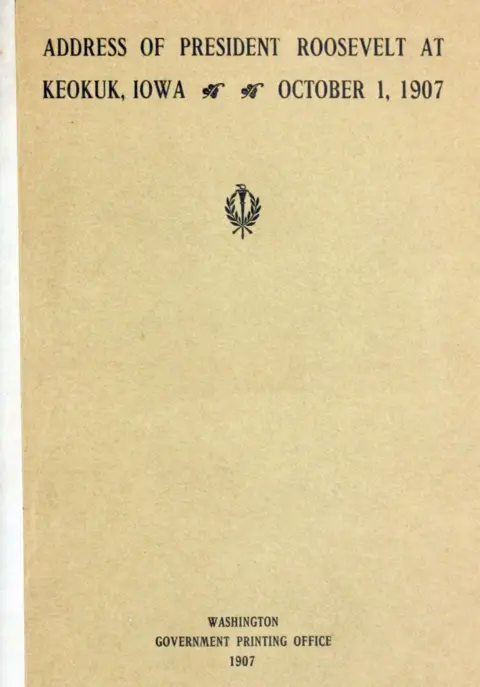
THE CLASSIC COLLECTION · 1907
"Address of President Roosevelt at Keokuk, Iowa, October 1, 1907" by Roosevelt is a political speech delivered during the early 20th century. This address focuses on important economic and social issues facing the United States at the time, particularly the relationship between the government and large corporations, as well as the significance of maintaining a strong, independent farming class. Roosevelt emphasizes the ideals of justice, fairness, and the need for active citizen engagement in promoting laws that benefit the average American. In his speech, Roosevelt discusses the threats posed by the growing divide between wealthy corporations and the average citizen, drawing historical parallels to the fall of the Roman Republic. He advocates for a government that ensures fairness and justice for all, while warning against the perils of either mob rule or plutocracy. Roosevelt also emphasizes the importance of agriculture and the role of the middle-sized farmer in American society, advocating for educational reforms and governmental policies that support farming and protect the rights of actual home-makers. He concludes with a call for a cooperative effort between the government and the citizenry to maintain the health of the nation’s agricultural and economic landscape, reflecting his belief in strong character and active self-governance as crucial for the nation’s future.
Introduction adapted from the source catalogue; source summaries may be automatically generated.
Free to read · English · 4,891 words · No account needed
MAKE TIME FOR A GOOD BOOK
On by default. Untick to stop anonymous reading totals. Each page counts after 10 seconds in view. How this works.
Anonymous counting is on unless you have switched it off.
Now, men of Iowa, I want to say just a word on a matter that concerns not the States of the Mississippi Valley itself, but the States west of them, the States of the Great Plains and the Rocky Mountains. Unfortunately, I am not able on this present trip to visit those States, or I should speak to their own people on the point to which I now intend to allude; but after all anything that affects a considerable number of Americans who live under one set of conditions, must be of moment to all other Americans, for never forget, friends, that in the long run we shall all go up or go down together.
The States of the high plains and of the mountains have a peculiar claim upon me, because for a number of years I lived and worked in them, and I have that intimate knowledge of their people that comes under such conditions. In those States there is need of a modification of the land laws that have worked so well in the well-watered fertile regions to the eastward, such as those in which you here dwell. The one object in all our land laws should always be to favor the actual settler, the actual home maker, who comes to dwell on the land and there to bring up his children to inherit it after him. The Government should part with its title to the land only to the actual home-maker――not to the profit-maker, who does not care to make a home. The land should be sold outright only in quantities sufficient for decent homes――not in huge areas to be held for speculative purposes or used as ranches, where those who do the actual work are merely tenants or hired hands. No temporary prosperity of any class of men could in the slightest degree atone for failure on our part to shape the laws so that they may work for the permanent good of the home-maker. This is fundamental, gentlemen, and is simply carrying out the idea upon which I dwell in speaking to you of your own farms here in Iowa. Now in many States where the rainfall is light it is a simple absurdity to expect any man to live, still less to bring up a family, on one hundred and sixty acres. Where we are able to introduce irrigation, the homestead can be very much less in size――can, for instance, be forty acres; and there is nothing that Congress has done during the past six years more important than the enactment of the national irrigation law. But where irrigation is not applicable and the land can only be used for grazing, it may be that you can not run more than one steer to ten acres, and it is not necessary to be much of a mathematician in order to see that where such is the case a homestead of one hundred and sixty acres will not go far toward the support of a family. In consequence of this fact, homesteaders do not take up the lands in the tracts in question. They are left open for anybody to graze upon that wishes to. The result is that the men who use them moderately and not with a view to exhausting their resources are at the mercy of those who care nothing for the future and simply intend to skin the land in the present. For instance, the small sheep farmer who has a home and who wishes that home to pass on to his children improved in value will naturally run his flock so that the land will support it, not only to-day, but ten years hence; but a big absentee sheep owner, who has no home on the land at all, but simply owns huge migratory flocks of sheep, may well find it to his profit to drive them over the small sheep farmer’s range and eat it all out. He can then drive his flocks on, whereas the small man can not. Of course, to permit such a state of things is not only evil for the small man, but is destructive of the best interests of the country. Substantially the same conditions obtain as regards cattle. The custom has therefore grown up of fencing great tracts of Government land without warrant of law. The men who fenced this land were sometimes rich men, who, by fencing it, kept out actual settlers and thereby worked evil to the country. But in many cases, whether they were large men or small men, their object was not to keep out actual settlers, but to protect themselves and their own industry by preventing overgrazing of the range on the part of reckless stock owners who had no place in the permanent development of the country and who were indifferent to everything except the profits of the moment. To permit the continuance of this illegal fencing inevitably tended to very grave abuses, and the Government has therefore forced the fencers to take down their fences. In doing this we have not only obeyed and enforced the law, but we have corrected many flagrant abuses. Nevertheless, we have also caused hardship, which, though unavoidable, I was exceedingly unwilling to cause. In some way or other we must provide for the use of the public range under conditions which shall inure primarily to the benefit of the actual settlers on or near it, and which shall prevent its being wasted. This means that in some shape or way the fencing of pasture land must be permitted under restrictions which will safeguard the rights of the actual settlers. I desire to act as these actual settlers wish to have me in this matter. I wish to find out their needs and desires and then to try to put them into effect. But they must take trouble, must look ahead to their own ultimate and real good, must insist upon being really represented by their public men, if we are to have a good result. A little while ago I received a very manly and sensible letter from one of the prominent members of the Laramie County, Wyo., Cattle and Horse Growers’ Association. My correspondent remarked incidentally in his letter, “I am a small ranchman, and have to plow and pitch hay myself,” and then went on to say that the great majority of their people had complied with the governmental order, had removed their fences and sold their cattle, but that they must get some kind of a lease law which would permit them to graze their stock under proper conditions or else it would be ruinous to them to continue in the business. The thing I have most at heart as regards this subject is to do whatever will be of permanent benefit to just exactly the people for whom this correspondent of mine spoke――the small ranchmen who have to plow and pitch hay themselves. All I want to do is to find out what will be to their real benefit, for that is certain to be to the benefit of the country as a whole. It may be that we can secure their interests best by permitting all homesteaders in the dry country to inclose, individually or a certain number of them together, big tracts of range for summer use, the tracts being proportioned to the number of neighboring homesteaders who wish to run their cattle upon it. It may be that parts of the range will only be valuable for companies that can lease it and put large herds on it; for the way properly to develop a region is to put it to those uses to which it is best adapted. The amount to be paid for the leasing privilege is to me a matter of comparative indifference. The Government does not wish to make money out of the range, but simply to provide for the necessary supervision that will prevent its being eaten out or exhausted; that is, that will secure it undamaged as an asset for the next generation, for the children of the present home makers. Of course we must also provide enough to pay the proper share of the county taxes. I am not wedded to any one plan, and I am willing to combine several plans if necessary. But the present system is wrong, and I hope to see, in all the States of the Great Plains and the Rockies, the men like my correspondent of the Laramie County Cattle and Horse Growers’ Association, the small ranchmen “who plow and pitch hay themselves,” seriously take up this matter and make their representatives in Congress understand that there must be some solution, and that this solution shall be one which will secure the greatest permanent well-being to the actual settlers, the actual home makers. I promise with all the strength I have to cooperate toward this end.
Your reading position is saved on this browser. Take it to another device with a library code. Reading pages adapt to text, rather than matching a printed edition.
Theodore Roosevelt
Theodore Roosevelt
Theodore Roosevelt

Theodore Roosevelt & Kermit Roosevelt
BEHIND THE BOOK
This eBook is for the use of anyone anywhere in the United States and most other parts of the world at no cost and with almost no restrictions whatsoever. You may copy it, give it away or re-use it under the terms of the Project Gutenberg License included with this eBook or online at www.gutenberg.org. If you are not located in the United States, you will have to check the laws of the country where you are located before using this eBook. Read the source licence.
The original source file, including credits and licence, is retained by this library. Request an original-format copy at no charge. Please include the book title and Project Gutenberg identifier #68119.
KEEP YOUR CURIOSITY GOING

David Patterson (Spirit) Hatch

David Patterson (Spirit) Hatch

David Patterson (Spirit) Hatch
Cécile Tormay

Moritz Busch
John L. Ransom