THE CLASSIC COLLECTION✦Letters to His ChildrenCLASSIC FREE BOOKS
Letters to His Children
Theodore Roosevelt
THE CLASSIC COLLECTION · 1907
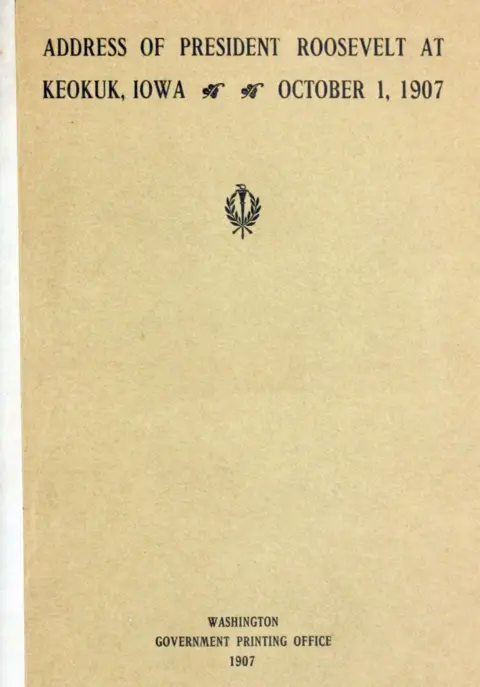
"Address of President Roosevelt at Keokuk, Iowa, October 1, 1907" by Roosevelt is a political speech delivered during the early 20th century. This address focuses on important economic and social issues facing the United States at the time, particularly the relationship between the government and large corporations, as well as the significance of maintaining a strong, independent farming class. Roosevelt emphasizes the ideals of justice, fairness, and the need for active citizen engagement in promoting laws that benefit the average American. In his speech, Roosevelt discusses the threats posed by the growing divide between wealthy corporations and the average citizen, drawing historical parallels to the fall of the Roman Republic. He advocates for a government that ensures fairness and justice for all, while warning against the perils of either mob rule or plutocracy. Roosevelt also emphasizes the importance of agriculture and the role of the middle-sized farmer in American society, advocating for educational reforms and governmental policies that support farming and protect the rights of actual home-makers. He concludes with a call for a cooperative effort between the government and the citizenry to maintain the health of the nation’s agricultural and economic landscape, reflecting his belief in strong character and active self-governance as crucial for the nation’s future.
Introduction adapted from the source catalogue; source summaries may be automatically generated.
Free to read · English · 4,891 words · No account needed
MAKE TIME FOR A GOOD BOOK
On by default. Untick to stop anonymous reading totals. Each page counts after 10 seconds in view. How this works.
Anonymous counting is on unless you have switched it off.
Therefore we need wise laws, and we need to have them resolutely administered. We can get such laws and such administration only if the people are alive to their interests. The other day I listened to an admirable sermon by Bishop Johnston, of western Texas. His theme was that the vital element in judging any man should be his conduct, and neither his position nor his pretensions; and, furthermore, that freedom could only stay with a people which has the habit of self-mastery. As he said, the price of liberty is not only eternal vigilance, but eternal virtue; and I may add, eternal common sense. Each man here knows that he himself has been able to use his freedom to advantage only provided that he could master himself, that he could control his own passions and direct his own faculties. Each of you fathers and mothers here knows that if your sons are to do well in the world they must know how to master themselves. Every man must have a master; if he is not his own master, then somebody else will be. This is just as true of public life as of private life. If we can not master ourselves, control ourselves, then sooner or later we shall have to submit to outside control; for there must be control somewhere.
One way of exercising such control is through the laws of the land. Ours is a government of liberty, but it is a government of that orderly liberty which comes by and through the honest enforcement of and obedience to the law. At intervals during the last few months the appeal has been made to me not to enforce the law against certain wrongdoers of great wealth because to do so would interfere with the business prosperity of the country. Under the effects of that kind of fright which when sufficiently acute we call panic, this appeal has been made to me even by men who ordinarily behave as decent citizens. One newspaper which has itself strongly advanced this view gave prominence to the statement of a certain man of great wealth to the effect that the so-called financial weakness “was due entirely to the admitted intention of President Roosevelt to punish the large moneyed interests which had transgressed the laws.” I do not admit that this has been the main cause of any business troubles we have had; but it is possible that it has been a contributory cause. If so, friends, as far as I am concerned it must be accepted as a disagreeable but unavoidable feature in a course of policy which as long as I am President will not be changed. In any great movement for righteousness, where the forces of evil are strongly intrenched, it is unfortunately inevitable that some unoffending people should suffer in company with the real offenders. This is not our fault. It is the fault of those to whose deceptive action these innocent people owe their false position. A year or two ago certain representatives of labor called upon me and in the course of a very pleasant conversation told me that they regarded me as “the friend of labor.” I answered that I certainly was, and that I would do everything in my power for the laboring man except anything that was wrong. I have the same answer to make to the business man. I will do everything I can do to help business conditions, except anything that is wrong. And it would be not merely wrong but infamous to fail to do all that can be done to secure the punishment of those wrongdoers whose deeds are peculiarly reprehensible because they are not committed under the stress of want. Whenever a serious effort is made to cut out what is evil in our political life, whether the effort takes the shape of warring against the gross and sordid forms of evil in some municipality, or whether it takes the shape of trying to secure the honest enforcement of the law as against very powerful and wealthy people, there are sure to be certain individuals who demand that the movement stop because it may hurt business. In each case the answer must be that we earnestly hope and believe that there will be no permanent damage to business from the movement, but that if righteousness conflicts with the fancied needs of business, then the latter must go to the wall. We can not afford to substitute any other test for that of guilt or innocence, of wrongdoing or welldoing, in judging any man. If a man does well, if he acts honestly, he has nothing to fear from this Administration. But so far as in me lies the corrupt politician, great or small, the private citizen who transgresses the law――be he rich or poor――shall be brought before the impartial justice of a court. Perhaps I am most anxious to get at the politician who is corrupt, because he betrays a great trust; but assuredly I shall not spare his brother corruptionist who shows himself a swindler in business life; and, according to our power, crimes of fraud and cunning shall be prosecuted as relentlessly as crimes of brutality and physical violence.
Your reading position is saved on this browser. Take it to another device with a library code. Reading pages adapt to text, rather than matching a printed edition.
Theodore Roosevelt
Theodore Roosevelt
Theodore Roosevelt

Theodore Roosevelt & Kermit Roosevelt
BEHIND THE BOOK
This eBook is for the use of anyone anywhere in the United States and most other parts of the world at no cost and with almost no restrictions whatsoever. You may copy it, give it away or re-use it under the terms of the Project Gutenberg License included with this eBook or online at www.gutenberg.org. If you are not located in the United States, you will have to check the laws of the country where you are located before using this eBook. Read the source licence.
The original source file, including credits and licence, is retained by this library. Request an original-format copy at no charge. Please include the book title and Project Gutenberg identifier #68119.
KEEP YOUR CURIOSITY GOING

David Patterson (Spirit) Hatch

David Patterson (Spirit) Hatch

David Patterson (Spirit) Hatch
Cécile Tormay

Moritz Busch
John L. Ransom