THE CLASSIC COLLECTION✦Andersonville diaryCLASSIC FREE BOOKS
Andersonville diary
John L. Ransom
THE CLASSIC COLLECTION · 1884
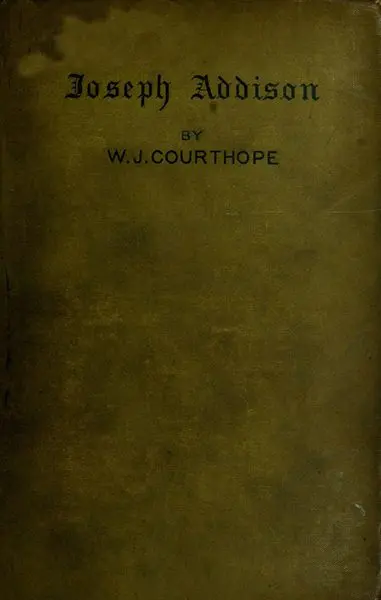
"Addison" by William John Courthope is a biographical account written in the early 20th century. This work is part of the English Men of Letters series, which aims to explore the lives and contributions of notable English authors. The book primarily focuses on the life, writings, and influence of Joseph Addison, delving into the literary and social context of the 18th century in England. The opening of the book sets the stage by examining the state of English society and letters after the Restoration. It highlights the contrast between the lack of significant personal records about Addison's life and the profound impact he had on his contemporaries. Courthope discusses the admiration Addison garnered from fellow writers, such as Pope and Swift, underscoring Addison's role in harmonizing societal debates through his writings. The narrative introduces themes of public opinion and the challenges of reconciling differing social elements amidst the chaotic political landscape of the time. This section hints at the complex interplay between Addison's personality, his contributions to literature, and the broader historical circumstances shaping his work.
Introduction adapted from the source catalogue; source summaries may be automatically generated.
Free to read · English · 56,603 words · No account needed
MAKE TIME FOR A GOOD BOOK
On by default. Untick to stop anonymous reading totals. Each page counts after 10 seconds in view. How this works.
Anonymous counting is on unless you have switched it off.
"Intrepid then o'er seas and land he flew;
Europe he saw, and Europe saw him too.
There all thy gifts and graces we display,
Thou, only thou, directing all our way!
To where the Seine, obsequious as she runs,
Pours at great Bourbon's feet her silken sons;
Or Tyber, now no longer Roman, rolls,
Vain of Italian arts, Italian souls:
To happy convents bosomed deep in vines,
Where slumber abbots purple as their wines:
To isles of fragrance, lily-silvered vales,
Diffusing languor in the panting gales:
To lands of singing or of dancing slaves,
Love-whispering woods, and lute-resounding waves.
But chief her shrine where naked Venus keeps,
And Cupids ride the lion of the deeps;
Where, eased of fleets, the Adriatic main
Wafts the smooth eunuch and enamoured swain.
Led by my hand, he sauntered Europe round,
And gathered every vice on Christian ground;
Saw every court, heard every king declare
His royal sense of operas or the fair;
The stews and palace equally explored,
Intrigued with glory, and with spirit whored;
Tried all hors-d'oeuvres, all liqueurs defined,
Judicious drank, and greatly daring dined;
Dropped the dull lumber of the Latin store,
Spoiled his own language, and acquired no more;
All classic learning lost on classic ground;
And last turned air, the echo of a sound."
It is needless to say that Addison's experiences of travel were of a very different kind. He left England in his twenty-eighth year, with a mind well equipped from a study of the best authors, and with the intention of qualifying himself for political employment at home, after familiarising himself with the languages and manners of foreign countries. His sojourn abroad extended over four years, and his experience was more than usually varied and comprehensive. Crossing from Dover to Calais, some time in the summer of 1699, he spent nearly eighteen months in France making himself master of the language. In December, 1700, he embarked at Marseilles for a tour in Italy, and visited in succession the following places: Monaco, Genoa, Pavia, Milan, Brescia, Verona, Padua, Venice, Ferrara, Ravenna, Rimini, S. Marino, Pesaro, Fano, Sinigaglia, Ancona, Loreto, Rome (where, as it was his intention to return, he only visited St. Peter's and the Pantheon), Naples, Capri, whence he came back to Rome by sea, the various towns in the neighbourhood of Rome, Siena, Leghorn, Pisa, Lucca, Florence, Bologna, Modena, Parma, and Turin. Thus, in the course of this journey, which lasted exactly a twelvemonth, he twice crossed the Apennines, and made acquaintance with all the more important cities in the northern part of the Peninsula. In December, 1701, he passed over Mont Cenis to Geneva, proceeding then by Fribourg, Berne, Soleure, Zurich, St. Gall, Linden, Insbruck, Hall, to Vienna, where he arrived in the autumn of 1702. After making a brief stay in the Austrian capital he turned his face homewards, and having visited the Protestant cities of Germany, and made a rather longer stay in Hamburg than in any other, he reached Holland in the spring of 1703, and remained in that country till his return to England, some time in the autumn of the same year.
Your reading position is saved on this browser. Take it to another device with a library code. Reading pages adapt to text, rather than matching a printed edition.
BEHIND THE BOOK
This eBook is for the use of anyone anywhere in the United States and most other parts of the world at no cost and with almost no restrictions whatsoever. You may copy it, give it away or re-use it under the terms of the Project Gutenberg License included with this eBook or online at www.gutenberg.org. If you are not located in the United States, you will have to check the laws of the country where you are located before using this eBook. Read the source licence.
The original source file, including credits and licence, is retained by this library. Request an original-format copy at no charge. Please include the book title and Project Gutenberg identifier #41496.
KEEP YOUR CURIOSITY GOING
John L. Ransom

Herman W. Mudgett

Harriet Monroe
Daniel Dulany Addison
Charles Lanman
Harold Rosher