THE CLASSIC COLLECTION✦Andersonville diaryCLASSIC FREE BOOKS
Andersonville diary
John L. Ransom
THE CLASSIC COLLECTION · 1884
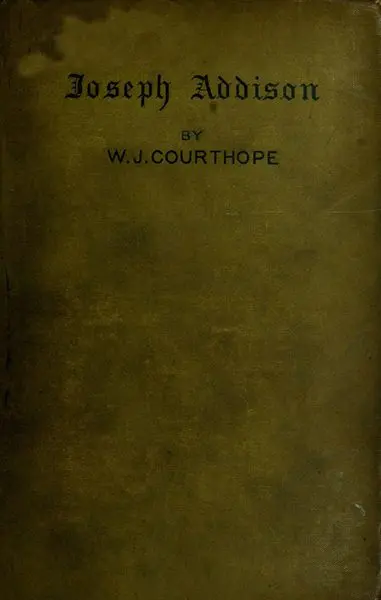
"Addison" by William John Courthope is a biographical account written in the early 20th century. This work is part of the English Men of Letters series, which aims to explore the lives and contributions of notable English authors. The book primarily focuses on the life, writings, and influence of Joseph Addison, delving into the literary and social context of the 18th century in England. The opening of the book sets the stage by examining the state of English society and letters after the Restoration. It highlights the contrast between the lack of significant personal records about Addison's life and the profound impact he had on his contemporaries. Courthope discusses the admiration Addison garnered from fellow writers, such as Pope and Swift, underscoring Addison's role in harmonizing societal debates through his writings. The narrative introduces themes of public opinion and the challenges of reconciling differing social elements amidst the chaotic political landscape of the time. This section hints at the complex interplay between Addison's personality, his contributions to literature, and the broader historical circumstances shaping his work.
Introduction adapted from the source catalogue; source summaries may be automatically generated.
Free to read · English · 56,603 words · No account needed
MAKE TIME FOR A GOOD BOOK
On by default. Untick to stop anonymous reading totals. Each page counts after 10 seconds in view. How this works.
Anonymous counting is on unless you have switched it off.
[1] Spectator, No. 108.
[2] Spectator, No. 158.
[3] Spectator, No. 341.
[4] Spectator, No. 65.
[5] Tatler, No. 25.
[6] A note in the edition of Johnson's Lives of the Poets, published in 1801, states, on the authority of a "Lady in Wiltshire," who derived her information from a Mr. Stephens, a Fellow of Magdalen and a contemporary of Addison's, that the Henry Sacheverell to whom Addison dedicated his Account of the Greatest English Poets was not the well-known divine, but a personal friend of Addison's, who died young, having written a History of the Isle of Man.
[7] Spence's Anecdotes, p. 50.
[8] Compare the Notes on the Metamorphoses, Fab. v. (Tickell's edition, vol. vi. p. 183), where the substance of the above passage is found in embryo.
[9] Dunciad, Book iv. 224.
[10] Compare Spectator, 414. "I do not know whether I am singular in my opinion, but for my part I would rather look upon a tree in all its luxuriancy and diffusion of boughs and branches, rather than when it is thus cut and trimmed into a mathematical figure; and cannot but fancy that an orchard in flower looks infinitely more delightful than all the little labyrinths of the finished parterre."
[11] Letter to the Right Honourable Charles Montague, Esq., Blois, 10{br}
1699.
[12] Letter from Italy to Lord Halifax.
[13] Addison's Works (Tickell's edition), vol. v. p. 301.
[14] Addison's Works (Tickell's edition), vol. v. p. 213.
[15] Oldham's Satire Dissuading from Poetry.
[16] Oldham's Satire Dissuading from Poetry.
[17] Blackmore, The Kit-Kats.
[18] Spectator, No. 9.
[19] Spectator, No. 18.
[20] Spectator, No. 18.
[21] Sir John Hawkins' History of Music, vol. v. p. 137.
[22] Burney's History of Music, vol. iv. p. 203.
[23] Spectator, No. 469.
[24] Fourth Drapier's Letter.
[25] Who the "mistress" was cannot be certainly ascertained. See, however,
p. 146.
[26] Egerton MSS., British Museum (1972).
[27] Andrews' History of British Journalism.
[28] Staple of News, Act I. Scene 2.
[29] Andrews' History of British Journalism.
[30] Tatler, No. 1.
[31] Ibid.
[32] Tatler, No. 271.
[33] Preface to the Fables.
[34] Tatler, No. 5.
[35] Ib., No. 82.
[36] Ib., Nos. 25, 26, 28, 29, 38, 39.
[37] Ib., No. 85.
[38] Tatler, No. 87.
[39] Spence's Anecdotes, p. 325.
[40] Tatler, vol. iv. p. 545 (Nichols' edition).
[41] See p. 93, note 3.
[42] Tatler, No. 6.
[43] Spectator, No. 10.
[44] Spectator, No. 10.
[45] Spectator, No. 10.
[46] The writer was a Miss Shepherd.
[47] Spectator, No. 134.
[48] Spectator, No. 553.
[49] Ibid., No. 542.
[50] Spectator, No. 10.
[51] Spectator, No. 555.
[52] See Addison's Works (Tickell's edition), vol. v. p. 187.
[53] Spence's Anecdotes, p. 196.
[54] Spectator, No. 40.
[55] Spectator, No. 40.
[56] See p. 43.
[57] Spence's Anecdotes, p. 151.
[58] Ibid.
[59] These lines are to be found in The Campaign, see p. 66.
[60] Spectator, No. 39.
[61] Spence's Anecdotes, pp. 148, 149.
[62] Spence's Anecdotes, p. 257.
[63] Pope's Works, Elwin and Courthope's edition, vol. vi. p. 408.
[64] Spence's Anecdotes, p. 146.
[65] Addison's Memorial to the King.
[66] Freeholder, No. 1.
[67] Spence's Anecdotes, p. 175.
[68] Tickell's Elegy. Compare Pope's Eloisa to Abelard, v. 107.
[69] Spectator, No. 125.
[70] Ibid., vol. iii., Nos. 201, 207.
[71] Ibid., No. 391.
[72] Ibid., No. 465.
[73] Ibid., No. 575.
[74] Ibid., No. 494.
[75] Ibid, Nos. 381, 387, 393.
[76] Spectator, No. 51.
[77] Ibid., No. 65.
[78] Spectator, No. 446.
[79] Spectator, No. 525 (by Hughes).
[80] Spectator, No. 399.
[81] Ibid., No. 507.
[82] Spectator, No. 125.
[83] Spectator, No. 158.
Your reading position is saved on this browser. Take it to another device with a library code. Reading pages adapt to text, rather than matching a printed edition.
BEHIND THE BOOK
This eBook is for the use of anyone anywhere in the United States and most other parts of the world at no cost and with almost no restrictions whatsoever. You may copy it, give it away or re-use it under the terms of the Project Gutenberg License included with this eBook or online at www.gutenberg.org. If you are not located in the United States, you will have to check the laws of the country where you are located before using this eBook. Read the source licence.
The original source file, including credits and licence, is retained by this library. Request an original-format copy at no charge. Please include the book title and Project Gutenberg identifier #41496.
KEEP YOUR CURIOSITY GOING
John L. Ransom

Herman W. Mudgett

Harriet Monroe
Daniel Dulany Addison
Charles Lanman

Harold Rosher