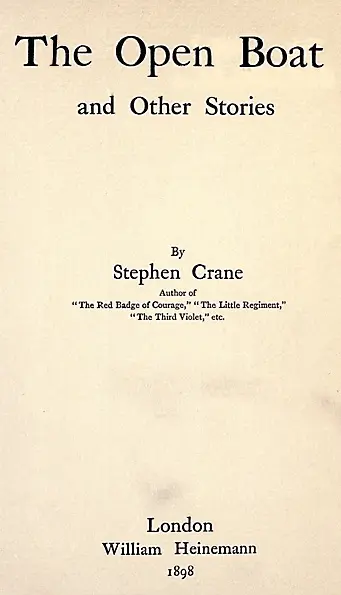
The Open Boat and Other Stories
Stephen Crane
THE CLASSIC COLLECTION · 1899
"Active Service" by Stephen Crane is a novel written during the late 19th century. The book explores themes of love, conflict, and the complexities of human relationships, particularly through the character of Marjory Wainwright, who grapples with her feelings for Rufus Coleman, a man her father disapproves of due to his reckless nature and dubious profession. The narrative unfolds in a backdrop of academic life and societal expectations, presenting a rich landscape for the exploration of these themes. The opening of "Active Service" establishes a tense dynamic between Marjory Wainwright and her father, an elderly professor, as she reveals her desire to marry Rufus Coleman. The professor's vehement disapproval and arguments against Coleman's suitability as a husband create an emotionally charged atmosphere. Marjory's initial hesitance soon gives way to resolve as she faces her father's expectations. The conversation reveals deep familial ties and the struggle between parental control and youthful desires. The complexity of Marjory's emotions and the drama surrounding her engagement to Coleman is framed within the professor's scholarly environment, hinting at broader themes of societal norms versus personal happiness that will likely develop as the story progresses.
Introduction adapted from the source catalogue; source summaries may be automatically generated.
Free to read · English · 77,980 words · No account needed
MAKE TIME FOR A GOOD BOOK
On by default. Untick to stop anonymous reading totals. Each page counts after 10 seconds in view. How this works.
Anonymous counting is on unless you have switched it off.
' Oh, dear! " She pressed her palm to a burning
cheek. She gave him a star-like, beseeching glance.
Let me go now-please."
" Well," he answered, somewhat affronted, " if you
like--"
At the door she turned to look at him, and this glance expressed in its elusive way a score of things which she had not yet been able to speak. It explained that she was loth to leave him, that she asked forgiveness for leaving him, that even for a short absence she wished to take his image in her eyes, that he must not bully her, that there was something now in her heart which frightened her, that she loved him, that she was happy---
When she had gone, Coleman went to the rooms of
the American minister. A Greek was there who
talked wildly as he waved his cigarette. Coleman
waited in well-concealed impatience for the dvapora-
tion of this man. Once the minister, regarding the
correspondent hurriedly, interpolated a comment.
" You look very cheerful ? "
" Yes," answered Coleman, " I've been taking your
advice."
" Oh, ho ! " said the minister.
The Greek with the cigarette jawed endlessly.
Coleman began to marvel at the enduring good man-
ners of the minister, who continued to nod and nod in
polite appreciation of the Greek's harangue, which,
Coleman firmly believed, had no point of interest
whatever. But at last the man, after an effusive farewell,
went his way.
" Now," said the minister, wheeling in his chair
tell me all about it."
Coleman arose, and thrusting his hands deep in his
trousers' pockets, began to pace the room with long
strides. He, said nothing, but kept his eyes on the
floor.
" Can I have a drink ? " he asked, abruptly pausing.
" What would you like? " asked the minister, benevolently,
as he touched the bell.
" A brandy and soda. I'd like it very much. You
see," he said, as he resumed his walk, " I have no kind
of right to burden you with my affairs, but, to tell the
truth, if I don't get this news off my mind and into
somebody's ear, I'll die. It's this-I asked Marjory
Wainwright to marry me, and-she accepted, and-
that's all."
" Well, I am very glad," cried the minister, arising and giving his hand. "And as for burdening me with your affairs, no one has a better right, you know, since you released me from the persecution of Washington and the friends of the Wainwrights. May good luck follow you both forever. You, in my opinion, are a very, very fortunate man. And, for her part she has not done too badly."
Your reading position is saved on this browser. Take it to another device with a library code. Reading pages adapt to text, rather than matching a printed edition.
BEHIND THE BOOK
This eBook is for the use of anyone anywhere in the United States and most other parts of the world at no cost and with almost no restrictions whatsoever. You may copy it, give it away or re-use it under the terms of the Project Gutenberg License included with this eBook or online at www.gutenberg.org. If you are not located in the United States, you will have to check the laws of the country where you are located before using this eBook. Read the source licence.
The original source file, including credits and licence, is retained by this library. Request an original-format copy at no charge. Please include the book title and Project Gutenberg identifier #2364.
KEEP YOUR CURIOSITY GOING
Coulson Kernahan

Maurice Baring
Frances Wright
Cécile Tormay

Frederic Jesup Stimson

W. H. P. (William Henry Pope) Jarvis