Tibet & Nepal
Arnold Henry Savage Landor
THE CLASSIC COLLECTION · 1903
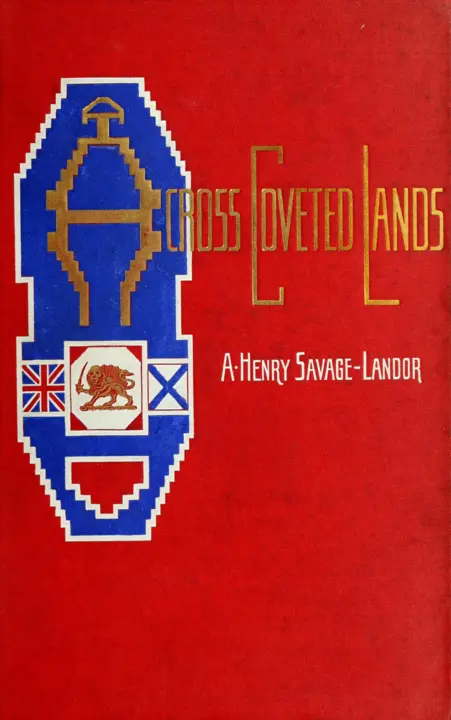
"Across Coveted Lands; or, a Journey from Flushing (Holland) to Calcutta…" by A. Henry Savage Landor is a travel narrative written in the early 20th century. This work details an extensive overland journey through Europe and Asia, capturing the author's experiences and observations as he traverses diverse cultures and landscapes. Landor's vivid prose and insightful anecdotes promise to engage readers interested in exploration and the intricacies of travel during this period. The opening of the book introduces the author's journey, beginning with his travel preparations and initial encounters at train stations. He navigates the complexities of customs at the Russian border with a humorous anecdote regarding a misunderstanding with French merchants about his guns, revealing both the fears and follies associated with traveling in unfamiliar territories. As he proceeds to Warsaw, the author reflects on the city's beauty while giving insights into its history and cultural significance, setting the stage for subsequent travels throughout Eastern Europe and into Asia. This initial chapter effectively establishes the tone for a fascinating exploration filled with both serious observations and light-hearted encounters.
Introduction adapted from the source catalogue; source summaries may be automatically generated.
Free to read · English · 219,571 words · No account needed
MAKE TIME FOR A GOOD BOOK
On by default. Untick to stop anonymous reading totals. Each page counts after 10 seconds in view. How this works.
Anonymous counting is on unless you have switched it off.
The Amir and the Sardars have at different times made purchases of boots, shoes, saddlery, silk, woollen and cotton cloths, rugs, shawls, crockery, and enamel ware, watches, chains, and knives, and have also bought a considerable number of English-made fancy goods, furniture, stationery, cigarettes, cigars and tobacco, &c. The humbler Sistanis purchase very freely from the Indian British shops, but cannot afford to pay very high prices; but the high officials pay cash and give a good price for all they buy.
Speaking generally, the articles which are mostly wanted at present are those mentioned in the official report. For these commodities there is a steady demand in the markets of Sistan and Khorassan, but the supply, it should be remembered, should be in proportion to the size of the population. Sistan, Birjand, Meshed, are not London nor Paris nor Berlin.
The articles wanted are:--
Woollen stuffs, flannels, muslins, mulls, sheetings, chintzes,
cottons, &c.
Velvets, satins, silks, brocades.
Indigo of medium and good quality. (Oudh indigo is principally in
demand in Bushire.)
Iron, brass and copper sheets.
Sulphur matches.
Spices, including cinnamon, cardamums, cloves, pepper, turmeric, &c.
Rice (for Sistan).
Tea, black for Persia, and green for Afghanistan and Transcaspia.
Coffee (in berry).
Refined sugar, loaf.
Ginger preserve (in jars).
Sal-ammoniac.
Baizes (specially of high class), Khinkhabs and gold cloth.
Cotton turbans (lungis) of all qualities, including those with
pure gold fringes.
Leather goods.
Boots (Cawnpore and English).
Saddlery (Cawnpore, as the English is too expensive).
Glass-ware.
Enamel-ware.
Cutlery.
Ironmongery of every description. Cheap padlocks find a ready sale.
Watches (cheap).
Jewellery.
Kalai (for tinning copper vessels).
Fire-arms would command a very ready sale, but their importation is
strictly forbidden.
The articles of export from Khorassan and Sistan are wool, ghi, saffron, dried fruit of various kinds, hides, jujubes, assafoetida, pistachio-nuts, barak, kurak, gum, valuable carpets, and some turquoises.
In Sistan itself wheat and oats are plentiful, but their export to foreign countries is not permitted. Opium finds its way out of the country via Bandar Abbas, and wool, ghi, feathers, carpets, and assafoetida are conveyed principally to Kerman, Birjand, Meshed, Yezd, the Gulf, and Quetta.
One of the principal problems of the new land route to India is not only how to induce British traders to go to Persia, but how to solve the more difficult point of persuading the big Persian traders to cross the bridge and venture into India. They seem at present too indolent and suspicious to undertake such a long journey, and would rather pay for luxuries to be brought to their doors than go and get them themselves.
Your reading position is saved on this browser. Take it to another device with a library code. Reading pages adapt to text, rather than matching a printed edition.
Arnold Henry Savage Landor
Arnold Henry Savage Landor
Arnold Henry Savage Landor
Arnold Henry Savage Landor
BEHIND THE BOOK
This eBook is for the use of anyone anywhere in the United States and most other parts of the world at no cost and with almost no restrictions whatsoever. You may copy it, give it away or re-use it under the terms of the Project Gutenberg License included with this eBook or online at www.gutenberg.org. If you are not located in the United States, you will have to check the laws of the country where you are located before using this eBook. Read the source licence.
The original source file, including credits and licence, is retained by this library. Request an original-format copy at no charge. Please include the book title and Project Gutenberg identifier #22117.
KEEP YOUR CURIOSITY GOING
Wilfrid Scawen Blunt
Wilfrid Scawen Blunt

E. W. (Edgar Watson) Howe
Francis Greenleaf Allinson & Anne C. E. (Anne Crosby Emery) Allinson
Cyrenus Cole

John Martineau