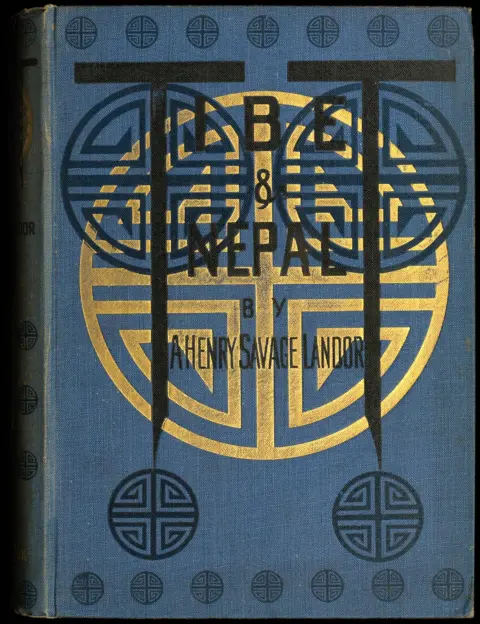
Tibet & Nepal
Arnold Henry Savage Landor

THE CLASSIC COLLECTION · 1903
"Across Coveted Lands; or, a Journey from Flushing (Holland) to Calcutta…" by A. Henry Savage Landor is a travel narrative written in the early 20th century. This work details an extensive overland journey through Europe and Asia, capturing the author's experiences and observations as he traverses diverse cultures and landscapes. Landor's vivid prose and insightful anecdotes promise to engage readers interested in exploration and the intricacies of travel during this period. The opening of the book introduces the author's journey, beginning with his travel preparations and initial encounters at train stations. He navigates the complexities of customs at the Russian border with a humorous anecdote regarding a misunderstanding with French merchants about his guns, revealing both the fears and follies associated with traveling in unfamiliar territories. As he proceeds to Warsaw, the author reflects on the city's beauty while giving insights into its history and cultural significance, setting the stage for subsequent travels throughout Eastern Europe and into Asia. This initial chapter effectively establishes the tone for a fascinating exploration filled with both serious observations and light-hearted encounters.
Introduction adapted from the source catalogue; source summaries may be automatically generated.
Free to read · English · 219,571 words · No account needed
MAKE TIME FOR A GOOD BOOK
On by default. Untick to stop anonymous reading totals. Each page counts after 10 seconds in view. How this works.
Anonymous counting is on unless you have switched it off.
The exports mainly consist of almonds and nuts, tobacco, opium (to China), colouring matters, walnut-wood, silk, wool, cotton carpets, felts, skins, assafoetida, shoes, copper pots, country loaf-sugar, sweetmeats, for which Yezd is celebrated, etc. Henna is brought to Yezd from Minab and Bandar Abbas to be ground and prepared for the Persian market, being used with rang as a dye for the hair.
The chief imports are spices, cotton goods, yarn, prints, copper sheeting, tin slabs, Indian tea, broadcloth, jewellery, arms, cutlery, watches, earthenware, glass and enamel wares, iron, loaf-sugar, powdered sugar, etc.
The Government of Yezd, as of other cities of Persia, is purely despotic, limited only by the power and influence of the Mahommedan priests, the Mullahs, and by the dread of private vengeance or an occasional insurrection. It is true that the actions of Hakims and Governors and their deputies are liable to revision from the Teheran authorities, but this does not prevent exactions and extortions being carried on quite openly and on a large scale.
The present Governor, Salal-ud-dauleh--"Glory of the state,"--eldest son of Zil-es-Sultan, is an intelligent and well-to-do young man, sensibly educated, who tries his best to be fair to everybody; but it is very difficult for him to run alone against the strong tide of corruption which swamps everything in Persia. He is not in good health, and spends much of his time hunting wild game at his country place in the hills near Yezd. His town residence is a kind of citadel--not particularly impressive, nor clean--inside the city wall. The Naib-ul-Kukumat was the Deputy-Governor at the time of my visit. He seemed quite an affable and intelligent man.
Near the Palace in the heart of the city are the covered bazaars, old and new, and well stocked with goods, but they are in character so exactly like those of Teheran and Isfahan, already described in previous chapters, that a repetition is quite unnecessary. The streets are irregularly planned, and the older ones are very dark and dingy, but the newer arcades are lofty and handsome. The merchants seem--for Persia--quite active and business-like.
At the beginning of the nineteenth century the population of Yezd is said to have been one hundred thousand souls, and to have dwindled down to less than thirty thousand in 1868-1870 during the terrific famine which took place at that time. Whether this is correct or not, it is difficult to ascertain, but to-day the city is on the increase again, and the population, as already stated, is certainly not less than sixty thousand. There are numerous Mahommedan hammams (baths)--some 65 or more--in Yezd, but Europeans are not allowed to enter them.
Your reading position is saved on this browser. Take it to another device with a library code. Reading pages adapt to text, rather than matching a printed edition.
Arnold Henry Savage Landor
Arnold Henry Savage Landor
Arnold Henry Savage Landor
Arnold Henry Savage Landor
BEHIND THE BOOK
This eBook is for the use of anyone anywhere in the United States and most other parts of the world at no cost and with almost no restrictions whatsoever. You may copy it, give it away or re-use it under the terms of the Project Gutenberg License included with this eBook or online at www.gutenberg.org. If you are not located in the United States, you will have to check the laws of the country where you are located before using this eBook. Read the source licence.
The original source file, including credits and licence, is retained by this library. Request an original-format copy at no charge. Please include the book title and Project Gutenberg identifier #22117.
KEEP YOUR CURIOSITY GOING
Wilfrid Scawen Blunt
Wilfrid Scawen Blunt

E. W. (Edgar Watson) Howe
Francis Greenleaf Allinson & Anne C. E. (Anne Crosby Emery) Allinson
Cyrenus Cole

John Martineau