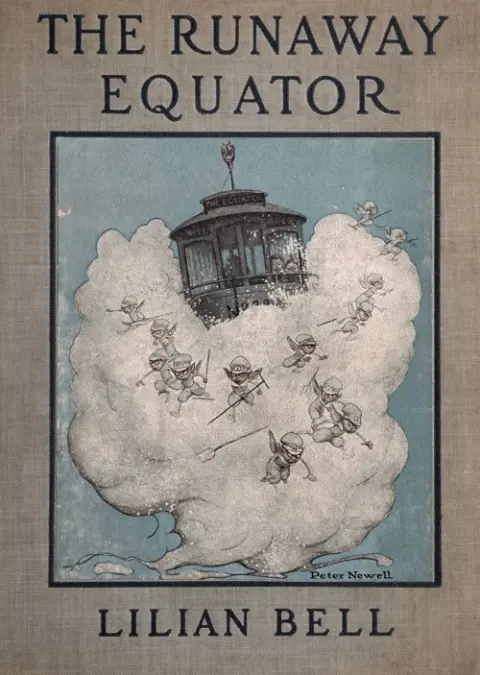
The Runaway Equator, and the Strange Adventures of a Little Boy in Pursuit of It
Lilian Bell
THE CLASSIC COLLECTION · 1902
"Abroad with the Jimmies" by Lilian Bell is a humorous travel narrative likely written during the late 19th century. The book chronicles the experiences of the author and her companions, the Jimmies (Mr. and Mrs. Jimmie), as they travel across Europe, indulging in leisure and adventure during their aimless outings. The narrative blends light-hearted anecdotes with insights into the cultural differences between Americans and Europeans, all while engaging readers with the dynamics of friendship among the characters. The opening of "Abroad with the Jimmies" introduces us to the protagonist, who embarks on a journey through Europe with her sister and the vivacious Jimmie couple. The story begins on a houseboat at Henley, where the excitement of travel mingles with unexpected encounters with fellow Americans. The protagonist illustrates her relationship with her sister, Bee, who enjoys managing their escapades, and Jimmie, whose boisterous personality adds comic relief. As they navigate through social occasions and mishaps, their interactions highlight charming cultural observations and the nuances of American and English lifestyles. The narrative sets a delightful tone for the escapades to come, promising readers a charming exploration of friendship, travel, and the amusing mishaps that ensue.
Introduction adapted from the source catalogue; source summaries may be automatically generated.
Free to read · English · 54,214 words · No account needed
MAKE TIME FOR A GOOD BOOK
On by default. Untick to stop anonymous reading totals. Each page counts after 10 seconds in view. How this works.
Anonymous counting is on unless you have switched it off.
The countess clasped her hands and said:
"How I envy you, but doesn't it cost you a great deal of money?"
"I suppose it does," I said, regretfully. "I am going to travel as long as my money holds out, but the rest are not so hampered."
"Alas, if I could only go with you," said the countess, "but we are under such heavy expense now. It used to be easier when we had three or four children nearer of an age who could be educated together. Then it cost less. But now this boy, my youngest, necessitates different tutors for everything, and it costs as much to educate this last one of thirteen as it did any four of the others."
"But then you educate so thoroughly," I said. "Russians always speak five or six, sometimes ten languages, including dialects. With us our wealthy people generally send their children to a good private school and afterward prepare them by tutor for college. Then the richest send them for a trip around the world, or perhaps a year abroad, and that ends it. But the ordinary American has only a public school education. Americans are not linguists naturally."
"Ah! but here we are obliged to be linguists, because, if we travel at all, we must speak other languages, and, if we entertain at all, we meet people who cannot speak ours, which is very difficult to learn. But languages are easy."
"Oh! are they?" said Jimmie, involuntarily, and everybody laughed.
"Jimmie's languages are unique," said Bee.
"Are you going to Italy?" said the countess.
"Yes, we hope to spend next spring in Italy, beginning with Sicily and working slowly northward."
"How delightful! How charming!" cried the countess. "How I wish, how I wish I could go with you."
"Go with us?" I cried in delight. "Could you manage it? We should be so flattered to have your company."
"Oh, if I could! I shall ask. It will do no harm to ask."
We had all stood up to go and had begun to shake hands when she cried
across to her husband:
"Leo, Leo, may I go--"
Then seeing she had not engaged her husband's attention, who was talking to Jimmie about single tax, she went over and pulled his sleeve.
"Leo, may I go with them to Italy in the spring? Please, dear Leo, say
yes."
He shook his head gravely, and the little countess smiled at her
mother's enthusiasm.
"It would cost too much," said Tolstoy, "besides, I cannot spare you. I
need you."
"You need me!" cried the countess in gay derision. Then pleadingly, "Do
let me go."
"I cannot," said Tolstoy, turning to Jimmie again.
Your reading position is saved on this browser. Take it to another device with a library code. Reading pages adapt to text, rather than matching a printed edition.
Lilian Bell
Lilian Bell
Lilian Bell
Lilian Bell
BEHIND THE BOOK
This eBook is for the use of anyone anywhere in the United States and most other parts of the world at no cost and with almost no restrictions whatsoever. You may copy it, give it away or re-use it under the terms of the Project Gutenberg License included with this eBook or online at www.gutenberg.org. If you are not located in the United States, you will have to check the laws of the country where you are located before using this eBook. Read the source licence.
The original source file, including credits and licence, is retained by this library. Request an original-format copy at no charge. Please include the book title and Project Gutenberg identifier #12184.
KEEP YOUR CURIOSITY GOING
Wilfrid Scawen Blunt
Wilfrid Scawen Blunt

E. W. (Edgar Watson) Howe
Francis Greenleaf Allinson & Anne C. E. (Anne Crosby Emery) Allinson
Cyrenus Cole

John Martineau