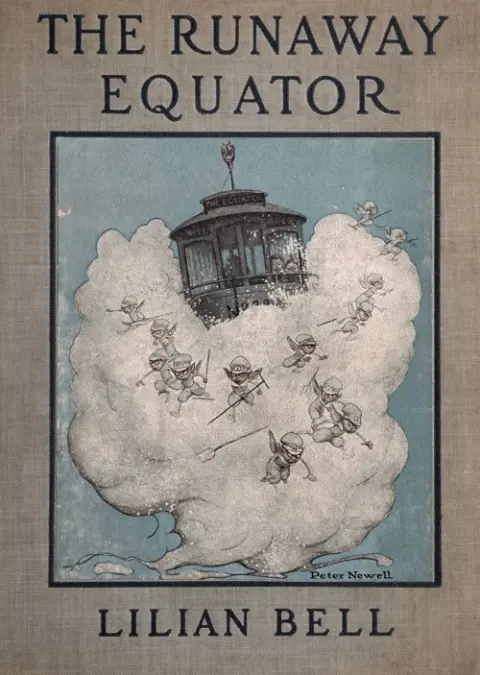
The Runaway Equator, and the Strange Adventures of a Little Boy in Pursuit of It
Lilian Bell
THE CLASSIC COLLECTION · 1902
"Abroad with the Jimmies" by Lilian Bell is a humorous travel narrative likely written during the late 19th century. The book chronicles the experiences of the author and her companions, the Jimmies (Mr. and Mrs. Jimmie), as they travel across Europe, indulging in leisure and adventure during their aimless outings. The narrative blends light-hearted anecdotes with insights into the cultural differences between Americans and Europeans, all while engaging readers with the dynamics of friendship among the characters. The opening of "Abroad with the Jimmies" introduces us to the protagonist, who embarks on a journey through Europe with her sister and the vivacious Jimmie couple. The story begins on a houseboat at Henley, where the excitement of travel mingles with unexpected encounters with fellow Americans. The protagonist illustrates her relationship with her sister, Bee, who enjoys managing their escapades, and Jimmie, whose boisterous personality adds comic relief. As they navigate through social occasions and mishaps, their interactions highlight charming cultural observations and the nuances of American and English lifestyles. The narrative sets a delightful tone for the escapades to come, promising readers a charming exploration of friendship, travel, and the amusing mishaps that ensue.
Introduction adapted from the source catalogue; source summaries may be automatically generated.
Free to read · English · 54,214 words · No account needed
MAKE TIME FOR A GOOD BOOK
On by default. Untick to stop anonymous reading totals. Each page counts after 10 seconds in view. How this works.
Anonymous counting is on unless you have switched it off.
"Would you take it away from them, if you could?" asked Tolstoy.
"Most certainly I would," I answered, "although my opinion is of no value, and I am only wasting your time by expressing it. I would take away the franchise from the negroes and from all foreigners until they had lived in our country twenty-one years, as our American men must do, and I would establish a property and educational qualification for every voter. I would not permit a man to vote upon property issues unless he were a property owner."
"Would you enfranchise the women?" asked the countess.
"I would, but under the same conditions."
"But would your best element of women exercise the privilege?" asked the
little countess.
"Not all of them at first, and some of them never, I suppose; but when once our country awakens to the meaning of patriotism, and our women understand that they are citizens exactly as the men are citizens, they will do their duty, and do it more conscientiously than the men."
"It is a very interesting subject," said the count; "and your suggestions open up many possibilities. Women do vote in several of your States, I am told."
"How I would love to see a woman who had voted," cried the countess, clasping her hands with all the vivacity of a French woman.
"Why, I have voted," said Bee, laughing. "I voted for President McKinley in the State of Colorado, and my sister and Mrs. Jimmie voted for school trustee in Illinois." All three of the Tolstoys turned eagerly toward Bee.
"Do tell me about it," said the count.
"There is very little to tell. I simply went and stood in line and cast
my ballot."
"But was there no shooting, no bribery, no excitement?" cried the countess. "Do they go dressed as you are now?"
"No, I dressed much better. I wore my best Paris gown, and drove down in my victoria. While I was in the line half a dozen gentlemen, who attended my receptions, came up and chatted with me, showed me how to fold my ballot, and attended me as if we were at a concert. When I came away, I took a street-car home, and sent my carriage for several ladies who otherwise would not have come."
"And you," said the countess, turning to Mrs. Jimmie.
"It was in a barber shop," she said, laughing. "When I went in, the men had their feet on the table, their hats on their heads, and they were all smoking, but at my entrance all these things changed. Hats came off, cigars were laid down, and feet disappeared. I was politely treated, and enjoyed it immensely."
Your reading position is saved on this browser. Take it to another device with a library code. Reading pages adapt to text, rather than matching a printed edition.
Lilian Bell
Lilian Bell
Lilian Bell
Lilian Bell
BEHIND THE BOOK
This eBook is for the use of anyone anywhere in the United States and most other parts of the world at no cost and with almost no restrictions whatsoever. You may copy it, give it away or re-use it under the terms of the Project Gutenberg License included with this eBook or online at www.gutenberg.org. If you are not located in the United States, you will have to check the laws of the country where you are located before using this eBook. Read the source licence.
The original source file, including credits and licence, is retained by this library. Request an original-format copy at no charge. Please include the book title and Project Gutenberg identifier #12184.
KEEP YOUR CURIOSITY GOING
Wilfrid Scawen Blunt
Wilfrid Scawen Blunt

E. W. (Edgar Watson) Howe
Francis Greenleaf Allinson & Anne C. E. (Anne Crosby Emery) Allinson
Cyrenus Cole

John Martineau