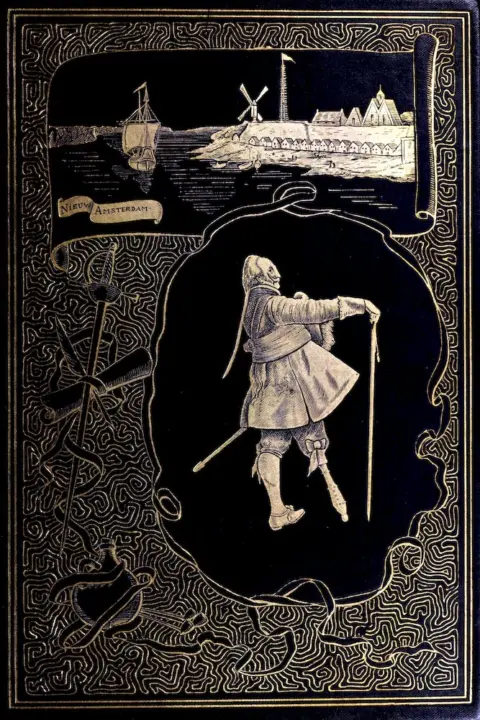
Knickerbocker’s history of New York, vol. 2 (of 2)
Washington Irving
THE CLASSIC COLLECTION · 1800
"Abbotsford and Newstead Abbey" by Washington Irving is a travelogue-style narrative written in the early 19th century. The book recounts Irving's visit to the renowned Abbotsford estate belonging to the famous Scotch author Sir Walter Scott, and includes detailed observations about the landscape, its history, and the illustrious figure who inhabited it. The narrative sets the tone for a journey into the past, intertwining details of Scott's life with the romantic essence of Scotland's heritage. The opening of the book describes Irving's arrival at Selkirk and his eagerness to visit Scott at Abbotsford. He provides a vivid depiction of the cottage, still under construction, and introduces the reader to the welcoming personality of Scott himself, who invites Irving to stay for breakfast and explore the surrounding area. As they head towards Melrose Abbey, Scott's son accompanies them, sharing anecdotes and enriching the journey with local lore. The narrative blends personal encounters with Scott's family, engaging conversations about history and nature, and insights into Scott's character, displaying his warmth and humor, as well as his deep connection to Scotland’s mythos and tradition.
Introduction adapted from the source catalogue; source summaries may be automatically generated.
Free to read · English · 49,509 words · No account needed
MAKE TIME FOR A GOOD BOOK
On by default. Untick to stop anonymous reading totals. Each page counts after 10 seconds in view. How this works.
Anonymous counting is on unless you have switched it off.
I would observe, that the access to the Rook Cell is by a spiral stone staircase leading up into it, as into a turret, from, the long shadowy corridor over the cloisters, one of the midnight walks of the Goblin Friar. Indeed, to the fancies engendered in his brain in this remote and lonely apartment, incorporated with the floating superstitions of the Abbey, we are no doubt indebted for the spectral scene in "Don Juan."
"Then as the night was clear, though cold, he threw
His chamber door wide open--and went forth
Into a gallery, of sombre hue,
Long furnish'd with old pictures of great worth,
Of knights and dames, heroic and chaste too,
As doubtless should be people of high birth.
"No sound except the echo of his sigh
Or step ran sadly through that antique house,
When suddenly he heard, or thought so, nigh,
A supernatural agent--or a mouse,
Whose little nibbling rustle will embarrass
Most people, as it plays along the arras.
"It was no mouse, but lo! a monk, arrayed
In cowl, and beads, and dusky garb, appeared,
Now in the moonlight, and now lapsed in shade;
With steps that trod as heavy, yet unheard;
His garments only a slight murmur made;
He moved as shadowy as the sisters weird,
But slowly; and as he passed Juan by
Glared, without pausing, on him a bright eye.
"Juan was petrified; he had heard a hint
Of such a spirit in these halls of old,
But thought, like most men, there was nothing in't
Beyond the rumor which such spots unfold,
Coin'd from surviving superstition's mint,
Which passes ghosts in currency like gold,
But rarely seen, like gold compared with paper.
And did he see this? or was it a vapor?
"Once, twice, thrice pass'd, repass'd--the thing of air, Or earth beneath, or heaven, or t'other place; And Juan gazed upon it with a stare, Yet could not speak or move; but, on its base As stauds a statue, stood: he felt his hair Twine like a knot of snakes around his face; He tax'd his tongue for words, which were not granted To ask the reverend person what he wanted.
"The third time, after a still longer pause,
The shadow pass'd away--but where? the hall
Was long, and thus far there was no great cause
To think its vanishing unnatural:
Doors there were many, through which, by the laws
Of physics, bodies, whether short or tall,
Might come or go; but Juan could not state
Through which the spectre seem'd to evaporate.
Your reading position is saved on this browser. Take it to another device with a library code. Reading pages adapt to text, rather than matching a printed edition.
Washington Irving
William Irving & Washington Irving & James Kirke Paulding
Washington Irving
Washington Irving
BEHIND THE BOOK
This eBook is for the use of anyone anywhere in the United States and most other parts of the world at no cost and with almost no restrictions whatsoever. You may copy it, give it away or re-use it under the terms of the Project Gutenberg License included with this eBook or online at www.gutenberg.org. If you are not located in the United States, you will have to check the laws of the country where you are located before using this eBook. Read the source licence.
The original source file, including credits and licence, is retained by this library. Request an original-format copy at no charge. Please include the book title and Project Gutenberg identifier #7948.
KEEP YOUR CURIOSITY GOING
Wilfrid Scawen Blunt
Wilfrid Scawen Blunt

E. W. (Edgar Watson) Howe
Francis Greenleaf Allinson & Anne C. E. (Anne Crosby Emery) Allinson
Cyrenus Cole

John Martineau