THE CLASSIC COLLECTION✦Their island homeCLASSIC FREE BOOKS
Their island home
Jules Verne
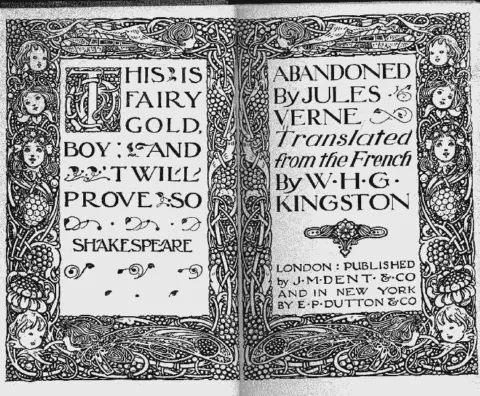
THE CLASSIC COLLECTION · 1915
"Abandoned" by Jules Verne is a novel serialized from August 1874 to September 1875. Five Union prisoners escape the American Civil War in a stolen balloon, only to crash on an uncharted volcanic island in the Pacific. Using ingenuity and engineering skills, they transform from castaways into colonists. But mysterious events suggest an unseen guardian watches over them. When pirates threaten their new home and secrets emerge from the island's depths, the survivors discover their refuge harbors an extraordinary connection to a legendary figure from the sea.
Introduction adapted from the source catalogue; source summaries may be automatically generated.
Free to read · English · 67,828 words · No account needed
MAKE TIME FOR A GOOD BOOK
On by default. Untick to stop anonymous reading totals. Each page counts after 10 seconds in view. How this works.
Anonymous counting is on unless you have switched it off.
Cyrus Harding and Herbert, whilst hunting one day, had entered the forest of the Far West, on the left bank of the Mercy, and, as usual, the lad was asking a thousand questions of the engineer, who answered them heartily. Now, as Harding was not a sportsman, and as, on the other side, Herbert was talking chemistry and natural philosophy, numbers of kangaroos, capybaras, and agoutis came within range, which, however, escaped the lad's gun; the consequence was that the day was already advanced, and the two hunters were in danger of having made a useless excursion, when Herbert, stopping, and uttering a cry of joy, exclaimed,--
"Oh, Captain Harding, do you see that tree?" and he pointed to a shrub, rather than a tree, for it was composed of a single stem, covered with a scaly bark, which bore leaves streaked with little parallel veins.
"And what is this tree which resembles a little palm?" asked Harding.
"It is a 'cycas revoluta,' of which I have a picture in our dictionary of Natural History!" said Herbert.
"But I can't see any fruit on this shrub!" observed his companion.
"No, captain," replied Herbert; "but its stem contains a flour with which nature has provided us all ready ground."
"It is, then, the bread-tree?"
"Yes, the bread-tree."
"Well, my boy," replied the engineer, "this is a valuable discovery,
since our wheat harvest is not yet ripe; I hope that you are not
mistaken!"
Herbert was not mistaken: he broke the stem of a cycas, which was composed of a glandulous tissue, containing a quantity of floury pith, traversed with woody fibre, separated by rings of the same substance, arranged concentrically. With this fecula was mingled a mucilaginous juice of disagreeable flavour, but which it would be easy to get rid of by pressure. This cellular substance was regular flour of a superior quality, extremely nourishing; its exportation was formerly forbidden by the Japanese laws.
Cyrus Harding and Herbert, after having examined that part of the Far West where the cycas grew, took their bearings, and returned to Granite House, where they made known their discovery.
The next day the settlers went to collect some and returned to Granite House with an ample supply of cycas stems. The engineer constructed a press, with which to extract the mucilaginous juice mingled with the fecula, and he obtained a large quantity of flour, which Neb soon transformed into cakes and puddings. This was not quite real wheaten bread, but it was very like it.
Your reading position is saved on this browser. Take it to another device with a library code. Reading pages adapt to text, rather than matching a printed edition.
Jules Verne
Jules Verne
Jules Verne
Jules Verne
BEHIND THE BOOK
This eBook is for the use of anyone anywhere in the United States and most other parts of the world at no cost and with almost no restrictions whatsoever. You may copy it, give it away or re-use it under the terms of the Project Gutenberg License included with this eBook or online at www.gutenberg.org. If you are not located in the United States, you will have to check the laws of the country where you are located before using this eBook. Read the source licence.
The original source file, including credits and licence, is retained by this library. Request an original-format copy at no charge. Please include the book title and Project Gutenberg identifier #33516.
KEEP YOUR CURIOSITY GOING
Coulson Kernahan

Maurice Baring
Frances Wright
Cécile Tormay

Frederic Jesup Stimson

W. H. P. (William Henry Pope) Jarvis