THE CLASSIC COLLECTION✦Their island homeCLASSIC FREE BOOKS
Their island home
Jules Verne
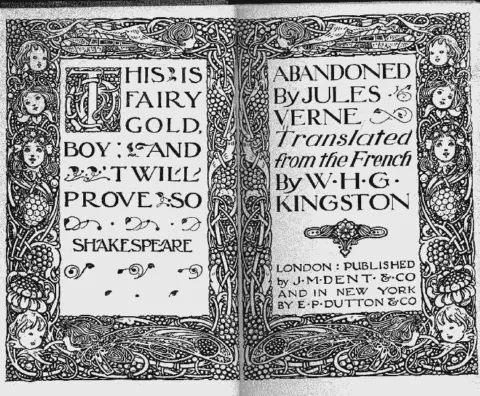
THE CLASSIC COLLECTION · 1915
"Abandoned" by Jules Verne is a novel serialized from August 1874 to September 1875. Five Union prisoners escape the American Civil War in a stolen balloon, only to crash on an uncharted volcanic island in the Pacific. Using ingenuity and engineering skills, they transform from castaways into colonists. But mysterious events suggest an unseen guardian watches over them. When pirates threaten their new home and secrets emerge from the island's depths, the survivors discover their refuge harbors an extraordinary connection to a legendary figure from the sea.
Introduction adapted from the source catalogue; source summaries may be automatically generated.
Free to read · English · 67,828 words · No account needed
MAKE TIME FOR A GOOD BOOK
On by default. Untick to stop anonymous reading totals. Each page counts after 10 seconds in view. How this works.
Anonymous counting is on unless you have switched it off.
From time to time, in certain places where the landing was easy, the canoe was stopped, when Gideon Spilett, Herbert, and Pencroft, their guns in their hands, and preceded by Top, jumped on shore. Without expecting game, some useful plant might be met with, and the young naturalist was delighted with discovering a sort of wild spinage, belonging to the order of chenopodiaceae, and numerous specimens of cruciferae, belonging to the cabbage tribe, which it would certainly be possible to cultivate by transplanting. There were cresses, horse-radish, turnips, and lastly, little branching hairy stalks, scarcely more than three feet high, which produced brownish grains.
"Do you know what this plant is?" asked Herbert of the sailor.
"Tobacco!" cried Pencroft, who evidently had never seen his favourite plant except in the bowl of his pipe.
"No, Pencroft," replied Herbert; "this is not tobacco, it is mustard."
"Mustard be hanged!" returned the sailor; "but if by chance you happen to come across a tobacco-plant, my boy, pray don't scorn that!"
"We shall find it some day!" said Gideon Spilett.
"Well!" exclaimed Pencroft, "when that day comes, I do not know what more will be wanting in our island!"
These different plants, which had been carefully rooted, up, were
carried to the canoe, where Cyrus Harding had remained buried in
thought.
The reporter, Herbert, and Pencroft in this manner frequently
disembarked, sometimes on the right bank, sometimes on the left bank
of the Mercy.
The latter was less abrupt, but the former more wooded. The engineer ascertained by consulting his pocket compass that the direction of the river from the first turn was obviously south-west and north-east, and nearly straight for a length of about three miles. But it was to be supposed that this direction changed beyond that point, and that the Mercy continued to the north-west, towards the spurs of Mount Franklin, among which the river rose.
During one of these excursions, Gideon Spilett managed to get hold of two couples of living gallinaceae. They were birds with long, thin beaks, lengthened necks, short wings, and without any appearance of a tail. Herbert rightly gave them the name of tinamons, and it was resolved that they should be the first tenants of their future poultry yard.
But till then the guns had not spoken, and the first report which awoke the echoes of the forest of the Far West was provoked by the appearance of a beautiful bird, resembling the kingfisher.
"I recognise him!" cried Pencroft, and it seemed as if his gun went
off by itself.
"What do you recognise?" asked the reporter.
Your reading position is saved on this browser. Take it to another device with a library code. Reading pages adapt to text, rather than matching a printed edition.
Jules Verne
Jules Verne
Jules Verne
Jules Verne
BEHIND THE BOOK
This eBook is for the use of anyone anywhere in the United States and most other parts of the world at no cost and with almost no restrictions whatsoever. You may copy it, give it away or re-use it under the terms of the Project Gutenberg License included with this eBook or online at www.gutenberg.org. If you are not located in the United States, you will have to check the laws of the country where you are located before using this eBook. Read the source licence.
The original source file, including credits and licence, is retained by this library. Request an original-format copy at no charge. Please include the book title and Project Gutenberg identifier #33516.
KEEP YOUR CURIOSITY GOING
Coulson Kernahan

Maurice Baring
Frances Wright
Cécile Tormay

Frederic Jesup Stimson

W. H. P. (William Henry Pope) Jarvis