THE CLASSIC COLLECTION✦Their island homeCLASSIC FREE BOOKS
Their island home
Jules Verne
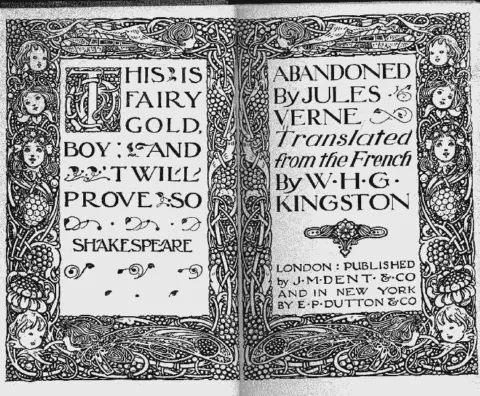
THE CLASSIC COLLECTION · 1915
"Abandoned" by Jules Verne is a novel serialized from August 1874 to September 1875. Five Union prisoners escape the American Civil War in a stolen balloon, only to crash on an uncharted volcanic island in the Pacific. Using ingenuity and engineering skills, they transform from castaways into colonists. But mysterious events suggest an unseen guardian watches over them. When pirates threaten their new home and secrets emerge from the island's depths, the survivors discover their refuge harbors an extraordinary connection to a legendary figure from the sea.
Introduction adapted from the source catalogue; source summaries may be automatically generated.
Free to read · English · 67,828 words · No account needed
MAKE TIME FOR A GOOD BOOK
On by default. Untick to stop anonymous reading totals. Each page counts after 10 seconds in view. How this works.
Anonymous counting is on unless you have switched it off.
"Captain," asked the sailor, "would it not be a good plan, before setting out, to build a canoe in which we could either ascend the river, or, if we liked, coast round the island? It will not do to be unprovided."
"Your idea is good, Pencroft," replied the engineer, "but we cannot wait for that. It would take at least a month to build a boat."
"Yes, a real boat," replied the sailor; "but we do not want one for a sea voyage, and in five days at the most, I will undertake to construct a canoe fit to navigate the Mercy."
"Five days," cried Neb, "to build a boat?"
"Yes, Neb; a boat in the Indian fashion."
"Of wood?" asked the negro, looking still unconvinced.
"Of wood," replied Pencroft, "or rather of bark. I repeat, captain, that in five days the work will be finished!"
"In five days, then, be it," replied the engineer.
"But till that time we must be very watchful," said Herbert.
"Very watchful indeed, my friends," replied Harding; "and I beg you to
confine your hunting excursions to the neighbourhood of Granite
House."
The dinner ended less gaily than Pencroft had hoped.
So, then, the island was, or had been, inhabited by others than the settlers. Proved as it was by the incident of the bullet, it was hereafter an unquestionable fact, and such a discovery could not but cause great uneasiness amongst the colonists.
Cyrus Harding and Gideon Spilett, before sleeping, conversed long about the matter. They asked themselves if by chance this incident might not have some connection with the inexplicable way in which the engineer had been saved, and the other peculiar circumstances which had struck them at different times. However Cyrus Harding, after having discussed the pros and cons of the question, ended by saying,--
"In short, would you like to know my opinion, my dear Spilett?"
"Yes, Cyrus."
"Well, then, it is this: however minutely we explore the island, we
shall find nothing."
The next day Pencroft set to work. He did not mean to build a boat with boards and planking, but simply a flat-bottomed canoe, which would be well suited for navigating the Mercy--above all, for approaching its source, where the water would naturally be shallow. Pieces of bark, fastened one to the other, would form a light boat; and in case of natural obstacles, which would render a portage necessary, it would be easily carried. Pencroft intended to secure the pieces of bark by means of nails, to insure the canoe being water-tight.
Your reading position is saved on this browser. Take it to another device with a library code. Reading pages adapt to text, rather than matching a printed edition.
Jules Verne
Jules Verne
Jules Verne
Jules Verne
BEHIND THE BOOK
This eBook is for the use of anyone anywhere in the United States and most other parts of the world at no cost and with almost no restrictions whatsoever. You may copy it, give it away or re-use it under the terms of the Project Gutenberg License included with this eBook or online at www.gutenberg.org. If you are not located in the United States, you will have to check the laws of the country where you are located before using this eBook. Read the source licence.
The original source file, including credits and licence, is retained by this library. Request an original-format copy at no charge. Please include the book title and Project Gutenberg identifier #33516.
KEEP YOUR CURIOSITY GOING
Coulson Kernahan

Maurice Baring
Frances Wright
Cécile Tormay

Frederic Jesup Stimson

W. H. P. (William Henry Pope) Jarvis