THE CLASSIC COLLECTION✦Their island homeCLASSIC FREE BOOKS
Their island home
Jules Verne
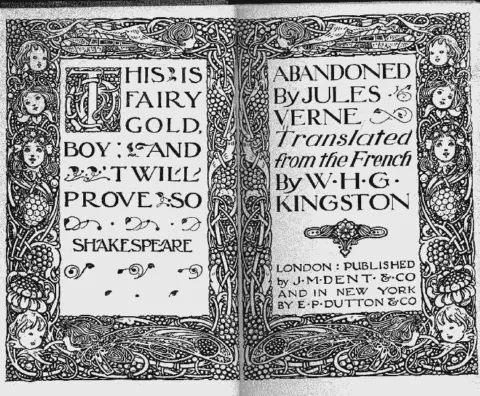
THE CLASSIC COLLECTION · 1915
"Abandoned" by Jules Verne is a novel serialized from August 1874 to September 1875. Five Union prisoners escape the American Civil War in a stolen balloon, only to crash on an uncharted volcanic island in the Pacific. Using ingenuity and engineering skills, they transform from castaways into colonists. But mysterious events suggest an unseen guardian watches over them. When pirates threaten their new home and secrets emerge from the island's depths, the survivors discover their refuge harbors an extraordinary connection to a legendary figure from the sea.
Introduction adapted from the source catalogue; source summaries may be automatically generated.
Free to read · English · 67,828 words · No account needed
MAKE TIME FOR A GOOD BOOK
On by default. Untick to stop anonymous reading totals. Each page counts after 10 seconds in view. How this works.
Anonymous counting is on unless you have switched it off.
It was real enjoyment to the settlers when in their room, well lighted with candles, well warmed with coal, after a good dinner, elder-berry coffee smoking in the cups, the pipes giving forth an odoriferous smoke, they could hear the storm howling without. Their comfort would have been complete, if complete comfort could ever exist for those who are far from their fellow creatures, and without any means of communication with them. They often talked of their country, of the friends whom they had left, of the grandeur of the American Republic, whose influence could not but increase, and Cyrus Harding, who had been much mixed up with the affairs of the Union, greatly interested his auditors by his recitals, his views, and his prognostics.
It chanced one day that Spilett was led to say,--
"But now, my dear Cyrus, all this industrial and commercial movement to which you predict a continual advance, does it not run the danger of being sooner or later completely stopped?"
"Stopped! And by what?"
"By the want of coal, which may justly be called the most precious of
minerals."
"Yes, the most precious indeed," replied the engineer; "and it would seem that nature wished to prove that it was so by making the diamond, which is simply pure carbon crystallised."
"You don't mean to say, captain," interrupted Pencroft, "that we burn diamonds in our stoves in the shape of coal?"
"No, my friend," replied Harding.
"However," resumed Gideon Spilett, "you do not deny that some day the coal will be entirely consumed?"
"Oh! the veins of coal are still considerable, and the hundred thousand miners who annually extract from them a hundred millions of hundredweights have not nearly exhausted them."
"With the increasing consumption of coal," replied Gideon Spilett, "it can be foreseen that the hundred thousand workmen will soon become two hundred thousand, and that the rate of extraction will be doubled."
"Doubtless, but after the European mines, which will be soon worked more thoroughly with new machines, the American and Australian mines will for a long time yet provide for the consumption in trade."
"For how long a time?" asked the reporter.
"For at least two hundred and fifty or three hundred years."
"That is reassuring for us, but a bad look-out for our great
grandchildren!" observed Pencroft.
"They will discover something else," said Herbert.
"It is to be hoped so," answered Spilett, "for without coal there would be no machinery, and without machinery there would be no railways, no steamers, no manufactories, nothing of that which is indispensable to modern civilisation!"
"But what will they find?" asked Pencroft. "Can you guess, captain?"
"Nearly, my friend."
Your reading position is saved on this browser. Take it to another device with a library code. Reading pages adapt to text, rather than matching a printed edition.
Jules Verne
Jules Verne
Jules Verne
Jules Verne
BEHIND THE BOOK
This eBook is for the use of anyone anywhere in the United States and most other parts of the world at no cost and with almost no restrictions whatsoever. You may copy it, give it away or re-use it under the terms of the Project Gutenberg License included with this eBook or online at www.gutenberg.org. If you are not located in the United States, you will have to check the laws of the country where you are located before using this eBook. Read the source licence.
The original source file, including credits and licence, is retained by this library. Request an original-format copy at no charge. Please include the book title and Project Gutenberg identifier #33516.
KEEP YOUR CURIOSITY GOING
Coulson Kernahan

Maurice Baring
Frances Wright
Cécile Tormay

Frederic Jesup Stimson

W. H. P. (William Henry Pope) Jarvis