THE CLASSIC COLLECTION✦Their island homeCLASSIC FREE BOOKS
Their island home
Jules Verne
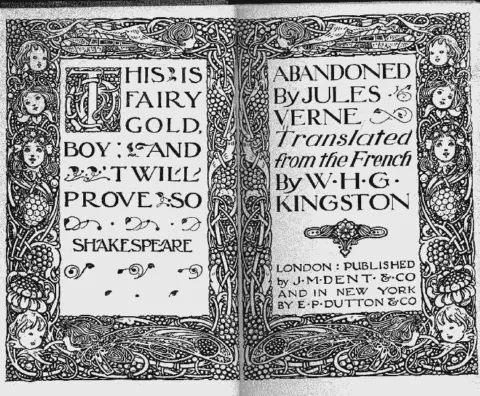
THE CLASSIC COLLECTION · 1915
"Abandoned" by Jules Verne is a novel serialized from August 1874 to September 1875. Five Union prisoners escape the American Civil War in a stolen balloon, only to crash on an uncharted volcanic island in the Pacific. Using ingenuity and engineering skills, they transform from castaways into colonists. But mysterious events suggest an unseen guardian watches over them. When pirates threaten their new home and secrets emerge from the island's depths, the survivors discover their refuge harbors an extraordinary connection to a legendary figure from the sea.
Introduction adapted from the source catalogue; source summaries may be automatically generated.
Free to read · English · 67,828 words · No account needed
MAKE TIME FOR A GOOD BOOK
On by default. Untick to stop anonymous reading totals. Each page counts after 10 seconds in view. How this works.
Anonymous counting is on unless you have switched it off.
"Then why venture there?"
"To know what is going on in Tabor Island."
"But nothing is going on there; nothing could happen there."
"Who knows?"
"And if you are caught in a hurricane?"
"There is no fear of that in the fine season," replied Pencroft. "But, captain, as we must provide against everything, I shall ask your permission to take Herbert only with me on this voyage."
"Pencroft," replied the engineer, placing his hand on the sailor's shoulder, "if any misfortune happens to you, or to this lad, whom chance has made our child, do you think we could ever cease to blame ourselves?"
"Captain Harding," replied Pencroft, with unshaken confidence, "we shall not cause you that sorrow. Besides, we will speak further of this voyage, when the time comes to make it. And I fancy, when you have seen our tight-rigged little craft, when you have observed how she behaves at sea, when we sail round our island, for we will do so together--I fancy, I say, that you will no longer hesitate to let me go. I don't conceal from you that your boat will be a masterpiece."
"Say 'our' boat, at least, Pencroft," replied the engineer, disarmed for the moment. The conversation ended thus, to be resumed later on, without convincing either the sailor or the engineer.
The first snow fell towards the end of the month of June. The corral had previously been largely supplied with stores, so that daily visits to it were not requisite; but it was decided that more than a week should never be allowed to pass without some one going to it.
Traps were again set, and the machines manufactured by Harding were tried. The bent whalebones, imprisoned in a case of ice, and covered with a thick outer layer of fat, were placed on the border of the forest at a spot where animals usually passed on their way to the lake.
To the engineer's great satisfaction, this invention, copied from the Aleutian fishermen, succeeded perfectly. A dozen foxes, a few wild boars, and even a jaguar, were taken in this way, the animals being found dead, their stomachs pierced by the unbent bones.
An incident must here be related, not only as interesting in itself, but because it was the first attempt made by the colonists to communicate with the rest of mankind.
Gideon Spilett had already several times pondered whether to throw into the sea a letter enclosed in a bottle, which currents might perhaps carry to an inhabited coast, or to confide it to pigeons.
Your reading position is saved on this browser. Take it to another device with a library code. Reading pages adapt to text, rather than matching a printed edition.
Jules Verne
Jules Verne
Jules Verne
Jules Verne
BEHIND THE BOOK
This eBook is for the use of anyone anywhere in the United States and most other parts of the world at no cost and with almost no restrictions whatsoever. You may copy it, give it away or re-use it under the terms of the Project Gutenberg License included with this eBook or online at www.gutenberg.org. If you are not located in the United States, you will have to check the laws of the country where you are located before using this eBook. Read the source licence.
The original source file, including credits and licence, is retained by this library. Request an original-format copy at no charge. Please include the book title and Project Gutenberg identifier #33516.
KEEP YOUR CURIOSITY GOING
Coulson Kernahan

Maurice Baring
Frances Wright
Cécile Tormay

Frederic Jesup Stimson

W. H. P. (William Henry Pope) Jarvis