
Letters of Marque
Rudyard Kipling
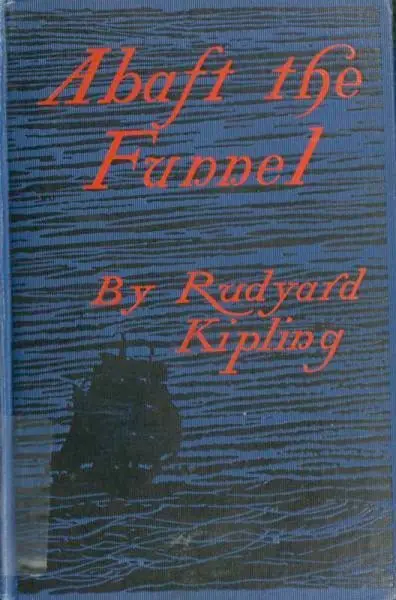
THE CLASSIC COLLECTION · 1909
"Abaft the Funnel" by Rudyard Kipling is a collection of short stories written in the early 20th century. This compilation features tales primarily set in maritime environments, reflecting Kipling's observations and experiences from his time spent in the British Raj and on the high seas. The stories include vibrant characters and scenarios that explore themes of adventure, humor, and the human condition, emphasizing the nuances of life aboard ships and in colonial settings. At the start of the book, readers are introduced to a range of lively characters aboard various ships, including a humorous incident involving a cat named Erastasius who has a penchant for mischief. The narrative delves into the day-to-day life aboard the ship "Whanghoa", showcasing the interactions between the crew and passengers, along with the cat’s amusing antics. Kipling sets a tone that blends quirky humor with vivid storytelling, striking a balance between light-heartedness and deeper reflections on the lives of those at sea. This opening portion captivates readers with its charm and invites them to delve into more tales that promise a mix of adventure and insight.
Introduction adapted from the source catalogue; source summaries may be automatically generated.
Free to read · English · 61,171 words · No account needed
MAKE TIME FOR A GOOD BOOK
On by default. Untick to stop anonymous reading totals. Each page counts after 10 seconds in view. How this works.
Anonymous counting is on unless you have switched it off.
"Yes," said he in an awestricken whisper. "That is my desire."
"Also," said I, "you love, excessively, in several places at once
cooks, housemaids, governesses, schoolgirls, and the aunts of other
people."
"But one only," said he, and the pink deepened to beetroot.
"Consequently," said I, "you have written much--you have written
verses."
"It was to teach me to write prose, only to teach me to write prose," he murmured. "You do it yourself, because I have bought your works--all your works."
He spoke as if he had purchased dunghills en bloc.
"We will waive that question," I said loftily. "Produce the verses."
"They--they aren't exactly verses," said the young man, plunging his
hand into his bosom.
"I beg your pardon, I meant will you be good enough to read your
five-act tragedy."
"How--how in the world did you know?" said the young man, more
impressed than ever.
He unearthed his tragedy, the title of which I have given, and began to read. I felt as though I were walking in a dream; having been till then ignorant of the fact that earth held young men who held five-act tragedies in their insides. The young man gave me the whole of the performance, from the preliminary scene, where nothing more than an eruption of Vesuvius occurs to mar the serenity of the manager, till the very end, where the Roman sentry of Pompeii is slowly banked up with ashes in the presence of the audience, and dies murmuring through his helmet-vizor: "S.P.Q.R.R.I.P.R.S.V.P.," or words to that effect.
For three hours and one-half he read to me. And then I made a mistake.
"Sir," said I, "who's your Ma and Pa?"
"I haven't got any," said he, and his lower lip quivered.
"Where do you live?" I said.
"At the back of Tarporley Mews," said he.
"How?" said I.
"On eleven shillings a week," said he.
"I was pretty well educated, and if you don't stay too long they will let you read the books in the Holywell Street stalls."
"And you wasted your money buying my books," said I with a lump the size of a bolster in my throat.
"I got them second-hand, four and sixpence," said he, "and some I
borrowed."
Then I collapsed. I didn't weep, but I took the tragedy and put it in the fire, and called myself every name that I knew.
This caused the young man to sob audibly, partly from emotion and
partly from lack of food.
Your reading position is saved on this browser. Take it to another device with a library code. Reading pages adapt to text, rather than matching a printed edition.
Rudyard Kipling

Rudyard Kipling
Rudyard Kipling

Rudyard Kipling
BEHIND THE BOOK
This eBook is for the use of anyone anywhere in the United States and most other parts of the world at no cost and with almost no restrictions whatsoever. You may copy it, give it away or re-use it under the terms of the Project Gutenberg License included with this eBook or online at www.gutenberg.org. If you are not located in the United States, you will have to check the laws of the country where you are located before using this eBook. Read the source licence.
The original source file, including credits and licence, is retained by this library. Request an original-format copy at no charge. Please include the book title and Project Gutenberg identifier #59332.
KEEP YOUR CURIOSITY GOING
Coulson Kernahan

Maurice Baring
Frances Wright
Cécile Tormay

Frederic Jesup Stimson

W. H. P. (William Henry Pope) Jarvis