THE CLASSIC COLLECTION✦The Disappearing EyeCLASSIC FREE BOOKS
The Disappearing Eye
Fergus Hume
THE CLASSIC COLLECTION · 1900
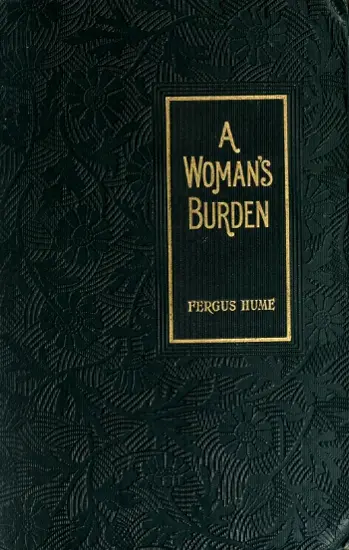
"A Woman's Burden: A Novel" by Fergus Hume is a work of fiction likely written in the late 19th century. The novel opens with a dramatic scene on Waterloo Bridge, where various characters are thrust into a dark and gritty narrative marked by themes of poverty, desperation, and crime. The central character introduced in this opening is Miriam, a woman of poverty who intervenes to save an elderly gentleman from an attempted robbery by a man named Jabez, setting off a chain of events that involves crime, survival, and complex human dynamics. At the start of the story, the atmosphere on Waterloo Bridge is thick with fog and foreboding, reflecting the struggles of the city's downtrodden. Miriam's selfless act of saving the gentleman from a dire fate reveals not only her physical bravery but also hints at deeper struggles and motivations tied to her relationship with Jabez. The gentleman, later revealed to be Mr. Barton, becomes intrigued by Miriam and offers her assistance, which introduces a tension-filled relationship filled with mutual reliance and latent conflict. This prologue sets the stage for a narrative woven around themes of social class, moral ambiguity, and the burdens carried by women like Miriam, suggesting her complex journey ahead in a world rife with challenges.
Introduction adapted from the source catalogue; source summaries may be automatically generated.
Free to read · English · 94,925 words · No account needed
MAKE TIME FOR A GOOD BOOK
On by default. Untick to stop anonymous reading totals. Each page counts after 10 seconds in view. How this works.
Anonymous counting is on unless you have switched it off.
"Be sure of that before you marry either of them," said the anxious mother. "Unless," with a touch of romance, "you are in love with----"
"Love!" Hilda echoed the word with fine contempt. "I want money, not love. Either Major Dundas or Gerald would make a good enough husband. I like Gerald the best--he is better looking and not so dull as the Major. But I'd marry anyone--even old Barton, much as I hate him, to get out of this pig-sty."
"It is your only home," said Mrs. Marsh with dignity.
"That's exactly why I want to get out of it, mother. If that red-haired governess tries any of her pranks, trust me, I won't spare her."
"Whatever do you mean, Hilda?"
"Never you mind, mother," Miss Marsh nodded mysteriously. "I've been talking with Mrs. Darrow, and she says--well, don't bother about it just now. But Miss Crane--if that is what her name is--is no saint, believe me. I'm not altogether sure that she's respectable."
"Hilda!" Mrs. Marsh's middle-class virtue was up in arms. "If that is so, you must not associate with her. Our house is lowly (she might have added dirty), lowly, but genteel."
"Now don't you bother, ma. Leave the governess to me. If you talk you'll
spoil all."
"All what?" cried Mrs. Marsh, frantic with curiosity.
"H'm, h'm," Hilda nodded again. "Come upstairs, ma, and look over my dresses. I must look particularly well to-morrow night."
"But the clearing and washing-up, Hilda?"
"Oh, the girls can do that when they come in; pigs! It's little enough
they do!"
"Your father will want something hot," suggested Mrs. Marsh with
compunction.
"Will he! Well, there's cold corned beef and pickles; he can warm them
if he likes."
So Mrs. Marsh went upstairs, novel, dressing-gown and all, and spent a happy hour with Hilda over chiffons. Dr. Marsh came home to a cold dinner, and was truly pathetic in the restraint of his language. The picnic-party arrived back hungry and boisterous, to find that as the baker had not called, there was no bread in the house. They lamented, Mrs. Marsh nagged, her husband's patience gave way, and the whole house was as pleasant as Bedlam. Hilda, the cause of the trouble, kept out of it in her room--the only clean room in the house--and stitched away at her costume. She thought of Miriam and smiled. It was not a sweet smile.
"So you're going to spoil my chance, are you, you horrid creature!" she thought. "I'll push you back into the mud you came from--or I'll know the reason why."
Your reading position is saved on this browser. Take it to another device with a library code. Reading pages adapt to text, rather than matching a printed edition.
Fergus Hume

Fergus Hume

Fergus Hume
Fergus Hume
BEHIND THE BOOK
This eBook is for the use of anyone anywhere in the United States and most other parts of the world at no cost and with almost no restrictions whatsoever. You may copy it, give it away or re-use it under the terms of the Project Gutenberg License included with this eBook or online at www.gutenberg.org. If you are not located in the United States, you will have to check the laws of the country where you are located before using this eBook. Read the source licence.
The original source file, including credits and licence, is retained by this library. Request an original-format copy at no charge. Please include the book title and Project Gutenberg identifier #35240.
KEEP YOUR CURIOSITY GOING
Coulson Kernahan

Maurice Baring
Frances Wright
Cécile Tormay

Frederic Jesup Stimson

W. H. P. (William Henry Pope) Jarvis