THE CLASSIC COLLECTION✦The Disappearing EyeCLASSIC FREE BOOKS
The Disappearing Eye
Fergus Hume
THE CLASSIC COLLECTION · 1900
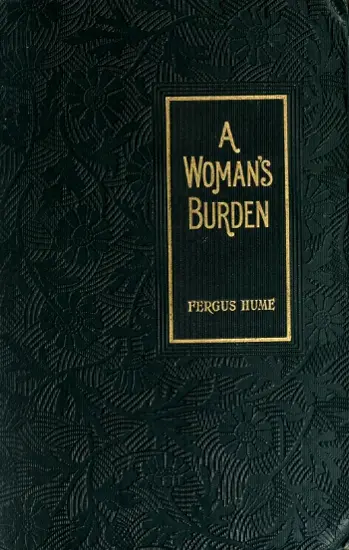
"A Woman's Burden: A Novel" by Fergus Hume is a work of fiction likely written in the late 19th century. The novel opens with a dramatic scene on Waterloo Bridge, where various characters are thrust into a dark and gritty narrative marked by themes of poverty, desperation, and crime. The central character introduced in this opening is Miriam, a woman of poverty who intervenes to save an elderly gentleman from an attempted robbery by a man named Jabez, setting off a chain of events that involves crime, survival, and complex human dynamics. At the start of the story, the atmosphere on Waterloo Bridge is thick with fog and foreboding, reflecting the struggles of the city's downtrodden. Miriam's selfless act of saving the gentleman from a dire fate reveals not only her physical bravery but also hints at deeper struggles and motivations tied to her relationship with Jabez. The gentleman, later revealed to be Mr. Barton, becomes intrigued by Miriam and offers her assistance, which introduces a tension-filled relationship filled with mutual reliance and latent conflict. This prologue sets the stage for a narrative woven around themes of social class, moral ambiguity, and the burdens carried by women like Miriam, suggesting her complex journey ahead in a world rife with challenges.
Introduction adapted from the source catalogue; source summaries may be automatically generated.
Free to read · English · 94,925 words · No account needed
MAKE TIME FOR A GOOD BOOK
On by default. Untick to stop anonymous reading totals. Each page counts after 10 seconds in view. How this works.
Anonymous counting is on unless you have switched it off.
"If my new governess isn't pretty, like Hilda, I don't want her," said Dicky, when his mother had wailed herself into a state of momentary passiveness. "I don't like ugly people."
"Would you like me to teach you, Dicky?" laughed Hilda.
"Oh, yes; we could read 'Robinson Crusoe' together!"
"I'm afraid that's not a lesson book, Dicky."
But Dicky insisted that Defoe was better than any lesson book.
"Lesson books make my head ache," he said; "and I learn a lot of hard words in 'Robinson Crusoe' without thinking. Why can't lesson books be nice like that?"
"You little imp," burst out his mother furiously; "the idea of talking about what you like. You'll be taught by a black woman if I choose; and I'll burn all those rubbishy story-books."
Thus did Mrs. Darrow, who had read nothing but society journals and fashion magazines, blend discipline with criticism.
"I never saw such a child," she wailed; "he's not a bit like me. Oh, Dicky, Dicky, why haven't you your mother's sweet disposition and sweet temper?"
Before Dicky could reply to this truly overwhelming question, to which but one answer was expected, a dried-up little man appeared at the French window opening on to the lawn, and stepped into the room. Hilda half rose to fly from her arch enemy, but being caught, decided it would be undignified to retreat. So she resumed her seat and talked in low tones to Dicky. Mrs. Darrow still lay on her sofa, and welcomed the stranger in the faintest of low tones, meant to be expressive of great weakness.
"How are you, Uncle Barton," she said. "I can hardly speak, I am so
ill."
"I know, I know," rasped out the cynic grimly. "I heard you talking to Dicky, no wonder you can't chatter now."
"I must do my duty to my child," cried Mrs. Darrow with more energy, "even though my health suffers."
Mr. Barton surveyed the plump recumbent figure with grim humour.
"You feel your parental duties too much, Julia, they will wear you out. How do you do, Miss Marsh? I see you and Julia have been spoiling your digestions with strong tea. Muffins too! Oh, Lord, think of your complexions!"
Hilda laughed, and glanced into a near mirror. Her complexion was her strong point, and she had no fear of its being criticised even by disagreeable Mr. Barton.
"I'm afraid my appetite is stronger than my vanity," she said.
"Then you must have the appetite of an ostrich," growled Barton, sitting down near his niece; "but Julia, poor dear, eats nothing."
"That I don't," murmured Mrs. Darrow. "I peck like a bird."
Your reading position is saved on this browser. Take it to another device with a library code. Reading pages adapt to text, rather than matching a printed edition.
Fergus Hume

Fergus Hume

Fergus Hume
Fergus Hume
BEHIND THE BOOK
This eBook is for the use of anyone anywhere in the United States and most other parts of the world at no cost and with almost no restrictions whatsoever. You may copy it, give it away or re-use it under the terms of the Project Gutenberg License included with this eBook or online at www.gutenberg.org. If you are not located in the United States, you will have to check the laws of the country where you are located before using this eBook. Read the source licence.
The original source file, including credits and licence, is retained by this library. Request an original-format copy at no charge. Please include the book title and Project Gutenberg identifier #35240.
KEEP YOUR CURIOSITY GOING
Coulson Kernahan

Maurice Baring
Frances Wright
Cécile Tormay

Frederic Jesup Stimson

W. H. P. (William Henry Pope) Jarvis