THE CLASSIC COLLECTION✦Judith LeeCLASSIC FREE BOOKS
Judith Lee
Richard Marsh
THE CLASSIC COLLECTION · 1907
"A Woman Perfected" by Richard Marsh is a novel written in the early 20th century. The story centers around the characters Donald Lindsay, who suffers a sudden stroke, and his daughter Nora, who is left to navigate the aftermath of her father's condition and the mysteries of their family life. As events unfold, the narrative delves into themes of male paternal control, the complications of wealth and social standing, and the complexities of personal relationships. At the start of the book, we witness a poignant scene where Donald Lindsay collapses after exhibiting unusual behavior, sparking concern among his daughter Nora and her friend, Elaine. The gravity of the situation escalates as they discover he is incapacitated in his study, having been engaged in mysterious, secretive activities before his collapse. The opening establishes a sense of foreboding as Nora becomes increasingly aware of her father's hidden life and the lack of communication about his affairs, primarily concerning the wealth and security he is supposed to provide her. From this point, the story hints at deeper secrets entwined with Donald's character, foreshadowing a narrative rich in suspense and intrigue surrounding family dynamics and social expectations.
Introduction adapted from the source catalogue; source summaries may be automatically generated.
Free to read · English · 95,301 words · No account needed
MAKE TIME FOR A GOOD BOOK
On by default. Untick to stop anonymous reading totals. Each page counts after 10 seconds in view. How this works.
Anonymous counting is on unless you have switched it off.
"Thank you, sir. Will you see her to-morrow morning?"
"Look here, Mr. Gibb, are you trying to bustle me?"
"Well,' sir, you see she's pawning her things----"
"Pawning her things! and you say she's a lady."
"Yes, sir, she is pawning her things, and she is a lady; and it's because I've reason to know that she may have to pawn something else either to-day or to-morrow that I've mentioned her to you at all; because when she's pawned all she's got what will she do?"
"Do you want me to lend her some money? or to give her some?"
Mr. Gibb smiled.
"When you've seen her, sir, you won't need to ask me that. Then you'll see her to-morrow morning?"
"Now don't you go putting any false hopes in her head, you'll only be doing her a disservice if you do; nothing will come of my seeing her, I'm only doing it to oblige you; let that be clearly understood."
"Yes, sir; thank you very much."
When Mr. Gibb got home he rushed straight up to Miss Lindsay, who was commencing the nondescript apology for a meal which served her as tea and supper.
"Miss Lindsay, I believe I've found you something which may lead to
something."
"Oh, Eustace! have you? what is it?"
"It's my chief." Mr. Gibb never would refer to him as "governor," as other clerks did; he thought it vulgar. "It's Mr. Hooper!"
"Mr. Hooper?"
"I happened to mention to him to-day that you were looking out for a secretaryship, and he said would you call round and see him to-morrow morning."
"Oh, Eustace! how shall I ever thank you? Is it for himself he wants a
secretary?"
"That I can't say; but if you'll take my advice you'll call and see
him."
"Of course I'll call and see him; I'm--I'm all trembling! as if I wouldn't call and see him! Do you think I've any chance?"
"That also I can't say; but if you'll allow me to give you what I
should describe as a hint----"
"Please do! What is it? You are so clever!"
"If I were you I should put on your prettiest frock, and your prettiest hat, and the prettiest everything you've got."
"Eustace! Why?"
Mr. Gibb put his hand up to his mouth, and coughed discreetly.
"Fact is, Mr. Hooper's more of an eye for female beauty than he
thinks, and if you come to him looking as I've seen you look, you'll
knock him."
"Knock him?"
Mr. Gibb was apologetic.
"It's not often that I do use words of that kind, but, asking your
pardon, this time I mean it."
Your reading position is saved on this browser. Take it to another device with a library code. Reading pages adapt to text, rather than matching a printed edition.
Richard Marsh
Richard Marsh
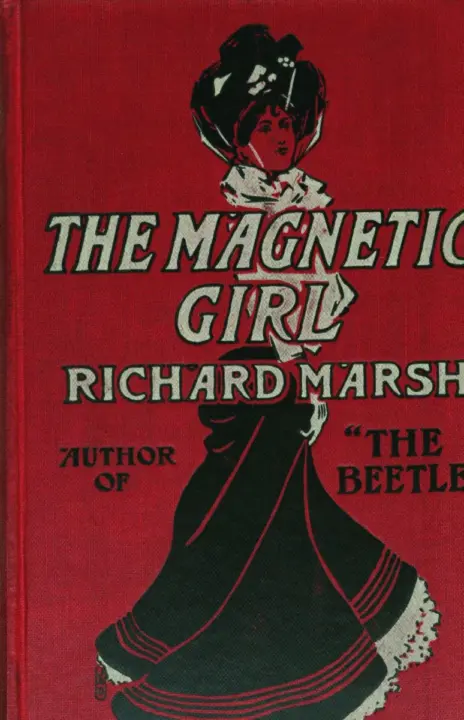
Richard Marsh
Richard Marsh
BEHIND THE BOOK
This eBook is for the use of anyone anywhere in the United States and most other parts of the world at no cost and with almost no restrictions whatsoever. You may copy it, give it away or re-use it under the terms of the Project Gutenberg License included with this eBook or online at www.gutenberg.org. If you are not located in the United States, you will have to check the laws of the country where you are located before using this eBook. Read the source licence.
The original source file, including credits and licence, is retained by this library. Request an original-format copy at no charge. Please include the book title and Project Gutenberg identifier #38181.
KEEP YOUR CURIOSITY GOING
Coulson Kernahan

Maurice Baring
Frances Wright
Cécile Tormay

Frederic Jesup Stimson

W. H. P. (William Henry Pope) Jarvis