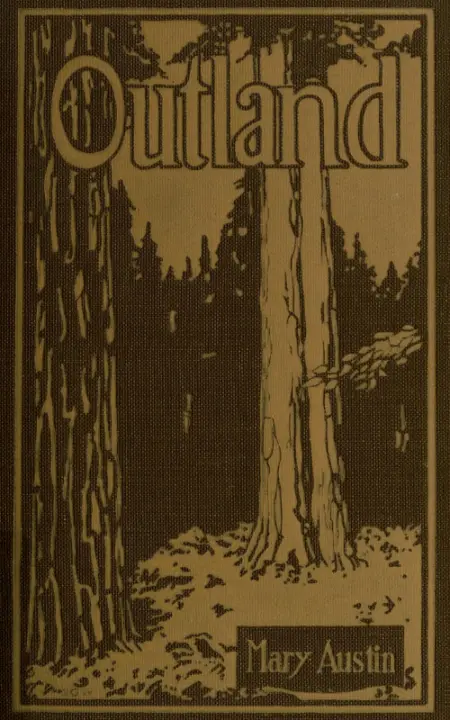
Outland
Mary Austin
THE CLASSIC COLLECTION · 1912
"A Woman of Genius" by Mary Austin is a novel crafted in the early 20th century. The narrative introduces Olivia Lattimore, whose life becomes a canvas for exploring the complexities of womanhood, creativity, and societal expectations in a small Midwestern town. The book delves into Olivia’s struggles with her identity and artistic aspirations, highlighting her relationships and the social constraints that shape her journey. The opening of the novel establishes a reflective tone as Olivia grapples with her past and her connection to Pauline Mills, a figure who embodies societal norms and expectations. Olivia contemplates the nature of genius, personal sacrifice, and the tumultuous path of self-discovery, setting the stage for her narrative that weaves through childhood experiences, familial relationships, and the haunting shadow of her father’s death. The early chapters hint at her artistic inclinations and the societal pressures that threaten to stifle her genius, inviting readers into a profound exploration of the personal and social dynamics at play.
Introduction adapted from the source catalogue; source summaries may be automatically generated.
Free to read · English · 123,474 words · No account needed
MAKE TIME FOR A GOOD BOOK
On by default. Untick to stop anonymous reading totals. Each page counts after 10 seconds in view. How this works.
Anonymous counting is on unless you have switched it off.
It must have been about eleven of the clock, while I was watching the little puffs of dust that rose between the planks of the flooring whenever the building shuddered and ground its teeth, divided between an affectation of timorousness which seemed to grow in favour as a suitable frame of behaviour, and the rapid rise of every tingling sense to the spacious movement of the weather and my private dramatization of the demolition of the building, from which only such occupants as I favoured should be rescued by my signal behaviour. Already several children had been abstracted by anxious parents, so that I failed to be even startled by another knocking until my attention was attracted by the teacher opening the door, and opening it wide upon my Uncle Alva.
I saw him step back with a motion of his head sidewise, to draw her after him, but it took all the suggestive nods and winks that, as she drew it shut behind her, were focussed on my desk, to pull me up to the realization that his visit must have something to do with me. It was not, in fact, until I was halfway down the aisle after Miss Jessel called me, that I recovered my surprise sufficiently to assume the mysteriously important air that was proper to the fifth grade on being privileged to answer the door.
There was not, I am sure, in the brief information that I was wanted at home, one betraying syllable; nothing sufficiently unusual in the way Miss Jessel tied me into my hood, nor in finding Effie tied into hers on the first floor, nor in the way her teacher kissed her--everybody kissed Effie who was allowed--nothing in Forester's having already cleared out without waiting for us. We got into the town in the wake of Uncle Alva and between the business blocks where the tall buildings abated the wind. There was no traffic in the streets that day. Here and there a foot passenger with his hat held down by both hands and his coat tails between his legs, staggered into doorways which were snapped to behind him, and from the glass of which faces looked out featureless in the blur of the wind. As we passed the side door of a men's clothing establishment one of these pale human orbs approached to the pane, exhibited a peering movement, rapped on the glass and beckoned. I know now this must have been the working of an instinct to which Taylorville was so habituated that it seemed natural to Uncle Alva--he was only my mother's half brother, not my father's--to send us on with a word about overtaking us, while he crossed the street at the instance of that beckoning finger to be chaffered with in the matter of my father's grave clothes. All this time there was not a word spoken that could convey to us children the import of our unexpected release. We drifted down the street, Effie and I, sidling against the blasts that drove furiously in the crossways, and finally as we caught our breath under a long red sandstone building, I recall being taken violently, as it were, by knowledge, and crying out that my father was dead, that he was dead and I should never see him again. I do not know how I knew, but I knew, and Effie accepted it; she came cuddling up to me in the smother of the wind, trying to comfort me as if, as I think did not occur to her, he had been my father only and not hers at all. I do not recall very well how we got across the town between the shut houses, high shouldered with the cold, except that Uncle Alva did not come up with us, and the vast lapping of the wind that swirled us together at intervals in a community of breathlessness, seemed somehow to have grown out of the occasion and be naturally commensurate with its desolating quality. I do not think it occurred to us as strange that we should have been left so to come to the knowledge that grew until, as we came in sight of our home, we were fairly taken aback to find it so little altered from what it had been when we left it three hours before. It had never been an attractive house: yellow painted, with chocolate trimmings and unshuttered windows against which the wind contrived. It cowered in a wide yard full of unpruned maples that now held up their limbs protestingly, that shook off from their stretched boughs, disclaimers of responsibility; the very smoke wrenched itself from the chimney and escaped, hurryingly upon the wind; the shrubbery wrung itself; whole flights of fallen leaves that had settled soddenly beside the borders all the winter, having at last got a plain sight of it, whirled up aghast and fled along the road. The blinds were down at the front windows, and no one came in or out.
Your reading position is saved on this browser. Take it to another device with a library code. Reading pages adapt to text, rather than matching a printed edition.
Mary Austin
Mary Austin
Mary Austin
Mary Austin
BEHIND THE BOOK
This eBook is for the use of anyone anywhere in the United States and most other parts of the world at no cost and with almost no restrictions whatsoever. You may copy it, give it away or re-use it under the terms of the Project Gutenberg License included with this eBook or online at www.gutenberg.org. If you are not located in the United States, you will have to check the laws of the country where you are located before using this eBook. Read the source licence.
The original source file, including credits and licence, is retained by this library. Request an original-format copy at no charge. Please include the book title and Project Gutenberg identifier #38592.
KEEP YOUR CURIOSITY GOING
Coulson Kernahan

Maurice Baring
Frances Wright
Cécile Tormay

Frederic Jesup Stimson

W. H. P. (William Henry Pope) Jarvis