
Last letters from the living dead man
David Patterson (Spirit) Hatch
THE CLASSIC COLLECTION · 1916
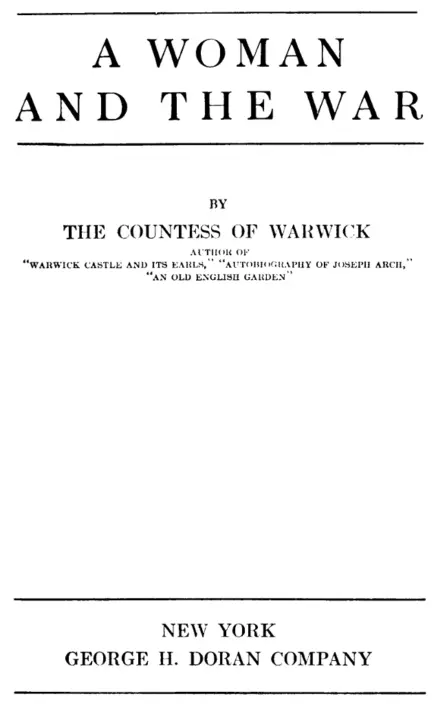
"A Woman and the War" by the Countess of Warwick is a collection of essays written during the early 20th century, specifically reflecting on the societal impacts of World War I. The book provides a woman's perspective on the challenges and sacrifices faced during wartime, touching upon themes such as social reform, women’s roles, and the critique of political authority. The author draws upon her experiences and insights to voice concerns regarding the war's influence on society, particularly the implications for women and the working class. The opening of the work introduces the Countess's preface, where she reflects on the tumultuous period of war and its effects on governance and freedom. She expresses a strong belief in the citizens' need to remain vigilant and critical of their leaders, arguing against the blind loyalty often fostered during wartime propaganda. The initial chapter begins a detailed discussion about King Edward and the Kaiser, representing her intent to debunk misconceptions about historical relationships between England and Germany leading up to the war, positioning the book as a critical reflection on political narratives and the necessity for greater citizen awareness and action amidst crisis.
Introduction adapted from the source catalogue; source summaries may be automatically generated.
Free to read · English · 60,528 words · No account needed
MAKE TIME FOR A GOOD BOOK
On by default. Untick to stop anonymous reading totals. Each page counts after 10 seconds in view. How this works.
Anonymous counting is on unless you have switched it off.
I have long been cognisant of the two great forces that were working, side by side though independently, to destroy Anglo-American friendship. The first was Irish-American resentment, a perfectly natural expression of feeling. Home Rule for Ireland was the only possible permanent cure, and the time for palliatives has long passed. With the coming of the cure we may look for the end of the complaint. The other force was more subtle, and was founded upon the presence in the States of tens of thousands of the Kaiser's subjects. They have carried across the Atlantic their old mischievous motto, "Deutschland über Alles," and have lost no opportunity of giving it effect. A powerful press, a great financial group, direct encouragement from the Kaiser, whose policy--a relic of Bismarck's day--was to sow ill-will between Great Britain and the United States under all circumstances, have been their weapons. To conciliate the States, to flatter them, to suggest that they needed German help against British intrigue, to show their leading representatives every courtesy, even to affect a sympathy with democracy, all this was the part of a settled programme. It lacked nothing but success.
This is not the time to go into details of deliberate attempts made to undermine Anglo-American good will. On a more fitting occasion I may reveal some. At the moment it does not seem right to increase the prevailing bitterness, but I may say that many social intrigues have come to my own notice and have left me wondering at Teuton pertinacity, at the persistence with which large and small matters alike are pursued, and at the curious psychological failing that nearly always loses count of the human element. Theoretically, logically perhaps, the German advances should have been entirely successful. Unhappily for the Kaiser's ambitions, it was always fairly obvious that behind every courtesy, however extravagant, behind every diplomatic action, however grave or trivial, there lay an Anglophobe bias. It was not perhaps always conscious to its originators; the state of mind towards Great Britain in Germany is largely inherited, and I sometimes think it is well-nigh sub-conscious. Indeed, I would venture the proposition that it is more obvious to an American than it is to the German possessors of it. The United States is of course the world's melting pot; happily for us, and I think for the world at large, the Anglo-Saxon element is dominant. In such an environment Anglophobia cannot thrive, and I think the Kaiser's representatives have mistaken the actualities of the situation. Anglo-American squabbles are the little family quarrels with which we are all familiar; if one were to come from the outside and seek to take part in them, he would soon learn that such an intrusion was unwarranted and unwelcome. Instead of extending the area of the original quarrel it would reduce it to vanishing point. In Anglo-American relations the Kaiser must remain an "outsider," accepted while he behaves himself, but known all the time for the representative of a proud, powerful nation that is avid of world power and will shrink from no effort to obtain it, a nation that, if it is to be judged by its rulers, holds that the result justifies the cause, and that kindness, deceit, generosity, cajolery, persuasion, threats, candour, and deceit are all weapons that find a proper place in the armoury of a subtle diplomacy and may be called upon in turn. There is a world in which this standard of things passes current, the world of the company promoter, the international financier, the Jesuit who holds that the end justifies if it cannot sanctify. On the other hand, all these mental processes are abhorrent to the Anglo-Saxon. He is by nature plain and blunt, subtleties are foreign to him. It is his ambition to play the game, and he requires the game to be clean that it may be worth the playing. He likes to place his cards on the table, you will not find them in his sleeve or his boot. We know that the sowing of mistrust between the United States and Great Britain has been one of the chief pre-occupations of German diplomacy, we know too that it has failed as signally as the early and vital attacks upon the Liége forts failed. To accomplish its destiny the Anglo-Saxon race must stand together. We need not interfere in each other's quarrels, we need not model our lives to a pattern that is not sanctified by use and custom, but we will not allow any other nation to come between us and our friendship, or to interfere with that slow, sure growth of understanding and good feeling that may bring to generations unborn the blessing of universal good-fellowship and peace.
Your reading position is saved on this browser. Take it to another device with a library code. Reading pages adapt to text, rather than matching a printed edition.
BEHIND THE BOOK
This eBook is for the use of anyone anywhere in the United States and most other parts of the world at no cost and with almost no restrictions whatsoever. You may copy it, give it away or re-use it under the terms of the Project Gutenberg License included with this eBook or online at www.gutenberg.org. If you are not located in the United States, you will have to check the laws of the country where you are located before using this eBook. Read the source licence.
The original source file, including credits and licence, is retained by this library. Request an original-format copy at no charge. Please include the book title and Project Gutenberg identifier #63910.
KEEP YOUR CURIOSITY GOING
David Patterson (Spirit) Hatch

David Patterson (Spirit) Hatch

David Patterson (Spirit) Hatch
Cécile Tormay

Moritz Busch
John L. Ransom