
Last letters from the living dead man
David Patterson (Spirit) Hatch
THE CLASSIC COLLECTION · 1916
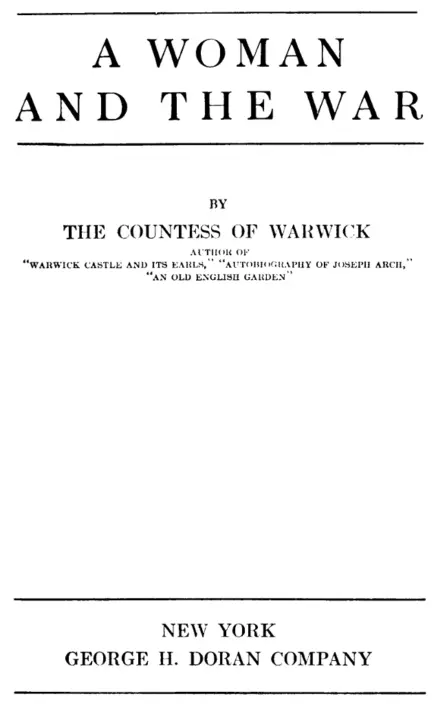
"A Woman and the War" by the Countess of Warwick is a collection of essays written during the early 20th century, specifically reflecting on the societal impacts of World War I. The book provides a woman's perspective on the challenges and sacrifices faced during wartime, touching upon themes such as social reform, women’s roles, and the critique of political authority. The author draws upon her experiences and insights to voice concerns regarding the war's influence on society, particularly the implications for women and the working class. The opening of the work introduces the Countess's preface, where she reflects on the tumultuous period of war and its effects on governance and freedom. She expresses a strong belief in the citizens' need to remain vigilant and critical of their leaders, arguing against the blind loyalty often fostered during wartime propaganda. The initial chapter begins a detailed discussion about King Edward and the Kaiser, representing her intent to debunk misconceptions about historical relationships between England and Germany leading up to the war, positioning the book as a critical reflection on political narratives and the necessity for greater citizen awareness and action amidst crisis.
Introduction adapted from the source catalogue; source summaries may be automatically generated.
Free to read · English · 60,528 words · No account needed
MAKE TIME FOR A GOOD BOOK
On by default. Untick to stop anonymous reading totals. Each page counts after 10 seconds in view. How this works.
Anonymous counting is on unless you have switched it off.
To any mortal such persecution had been fatal, but Truth is immortal and persists. Not even the Jews whose sufferings are eternal, or the Belgians, Poles, Armenians, Servians, and others whose persecution though intolerable is temporary, strive to recover their vanished freedom as resolutely as Truth. The harder you use it, the greater its persistence. Drive it out at the door it returns by the window, an indefatigable, untiring immortal, seemingly unconscious of the loss of popularity, convinced that it has a place in the great scheme of things. It whispers to kings on their thrones, and to chancellors in their studies, to statesmen on Government and opposition benches, to clergymen in their pulpits, lawyers in their consulting rooms; passing by janitor, secretary, and a sub-editorial array, it even invades the editor's desk, persistent though ignored. Trampled upon, cast aside, ignored, eviscerated, turned inside out, confuted, obscured, denied, perverted, misunderstood and damned, it still labours, powerful as in the days when old Thomas Carlyle watched its progress through the world and hailed it alone immortal. With a striking disregard of the laws of emergency and confusion, it declines to be regarded as an enemy alien. With an utter contempt for a Fiction entrenched behind all the barbed wires of popularity, it whispers the most disconcerting statements to those who hoped or believed that it was dead. None can say what form the instructions, warnings, and admonitions take, but all may guess them, and the temptation so to do is ever present.
I think that the one outstanding fact upon which Truth insists is that until it is allowed to prevail there can be no peace in the world, that even victories must be unavailing while the hard-won lessons they bring are taught in terms of fiction. Truth tells us that the fog of war is hardly more horrible than the fog of falsehood; product of a poison gas that is manufactured by every country alike. To the Prussians who are in our midst striving to fasten upon us the fetters fashioned by our enemies for the control of all liberty, comes the secret warning that such fetters will not fit the Anglo-Saxon people, that the rivets will not hold, that they will be torn asunder and even used as weapons against all forgers. Truth will tell those who seek to effect economies at the expense of education that only sound training and diligent application to every form of activity can enable us to hold our own against Germany, whether the defeat of that country be whole or partial. Truth says the will of the people is being forged as of wrought iron upon the fields of war, and that the days of privilege are numbered. Truth whispers that the burdens imposed upon those yet unborn, not only in Great Britain, but in every belligerent country can only be met if they are shared by one and all, not with any sense of precedence or class distinction but in a brotherhood that embraces all who labour whether with hand or brain to the common end. Truth will whisper to those who shrink before strong, whole-hearted and courageous methods necessary to bring all classes into line that the needs of the time are paramount and that those who will not steer the ship of State to a safe harbour because of the adverse winds and storming waves that lie ahead, must yield to other pilots cast in sterner mould. It will point out that the old days of political trifling and dalliance are numbered, that right and wrong, bravery and cowardice, energy and inaction, whatever their future, can no longer be weighed in the unjust balances of the party system. Truth will say that our empire needs the best service, not only of every man, but of every woman, and in consequence, that both must be rendered fit to serve and allowed to express themselves to the State's best advantage without reference to pedigree or sex. It will declare that an England in which the labours of six men out of seven are valued at three pounds a week or under, cannot endure for the simple reason that under the present social system, hundreds of thousands of really capable people who could deserve well of their country are doomed by poverty to ineffectiveness. Truth will say bluntly that the future demands statesmen rather than politicians, men in their prime rather than men in their decline. It will whisper of the vigorous democracies that the genius of empire has brought into being, the democracies that have striven so nobly to save the empire and must--not for reasons of sentiment alone--play their part in administering it. There will not be wanting the reminder that the season in which crises, military, social, political, can be smothered in platitudes is past, not in our time to return.
Your reading position is saved on this browser. Take it to another device with a library code. Reading pages adapt to text, rather than matching a printed edition.
BEHIND THE BOOK
This eBook is for the use of anyone anywhere in the United States and most other parts of the world at no cost and with almost no restrictions whatsoever. You may copy it, give it away or re-use it under the terms of the Project Gutenberg License included with this eBook or online at www.gutenberg.org. If you are not located in the United States, you will have to check the laws of the country where you are located before using this eBook. Read the source licence.
The original source file, including credits and licence, is retained by this library. Request an original-format copy at no charge. Please include the book title and Project Gutenberg identifier #63910.
KEEP YOUR CURIOSITY GOING
David Patterson (Spirit) Hatch

David Patterson (Spirit) Hatch

David Patterson (Spirit) Hatch
Cécile Tormay

Moritz Busch
John L. Ransom