THE CLASSIC COLLECTION✦Familiar Letters The Writings of Henry David Thoreau, Volume 06 (of 20)CLASSIC FREE BOOKS
Familiar Letters The Writings of Henry David Thoreau, Volume 06 (of 20)
Henry David Thoreau
THE CLASSIC COLLECTION · 1849
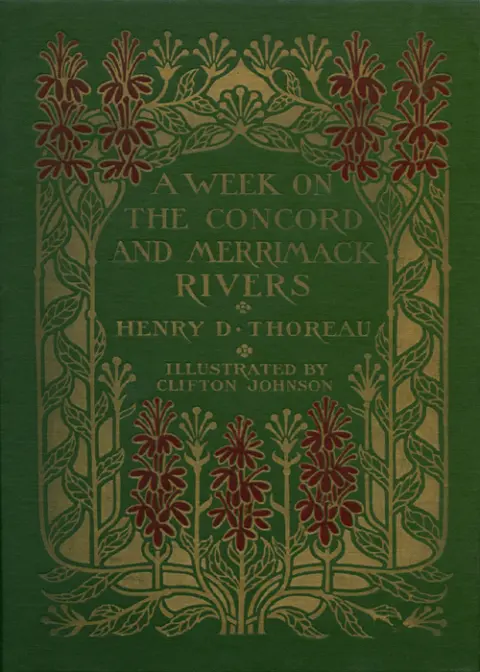
"A Week on the Concord and Merrimack Rivers" by Henry David Thoreau is a book published in 1849. It recounts a boat journey Thoreau took with his brother John in 1839, written partly as a tribute after John's death. Though structured as a travel narrative divided by days, the book weaves extensive digressions on religion, poetry, history, and the author's reflections on Industrial Revolution changes transforming New England. His first published work, it initially sold only 219 copies.
Introduction adapted from the source catalogue; source summaries may be automatically generated.
Free to read · English · 115,968 words · No account needed
MAKE TIME FOR A GOOD BOOK
On by default. Untick to stop anonymous reading totals. Each page counts after 10 seconds in view. How this works.
Anonymous counting is on unless you have switched it off.
We thus worked our way up this river, gradually adjusting our thoughts to novelties, beholding from its placid bosom a new nature and new works of men, and, as it were with increasing confidence, finding nature still habitable, genial, and propitious to us; not following any beaten path, but the windings of the river, as ever the nearest way for us. Fortunately we had no business in this country. The Concord had rarely been a river, or rivus, but barely fluvius, or between fluvius and lacus. This Merrimack was neither rivus nor fluvius nor lacus, but rather amnis here, a gently swelling and stately rolling flood approaching the sea. We could even sympathize with its buoyant tide, going to seek its fortune in the ocean, and, anticipating the time when “being received within the plain of its freer water,” it should “beat the shores for banks,”—
“campoque recepta
Liberioris aquæ, pro ripis litora pulsant.”
At length we doubled a low shrubby islet, called Rabbit Island, subjected alternately to the sun and to the waves, as desolate as if it lay some leagues within the icy sea, and found ourselves in a narrower part of the river, near the sheds and yards for picking the stone known as the Chelmsford granite, which is quarried in Westford and the neighboring towns. We passed Wicasuck Island, which contains seventy acres or more, on our right, between Chelmsford and Tyngsborough. This was a favorite residence of the Indians. According to the History of Dunstable, “About 1663, the eldest son of Passaconaway [Chief of the Penacooks] was thrown into jail for a debt of £45, due to John Tinker, by one of his tribe, and which he had promised verbally should be paid. To relieve him from his imprisonment, his brother Wannalancet and others, who owned Wicasuck Island, sold it and paid the debt.” It was, however, restored to the Indians by the General Court in 1665. After the departure of the Indians in 1683, it was granted to Jonathan Tyng in payment for his services to the colony, in maintaining a garrison at his house. Tyng’s house stood not far from Wicasuck Falls. Gookin, who, in his Epistle Dedicatory to Robert Boyle, apologizes for presenting his “matter clothed in a wilderness dress,” says that on the breaking out of Philip’s war in 1675, there were taken up by the Christian Indians and the English in Marlborough, and sent to Cambridge, seven “Indians belonging to Narragansett, Long Island, and Pequod, who had all been at work about seven weeks with one Mr. Jonathan Tyng, of Dunstable, upon Merrimack River; and, hearing of the war, they reckoned with their master, and getting their wages, conveyed themselves away without his privity, and, being afraid, marched secretly through the woods, designing to go to their own country.” However, they were released soon after. Such were the hired men in those days. Tyng was the first permanent settler of Dunstable, which then embraced what is now Tyngsborough and many other towns. In the winter of 1675, in Philip’s war, every other settler left the town, but “he,” says the historian of Dunstable, “fortified his house; and, although ‘obliged to send to Boston for his food,’ sat himself down in the midst of his savage enemies, alone, in the wilderness, to defend his home. Deeming his position an important one for the defence of the frontiers, in February, 1676, he petitioned the Colony for aid,” humbly showing, as his petition runs, that, as he lived “in the uppermost house on Merrimac river, lying open to ye enemy, yet being so seated that it is, as it were, a watch-house to the neighboring towns,” he could render important service to his country if only he had some assistance, “there being,” he said, “never an inhabitant left in the town but myself.” Wherefore he requests that their “Honors would be pleased to order him three or four men to help garrison his said house,” which they did. But methinks that such a garrison would be weakened by the addition of a man.
Your reading position is saved on this browser. Take it to another device with a library code. Reading pages adapt to text, rather than matching a printed edition.
Henry David Thoreau

Henry David Thoreau

Henry David Thoreau
Henry David Thoreau
BEHIND THE BOOK
This eBook is for the use of anyone anywhere in the United States and most other parts of the world at no cost and with almost no restrictions whatsoever. You may copy it, give it away or re-use it under the terms of the Project Gutenberg License included with this eBook or online at www.gutenberg.org. If you are not located in the United States, you will have to check the laws of the country where you are located before using this eBook. Read the source licence.
The original source file, including credits and licence, is retained by this library. Request an original-format copy at no charge. Please include the book title and Project Gutenberg identifier #4232.
KEEP YOUR CURIOSITY GOING
Wilfrid Scawen Blunt
Wilfrid Scawen Blunt

E. W. (Edgar Watson) Howe

David Patterson (Spirit) Hatch
Coulson Kernahan

Ralph Waldo Emerson