THE CLASSIC COLLECTION✦Familiar Letters The Writings of Henry David Thoreau, Volume 06 (of 20)CLASSIC FREE BOOKS
Familiar Letters The Writings of Henry David Thoreau, Volume 06 (of 20)
Henry David Thoreau
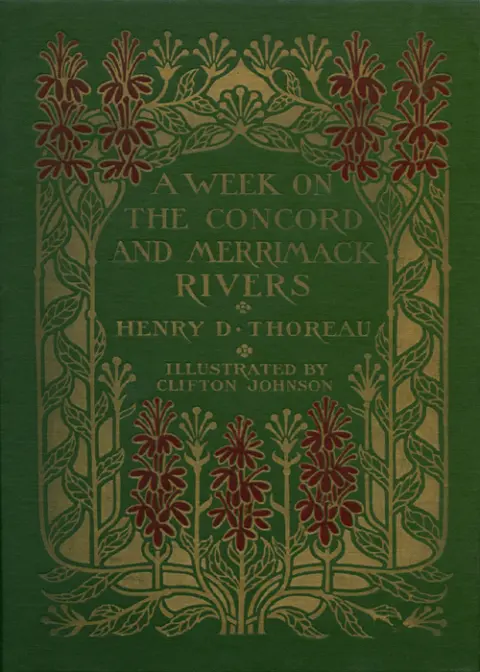
THE CLASSIC COLLECTION · 1849
"A Week on the Concord and Merrimack Rivers" by Henry David Thoreau is a book published in 1849. It recounts a boat journey Thoreau took with his brother John in 1839, written partly as a tribute after John's death. Though structured as a travel narrative divided by days, the book weaves extensive digressions on religion, poetry, history, and the author's reflections on Industrial Revolution changes transforming New England. His first published work, it initially sold only 219 copies.
Introduction adapted from the source catalogue; source summaries may be automatically generated.
Free to read · English · 115,968 words · No account needed
MAKE TIME FOR A GOOD BOOK
On by default. Untick to stop anonymous reading totals. Each page counts after 10 seconds in view. How this works.
Anonymous counting is on unless you have switched it off.
There are already essays and poems, the growth of this land, which are not in vain, all which, however, we could conveniently have stowed in the till of our chest. If the gods permitted their own inspiration to be breathed in vain, these might be overlooked in the crowd, but the accents of truth are as sure to be heard at last on earth as in heaven. They already seem ancient, and in some measure have lost the traces of their modern birth. Here are they who
—“ask for that which is our whole life’s light, For the perpetual, true and clear insight.”
I remember a few sentences which spring like the sward in its native pasture, where its roots were never disturbed, and not as if spread over a sandy embankment; answering to the poet’s prayer,
“Let us set so just
A rate on knowledge, that the world may trust
The poet’s sentence, and not still aver
Each art is to itself a flatterer.”
But, above all, in our native port, did we not frequent the peaceful games of the Lyceum, from which a new era will be dated to New England, as from the games of Greece. For if Herodotus carried his history to Olympia to read, after the cestus and the race, have we not heard such histories recited there, which since our countrymen have read, as made Greece sometimes to be forgotten?—Philosophy, too, has there her grove and portico, not wholly unfrequented in these days.
Lately the victor, whom all Pindars praised, has won another palm,
contending with
“Olympian bards who sung
Divine ideas below,
Which always find us young,
And always keep us so.”
What earth or sea, mountain or stream, or Muses’ spring or grove, is safe from his all-searching ardent eye, who drives off Phœbus’ beaten track, visits unwonted zones, makes the gelid Hyperboreans glow, and the old polar serpent writhe, and many a Nile flow back and hide his head!
That Phaeton of our day,
Who’d make another milky way,
And burn the world up with his ray;
By us an undisputed seer,—
Who’d drive his flaming car so near
Unto our shuddering mortal sphere,
Disgracing all our slender worth,
And scorching up the living earth,
To prove his heavenly birth.
The silver spokes, the golden tire,
Are glowing with unwonted fire,
And ever nigher roll and nigher;
The pins and axle melted are,
The silver radii fly afar,
Ah, he will spoil his Father’s car!
Who let him have the steeds he cannot steer?
Henceforth the sun will not shine for a year;
And we shall Ethiops all appear.
From his
Your reading position is saved on this browser. Take it to another device with a library code. Reading pages adapt to text, rather than matching a printed edition.
Henry David Thoreau

Henry David Thoreau

Henry David Thoreau
Henry David Thoreau
BEHIND THE BOOK
This eBook is for the use of anyone anywhere in the United States and most other parts of the world at no cost and with almost no restrictions whatsoever. You may copy it, give it away or re-use it under the terms of the Project Gutenberg License included with this eBook or online at www.gutenberg.org. If you are not located in the United States, you will have to check the laws of the country where you are located before using this eBook. Read the source licence.
The original source file, including credits and licence, is retained by this library. Request an original-format copy at no charge. Please include the book title and Project Gutenberg identifier #4232.
KEEP YOUR CURIOSITY GOING
Wilfrid Scawen Blunt
Wilfrid Scawen Blunt

E. W. (Edgar Watson) Howe

David Patterson (Spirit) Hatch
Coulson Kernahan

Ralph Waldo Emerson