THE CLASSIC COLLECTION✦Familiar Letters The Writings of Henry David Thoreau, Volume 06 (of 20)CLASSIC FREE BOOKS
Familiar Letters The Writings of Henry David Thoreau, Volume 06 (of 20)
Henry David Thoreau
THE CLASSIC COLLECTION · 1849
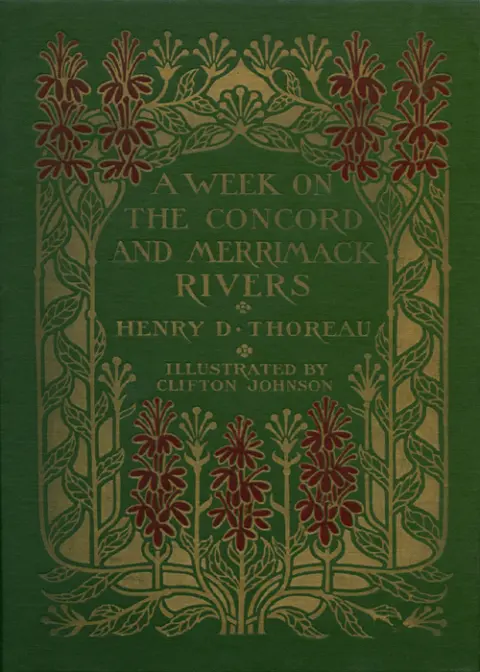
"A Week on the Concord and Merrimack Rivers" by Henry David Thoreau is a book published in 1849. It recounts a boat journey Thoreau took with his brother John in 1839, written partly as a tribute after John's death. Though structured as a travel narrative divided by days, the book weaves extensive digressions on religion, poetry, history, and the author's reflections on Industrial Revolution changes transforming New England. His first published work, it initially sold only 219 copies.
Introduction adapted from the source catalogue; source summaries may be automatically generated.
Free to read · English · 115,968 words · No account needed
MAKE TIME FOR A GOOD BOOK
On by default. Untick to stop anonymous reading totals. Each page counts after 10 seconds in view. How this works.
Anonymous counting is on unless you have switched it off.
Crodar, blind and old, receives Ossian, son of Fingal, who comes to aid
him in war;—
“‘My eyes have failed,’ says he, ‘Crodar is blind,
Is thy strength like that of thy fathers?
Stretch, Ossian, thine arm to the hoary-haired.’
I gave my arm to the king.
The aged hero seized my hand;
He heaved a heavy sigh;
Tears flowed incessant down his cheek.
’Strong art thou, son of the mighty,
Though not so dreadful as Morven’s prince.
Let my feast be spread in the hall,
Let every sweet-voiced minstrel sing;
Great is he who is within my walls,
Sons of wave-echoing Croma.’”
Even Ossian himself, the hero-bard, pays tribute to the superior
strength of his father Fingal.
“How beauteous, mighty man, was thy mind,
Why succeeded Ossian without its strength?”
While we sailed fleetly before the wind, with the river gurgling under our stern, the thoughts of autumn coursed as steadily through our minds, and we observed less what was passing on the shore, than the dateless associations and impressions which the season awakened, anticipating in some measure the progress of the year.
I hearing get, who had but ears,
And sight, who had but eyes before,
I moments live, who lived but years,
And truth discern, who knew but learning’s lore.
Sitting with our faces now up stream, we studied the landscape by degrees, as one unrolls a map, rock, tree, house, hill, and meadow, assuming new and varying positions as wind and water shifted the scene, and there was variety enough for our entertainment in the metamorphoses of the simplest objects. Viewed from this side the scenery appeared new to us.
The most familiar sheet of water viewed from a new hill-top, yields a novel and unexpected pleasure. When we have travelled a few miles, we do not recognize the profiles even of the hills which overlook our native village, and perhaps no man is quite familiar with the horizon as seen from the hill nearest to his house, and can recall its outline distinctly when in the valley. We do not commonly know, beyond a short distance, which way the hills range which take in our houses and farms in their sweep. As if our birth had at first sundered things, and we had been thrust up through into nature like a wedge, and not till the wound heals and the scar disappears, do we begin to discover where we are, and that nature is one and continuous everywhere. It is an important epoch when a man who has always lived on the east side of a mountain, and seen it in the west, travels round and sees it in the east. Yet the universe is a sphere whose centre is wherever there is intelligence. The sun is not so central as a man. Upon an isolated hill-top, in an open country, we seem to ourselves to be standing on the boss of an immense shield, the immediate landscape being apparently depressed below the more remote, and rising gradually to the horizon, which is the rim of the shield, villas, steeples, forests, mountains, one above another, till they are swallowed up in the heavens. The most distant mountains in the horizon appear to rise directly from the shore of that lake in the woods by which we chance to be standing, while from the mountain-top, not only this, but a thousand nearer and larger lakes, are equally unobserved.
Your reading position is saved on this browser. Take it to another device with a library code. Reading pages adapt to text, rather than matching a printed edition.
Henry David Thoreau

Henry David Thoreau

Henry David Thoreau
Henry David Thoreau
BEHIND THE BOOK
This eBook is for the use of anyone anywhere in the United States and most other parts of the world at no cost and with almost no restrictions whatsoever. You may copy it, give it away or re-use it under the terms of the Project Gutenberg License included with this eBook or online at www.gutenberg.org. If you are not located in the United States, you will have to check the laws of the country where you are located before using this eBook. Read the source licence.
The original source file, including credits and licence, is retained by this library. Request an original-format copy at no charge. Please include the book title and Project Gutenberg identifier #4232.
KEEP YOUR CURIOSITY GOING
Wilfrid Scawen Blunt
Wilfrid Scawen Blunt

E. W. (Edgar Watson) Howe

David Patterson (Spirit) Hatch
Coulson Kernahan

Ralph Waldo Emerson