THE CLASSIC COLLECTION✦Familiar Letters The Writings of Henry David Thoreau, Volume 06 (of 20)CLASSIC FREE BOOKS
Familiar Letters The Writings of Henry David Thoreau, Volume 06 (of 20)
Henry David Thoreau
THE CLASSIC COLLECTION · 1849
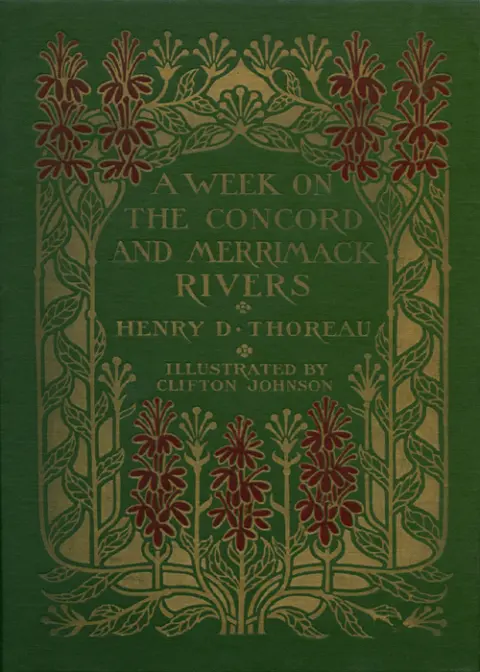
"A Week on the Concord and Merrimack Rivers" by Henry David Thoreau is a book published in 1849. It recounts a boat journey Thoreau took with his brother John in 1839, written partly as a tribute after John's death. Though structured as a travel narrative divided by days, the book weaves extensive digressions on religion, poetry, history, and the author's reflections on Industrial Revolution changes transforming New England. His first published work, it initially sold only 219 copies.
Introduction adapted from the source catalogue; source summaries may be automatically generated.
Free to read · English · 115,968 words · No account needed
MAKE TIME FOR A GOOD BOOK
On by default. Untick to stop anonymous reading totals. Each page counts after 10 seconds in view. How this works.
Anonymous counting is on unless you have switched it off.
“Not only o’er the dial’s face,
This silent phantom day by day,
With slow, unseen, unceasing pace
Steals moments, months, and years away;
From hoary rock and aged tree,
From proud Palmyra’s mouldering walls,
From Teneriffe, towering o’er the sea,
From every blade of grass it falls.”
It is almost the only game which the trees play at, this tit-for-tat, now this side in the sun, now that, the drama of the day. In deep ravines under the eastern sides of cliffs, Night forwardly plants her foot even at noonday, and as Day retreats she steps into his trenches, skulking from tree to tree, from fence to fence, until at last she sits in his citadel and draws out her forces into the plain. It may be that the forenoon is brighter than the afternoon, not only because of the greater transparency of its atmosphere, but because we naturally look most into the west, as forward into the day, and so in the forenoon see the sunny side of things, but in the afternoon the shadow of every tree.
The afternoon is now far advanced, and a fresh and leisurely wind is blowing over the river, making long reaches of bright ripples. The river has done its stint, and appears not to flow, but lie at its length reflecting the light, and the haze over the woods is like the inaudible panting, or rather the gentle perspiration of resting nature, rising from a myriad of pores into the attenuated atmosphere.
On the thirty-first day of March, one hundred and forty-two years before this, probably about this time in the afternoon, there were hurriedly paddling down this part of the river, between the pine woods which then fringed these banks, two white women and a boy, who had left an island at the mouth of the Contoocook before daybreak. They were slightly clad for the season, in the English fashion, and handled their paddles unskilfully, but with nervous energy and determination, and at the bottom of their canoe lay the still bleeding scalps of ten of the aborigines. They were Hannah Dustan, and her nurse, Mary Neff, both of Haverhill, eighteen miles from the mouth of this river, and an English boy, named Samuel Lennardson, escaping from captivity among the Indians. On the 15th of March previous, Hannah Dustan had been compelled to rise from child-bed, and half dressed, with one foot bare, accompanied by her nurse, commence an uncertain march, in still inclement weather, through the snow and the wilderness. She had seen her seven elder children flee with their father, but knew not of their fate. She had seen her infant’s brains dashed out against an apple-tree, and had left her own and her neighbors’ dwellings in ashes. When she reached the wigwam of her captor, situated on an island in the Merrimack, more than twenty miles above where we now are, she had been told that she and her nurse were soon to be taken to a distant Indian settlement, and there made to run the gauntlet naked. The family of this Indian consisted of two men, three women, and seven children, beside an English boy, whom she found a prisoner among them. Having determined to attempt her escape, she instructed the boy to inquire of one of the men, how he should despatch an enemy in the quickest manner, and take his scalp. “Strike ’em there,” said he, placing his finger on his temple, and he also showed him how to take off the scalp. On the morning of the 31st she arose before daybreak, and awoke her nurse and the boy, and taking the Indians’ tomahawks, they killed them all in their sleep, excepting one favorite boy, and one squaw who fled wounded with him to the woods. The English boy struck the Indian who had given him the information, on the temple, as he had been directed. They then collected all the provision they could find, and took their master’s tomahawk and gun, and scuttling all the canoes but one, commenced their flight to Haverhill, distant about sixty miles by the river. But after having proceeded a short distance, fearing that her story would not be believed if she should escape to tell it, they returned to the silent wigwam, and taking off the scalps of the dead, put them into a bag as proofs of what they had done, and then retracing their steps to the shore in the twilight, recommenced their voyage.
Your reading position is saved on this browser. Take it to another device with a library code. Reading pages adapt to text, rather than matching a printed edition.
Henry David Thoreau

Henry David Thoreau

Henry David Thoreau
Henry David Thoreau
BEHIND THE BOOK
This eBook is for the use of anyone anywhere in the United States and most other parts of the world at no cost and with almost no restrictions whatsoever. You may copy it, give it away or re-use it under the terms of the Project Gutenberg License included with this eBook or online at www.gutenberg.org. If you are not located in the United States, you will have to check the laws of the country where you are located before using this eBook. Read the source licence.
The original source file, including credits and licence, is retained by this library. Request an original-format copy at no charge. Please include the book title and Project Gutenberg identifier #4232.
KEEP YOUR CURIOSITY GOING
Wilfrid Scawen Blunt
Wilfrid Scawen Blunt

E. W. (Edgar Watson) Howe

David Patterson (Spirit) Hatch
Coulson Kernahan

Ralph Waldo Emerson