THE CLASSIC COLLECTION✦Familiar Letters The Writings of Henry David Thoreau, Volume 06 (of 20)CLASSIC FREE BOOKS
Familiar Letters The Writings of Henry David Thoreau, Volume 06 (of 20)
Henry David Thoreau
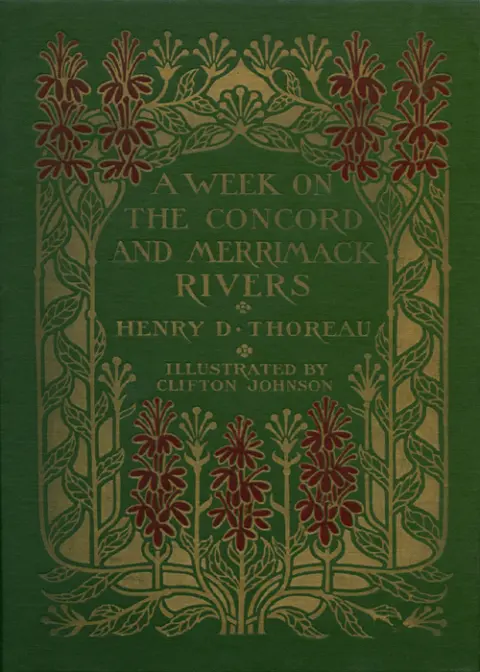
THE CLASSIC COLLECTION · 1849
"A Week on the Concord and Merrimack Rivers" by Henry David Thoreau is a book published in 1849. It recounts a boat journey Thoreau took with his brother John in 1839, written partly as a tribute after John's death. Though structured as a travel narrative divided by days, the book weaves extensive digressions on religion, poetry, history, and the author's reflections on Industrial Revolution changes transforming New England. His first published work, it initially sold only 219 copies.
Introduction adapted from the source catalogue; source summaries may be automatically generated.
Free to read · English · 115,968 words · No account needed
MAKE TIME FOR A GOOD BOOK
On by default. Untick to stop anonymous reading totals. Each page counts after 10 seconds in view. How this works.
Anonymous counting is on unless you have switched it off.
Surely the fates are forever kind, though Nature’s laws are more immutable than any despot’s, yet to man’s daily life they rarely seem rigid, but permit him to relax with license in summer weather. He is not harshly reminded of the things he may not do. She is very kind and liberal to all men of vicious habits, and certainly does not deny them quarter; they do not die without priest. Still they maintain life along the way, keeping this side the Styx, still hearty, still resolute, “never better in their lives”; and again, after a dozen years have elapsed, they start up from behind a hedge, asking for work and wages for able-bodied men. Who has not met such
“a beggar on the way,
Who sturdily could gang? ….
Who cared neither for wind nor wet,
In lands where’er he past?”
“That bold adopts each house he views, his own; Makes every pulse his checquer, and, at pleasure, Walks forth, and taxes all the world, like Cæsar”;—
As if consistency were the secret of health, while the poor inconsistent aspirant man, seeking to live a pure life, feeding on air, divided against himself, cannot stand, but pines and dies after a life of sickness, on beds of down.
The unwise are accustomed to speak as if some were not sick; but methinks the difference between men in respect to health is not great enough to lay much stress upon. Some are reputed sick and some are not. It often happens that the sicker man is the nurse to the sounder.
Shad are still taken in the basin of Concord River at Lowell, where they are said to be a month earlier than the Merrimack shad, on account of the warmth of the water. Still patiently, almost pathetically, with instinct not to be discouraged, not to be reasoned with, revisiting their old haunts, as if their stern fates would relent, and still met by the Corporation with its dam. Poor shad! where is thy redress? When Nature gave thee instinct, gave she thee the heart to bear thy fate? Still wandering the sea in thy scaly armor to inquire humbly at the mouths of rivers if man has perchance left them free for thee to enter. By countless shoals loitering uncertain meanwhile, merely stemming the tide there, in danger from sea foes in spite of thy bright armor, awaiting new instructions, until the sands, until the water itself, tell thee if it be so or not. Thus by whole migrating nations, full of instinct, which is thy faith, in this backward spring, turned adrift, and perchance knowest not where men do not dwell, where there are not factories, in these days. Armed with no sword, no electric shock, but mere Shad, armed only with innocence and a just cause, with tender dumb mouth only forward, and scales easy to be detached. I for one am with thee, and who knows what may avail a crow-bar against that Billerica dam?—Not despairing when whole myriads have gone to feed those sea monsters during thy suspense, but still brave, indifferent, on easy fin there, like shad reserved for higher destinies. Willing to be decimated for man’s behoof after the spawning season. Away with the superficial and selfish phil-anthropy of men,—who knows what admirable virtue of fishes may be below low-water-mark, bearing up against a hard destiny, not admired by that fellow-creature who alone can appreciate it! Who hears the fishes when they cry? It will not be forgotten by some memory that we were contemporaries. Thou shalt erelong have thy way up the rivers, up all the rivers of the globe, if I am not mistaken. Yea, even thy dull watery dream shall be more than realized. If it were not so, but thou wert to be overlooked at first and at last, then would not I take their heaven. Yes, I say so, who think I know better than thou canst. Keep a stiff fin then, and stem all the tides thou mayst meet.
Your reading position is saved on this browser. Take it to another device with a library code. Reading pages adapt to text, rather than matching a printed edition.
Henry David Thoreau

Henry David Thoreau

Henry David Thoreau
Henry David Thoreau
BEHIND THE BOOK
This eBook is for the use of anyone anywhere in the United States and most other parts of the world at no cost and with almost no restrictions whatsoever. You may copy it, give it away or re-use it under the terms of the Project Gutenberg License included with this eBook or online at www.gutenberg.org. If you are not located in the United States, you will have to check the laws of the country where you are located before using this eBook. Read the source licence.
The original source file, including credits and licence, is retained by this library. Request an original-format copy at no charge. Please include the book title and Project Gutenberg identifier #4232.
KEEP YOUR CURIOSITY GOING
Wilfrid Scawen Blunt
Wilfrid Scawen Blunt

E. W. (Edgar Watson) Howe

David Patterson (Spirit) Hatch
Coulson Kernahan

Ralph Waldo Emerson