THE CLASSIC COLLECTION✦Familiar Letters The Writings of Henry David Thoreau, Volume 06 (of 20)CLASSIC FREE BOOKS
Familiar Letters The Writings of Henry David Thoreau, Volume 06 (of 20)
Henry David Thoreau
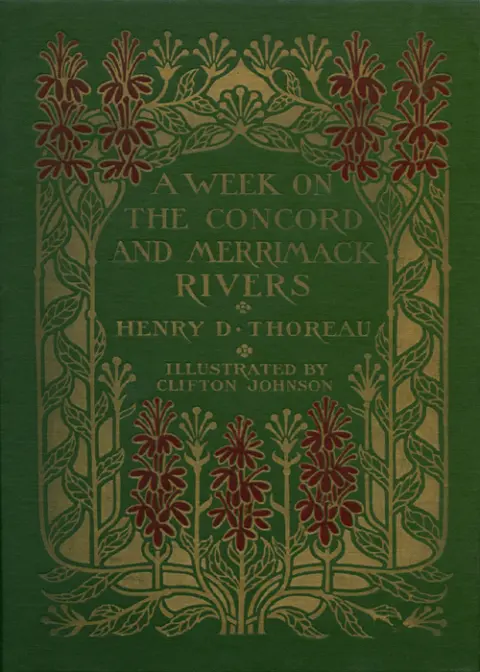
THE CLASSIC COLLECTION · 1849
"A Week on the Concord and Merrimack Rivers" by Henry David Thoreau is a book published in 1849. It recounts a boat journey Thoreau took with his brother John in 1839, written partly as a tribute after John's death. Though structured as a travel narrative divided by days, the book weaves extensive digressions on religion, poetry, history, and the author's reflections on Industrial Revolution changes transforming New England. His first published work, it initially sold only 219 copies.
Introduction adapted from the source catalogue; source summaries may be automatically generated.
Free to read · English · 115,968 words · No account needed
MAKE TIME FOR A GOOD BOOK
On by default. Untick to stop anonymous reading totals. Each page counts after 10 seconds in view. How this works.
Anonymous counting is on unless you have switched it off.
But we found that the frontiers were not this way any longer. This generation has come into the world fatally late for some enterprises. Go where we will on the surface of things, men have been there before us. We cannot now have the pleasure of erecting the last house; that was long ago set up in the suburbs of Astoria City, and our boundaries have literally been run to the South Sea, according to the old patents. But the lives of men, though more extended laterally in their range, are still as shallow as ever. Undoubtedly, as a Western orator said, “Men generally live over about the same surface; some live long and narrow, and others live broad and short”; but it is all superficial living. A worm is as good a traveller as a grasshopper or a cricket, and a much wiser settler. With all their activity these do not hop away from drought nor forward to summer. We do not avoid evil by fleeing before it, but by rising above or diving below its plane; as the worm escapes drought and frost by boring a few inches deeper. The frontiers are not east or west, north or south, but wherever a man fronts a fact, though that fact be his neighbor, there is an unsettled wilderness between him and Canada, between him and the setting sun, or, farther still, between him and it. Let him build himself a log-house with the bark on where he is, fronting IT, and wage there an Old French war for seven or seventy years, with Indians and Rangers, or whatever else may come between him and the reality, and save his scalp if he can.
We now no longer sailed or floated on the river, but trod the unyielding land like pilgrims. Sadi tells who may travel; among others, “A common mechanic, who can earn a subsistence by the industry of his hand, and shall not have to stake his reputation for every morsel of bread, as philosophers have said.” He may travel who can subsist on the wild fruits and game of the most cultivated country. A man may travel fast enough and earn his living on the road. I have at times been applied to to do work when on a journey; to do tinkering and repair clocks, when I had a knapsack on my back. A man once applied to me to go into a factory, stating conditions and wages, observing that I succeeded in shutting the window of a railroad car in which we were travelling, when the other passengers had failed. “Hast thou not heard of a Sufi, who was hammering some nails into the sole of his sandal; an officer of cavalry took him by the sleeve, saying, Come along and shoe my horse.” Farmers have asked me to assist them in haying, when I was passing their fields. A man once applied to me to mend his umbrella, taking me for an umbrella-mender, because, being on a journey, I carried an umbrella in my hand while the sun shone. Another wished to buy a tin cup of me, observing that I had one strapped to my belt, and a sauce-pan on my back. The cheapest way to travel, and the way to travel the farthest in the shortest distance, is to go afoot, carrying a dipper, a spoon, and a fish-line, some Indian meal, some salt, and some sugar. When you come to a brook or pond, you can catch fish and cook them; or you can boil a hasty-pudding; or you can buy a loaf of bread at a farmer’s house for fourpence, moisten it in the next brook that crosses the road, and dip into it your sugar,—this alone will last you a whole day;—or, if you are accustomed to heartier living, you can buy a quart of milk for two cents, crumb your bread or cold pudding into it, and eat it with your own spoon out of your own dish. Any one of these things I mean, not all together. I have travelled thus some hundreds of miles without taking any meal in a house, sleeping on the ground when convenient, and found it cheaper, and in many respects more profitable, than staying at home. So that some have inquired why it would not be best to travel always. But I never thought of travelling simply as a means of getting a livelihood. A simple woman down in Tyngsborough, at whose house I once stopped to get a draught of water, when I said, recognizing the bucket, that I had stopped there nine years before for the same purpose, asked if I was not a traveller, supposing that I had been travelling ever since, and had now come round again; that travelling was one of the professions, more or less productive, which her husband did not follow. But continued travelling is far from productive. It begins with wearing away the soles of the shoes, and making the feet sore, and erelong it will wear a man clean up, after making his heart sore into the bargain. I have observed that the after-life of those who have travelled much is very pathetic. True and sincere travelling is no pastime, but it is as serious as the grave, or any part of the human journey, and it requires a long probation to be broken into it. I do not speak of those that travel sitting, the sedentary travellers whose legs hang dangling the while, mere idle symbols of the fact, any more than when we speak of sitting hens we mean those that sit standing, but I mean those to whom travelling is life for the legs, and death too, at last. The traveller must be born again on the road, and earn a passport from the elements, the principal powers that be for him. He shall experience at last that old threat of his mother fulfilled, that he shall be skinned alive. His sores shall gradually deepen themselves that they may heal inwardly, while he gives no rest to the sole of his foot, and at night weariness must be his pillow, that so he may acquire experience against his rainy days.—So was it with us.
Your reading position is saved on this browser. Take it to another device with a library code. Reading pages adapt to text, rather than matching a printed edition.
Henry David Thoreau

Henry David Thoreau

Henry David Thoreau
Henry David Thoreau
BEHIND THE BOOK
This eBook is for the use of anyone anywhere in the United States and most other parts of the world at no cost and with almost no restrictions whatsoever. You may copy it, give it away or re-use it under the terms of the Project Gutenberg License included with this eBook or online at www.gutenberg.org. If you are not located in the United States, you will have to check the laws of the country where you are located before using this eBook. Read the source licence.
The original source file, including credits and licence, is retained by this library. Request an original-format copy at no charge. Please include the book title and Project Gutenberg identifier #4232.
KEEP YOUR CURIOSITY GOING
Wilfrid Scawen Blunt
Wilfrid Scawen Blunt

E. W. (Edgar Watson) Howe

David Patterson (Spirit) Hatch
Coulson Kernahan

Ralph Waldo Emerson