THE CLASSIC COLLECTION✦Familiar Letters The Writings of Henry David Thoreau, Volume 06 (of 20)CLASSIC FREE BOOKS
Familiar Letters The Writings of Henry David Thoreau, Volume 06 (of 20)
Henry David Thoreau
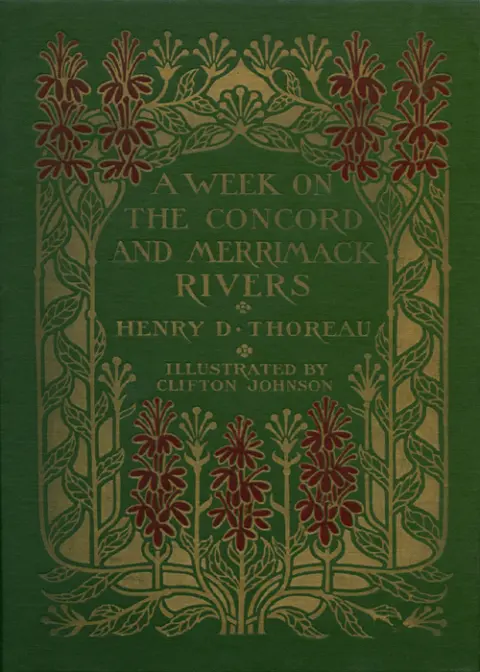
THE CLASSIC COLLECTION · 1849
"A Week on the Concord and Merrimack Rivers" by Henry David Thoreau is a book published in 1849. It recounts a boat journey Thoreau took with his brother John in 1839, written partly as a tribute after John's death. Though structured as a travel narrative divided by days, the book weaves extensive digressions on religion, poetry, history, and the author's reflections on Industrial Revolution changes transforming New England. His first published work, it initially sold only 219 copies.
Introduction adapted from the source catalogue; source summaries may be automatically generated.
Free to read · English · 115,968 words · No account needed
MAKE TIME FOR A GOOD BOOK
On by default. Untick to stop anonymous reading totals. Each page counts after 10 seconds in view. How this works.
Anonymous counting is on unless you have switched it off.
Ah, my dear Strangers and Enemies, I would not forget you. I can well afford to welcome you. Let me subscribe myself Yours ever and truly,—your much obliged servant. We have nothing to fear from our foes; God keeps a standing army for that service; but we have no ally against our Friends, those ruthless Vandals.
Once more to one and all,
“Friends, Romans, Countrymen, and Lovers.”
Let such pure hate still underprop
Our love, that we may be
Each other’s conscience.
And have our sympathy
Mainly from thence.
We’ll one another treat like gods,
And all the faith we have
In virtue and in truth, bestow
On either, and suspicion leave
To gods below.
Two solitary stars,—
Unmeasured systems far
Between us roll,
But by our conscious light we are
Determined to one pole.
What need confound the sphere,—
Love can afford to wait,
For it no hour’s too late
That witnesseth one duty’s end,
Or to another doth beginning lend.
It will subserve no use,
More than the tints of flowers,
Only the independent guest
Frequents its bowers,
Inherits its bequest.
No speech though kind has it,
But kinder silence doles
Unto its mates,
By night consoles,
By day congratulates.
What saith the tongue to tongue?
What heareth ear of ear?
By the decrees of fate
From year to year,
Does it communicate.
Pathless the gulf of feeling yawns,—
No trivial bridge of words,
Or arch of boldest span,
Can leap the moat that girds
The sincere man.
No show of bolts and bars
Can keep the foeman out,
Or ’scape his secret mine
Who entered with the doubt
That drew the line.
No warder at the gate
Can let the friendly in,
But, like the sun, o’er all
He will the castle win,
And shine along the wall.
There’s nothing in the world I know
That can escape from love,
For every depth it goes below,
And every height above.
It waits as waits the sky,
Until the clouds go by,
Yet shines serenely on
With an eternal day,
Alike when they are gone,
And when they stay.
Implacable is Love,—
Foes may be bought or teased
From their hostile intent,
But he goes unappeased
Who is on kindness bent.
Your reading position is saved on this browser. Take it to another device with a library code. Reading pages adapt to text, rather than matching a printed edition.
Henry David Thoreau

Henry David Thoreau

Henry David Thoreau
Henry David Thoreau
BEHIND THE BOOK
This eBook is for the use of anyone anywhere in the United States and most other parts of the world at no cost and with almost no restrictions whatsoever. You may copy it, give it away or re-use it under the terms of the Project Gutenberg License included with this eBook or online at www.gutenberg.org. If you are not located in the United States, you will have to check the laws of the country where you are located before using this eBook. Read the source licence.
The original source file, including credits and licence, is retained by this library. Request an original-format copy at no charge. Please include the book title and Project Gutenberg identifier #4232.
KEEP YOUR CURIOSITY GOING
Wilfrid Scawen Blunt
Wilfrid Scawen Blunt

E. W. (Edgar Watson) Howe

David Patterson (Spirit) Hatch
Coulson Kernahan

Ralph Waldo Emerson