THE CLASSIC COLLECTION✦Familiar Letters The Writings of Henry David Thoreau, Volume 06 (of 20)CLASSIC FREE BOOKS
Familiar Letters The Writings of Henry David Thoreau, Volume 06 (of 20)
Henry David Thoreau
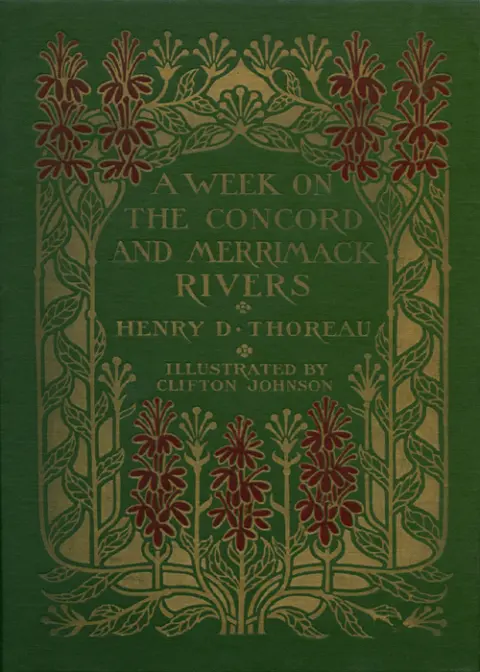
THE CLASSIC COLLECTION · 1849
"A Week on the Concord and Merrimack Rivers" by Henry David Thoreau is a book published in 1849. It recounts a boat journey Thoreau took with his brother John in 1839, written partly as a tribute after John's death. Though structured as a travel narrative divided by days, the book weaves extensive digressions on religion, poetry, history, and the author's reflections on Industrial Revolution changes transforming New England. His first published work, it initially sold only 219 copies.
Introduction adapted from the source catalogue; source summaries may be automatically generated.
Free to read · English · 115,968 words · No account needed
MAKE TIME FOR A GOOD BOOK
On by default. Untick to stop anonymous reading totals. Each page counts after 10 seconds in view. How this works.
Anonymous counting is on unless you have switched it off.
“This all Indian hand, but pray you do consider your humble servant,
Signed also by Simon Detogkom, King Hary, Sam Linis, Mr. Jorge Rodunnonukgus, John Owamosimmin, and nine other Indians, with their marks against their names.
But now, one hundred and fifty-four years having elapsed since the date of this letter, we went unalarmed on our way without “brecking” our “conow,” reading the New England Gazetteer, and seeing no traces of “Mohogs” on the banks.
The Souhegan, though a rapid river, seemed to-day to have borrowed its
character from the noon.
Where gleaming fields of haze
Meet the voyageur’s gaze,
And above, the heated air
Seems to make a river there,
The pines stand up with pride
By the Souhegan’s side,
And the hemlock and the larch
With their triumphal arch
Are waving o’er its march
To the sea.
No wind stirs its waves,
But the spirits of the braves
Hov’ring o’er,
Whose antiquated graves
Its still water laves
On the shore.
With an Indian’s stealthy tread
It goes sleeping in its bed,
Without joy or grief,
Or the rustle of a leaf,
Without a ripple or a billow,
Or the sigh of a willow,
From the Lyndeboro’ hills
To the Merrimack mills.
With a louder din
Did its current begin,
When melted the snow
On the far mountain’s brow,
And the drops came together
In that rainy weather.
Experienced river,
Hast thou flowed forever?
Souhegan soundeth old,
But the half is not told,
What names hast thou borne,
In the ages far gone,
When the Xanthus and Meander
Commenced to wander,
Ere the black bear haunted
Thy red forest-floor,
Or Nature had planted
The pines by thy shore?
During the heat of the day, we rested on a large island a mile above the mouth of this river, pastured by a herd of cattle, with steep banks and scattered elms and oaks, and a sufficient channel for canal-boats on each side. When we made a fire to boil some rice for our dinner, the flames spreading amid the dry grass, and the smoke curling silently upward and casting grotesque shadows on the ground, seemed phenomena of the noon, and we fancied that we progressed up the stream without effort, and as naturally as the wind and tide went down, not outraging the calm days by unworthy bustle or impatience. The woods on the neighboring shore were alive with pigeons, which were moving south, looking for mast, but now, like ourselves, spending their noon in the shade. We could hear the slight, wiry, winnowing sound of their wings as they changed their roosts from time to time, and their gentle and tremulous cooing. They sojourned with us during the noontide, greater travellers far than we. You may frequently discover a single pair sitting upon the lower branches of the white-pine in the depths of the wood, at this hour of the day, so silent and solitary, and with such a hermit-like appearance, as if they had never strayed beyond its skirts, while the acorn which was gathered in the forests of Maine is still undigested in their crops. We obtained one of these handsome birds, which lingered too long upon its perch, and plucked and broiled it here with some other game, to be carried along for our supper; for, beside the provisions which we carried with us, we depended mainly on the river and forest for our supply. It is true, it did not seem to be putting this bird to its right use to pluck off its feathers, and extract its entrails, and broil its carcass on the coals; but we heroically persevered, nevertheless, waiting for further information. The same regard for Nature which excited our sympathy for her creatures nerved our hands to carry through what we had begun. For we would be honorable to the party we deserted; we would fulfil fate, and so at length, perhaps, detect the secret innocence of these incessant tragedies which Heaven allows.
Your reading position is saved on this browser. Take it to another device with a library code. Reading pages adapt to text, rather than matching a printed edition.
Henry David Thoreau

Henry David Thoreau

Henry David Thoreau
Henry David Thoreau
BEHIND THE BOOK
This eBook is for the use of anyone anywhere in the United States and most other parts of the world at no cost and with almost no restrictions whatsoever. You may copy it, give it away or re-use it under the terms of the Project Gutenberg License included with this eBook or online at www.gutenberg.org. If you are not located in the United States, you will have to check the laws of the country where you are located before using this eBook. Read the source licence.
The original source file, including credits and licence, is retained by this library. Request an original-format copy at no charge. Please include the book title and Project Gutenberg identifier #4232.
KEEP YOUR CURIOSITY GOING
Wilfrid Scawen Blunt
Wilfrid Scawen Blunt

E. W. (Edgar Watson) Howe

David Patterson (Spirit) Hatch
Coulson Kernahan

Ralph Waldo Emerson