THE CLASSIC COLLECTION✦Familiar Letters The Writings of Henry David Thoreau, Volume 06 (of 20)CLASSIC FREE BOOKS
Familiar Letters The Writings of Henry David Thoreau, Volume 06 (of 20)
Henry David Thoreau
THE CLASSIC COLLECTION · 1849
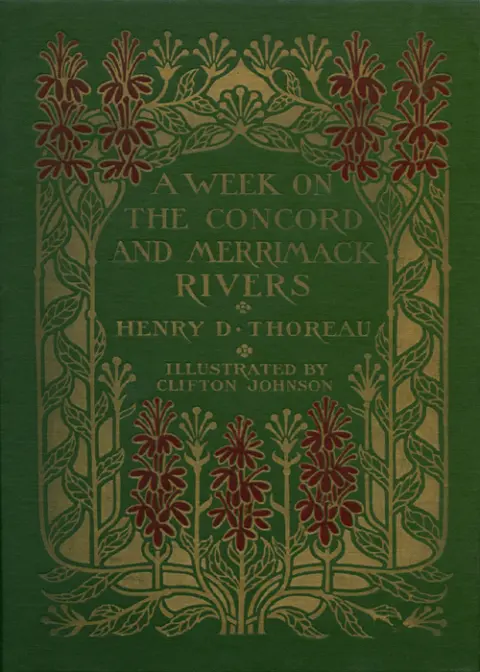
"A Week on the Concord and Merrimack Rivers" by Henry David Thoreau is a book published in 1849. It recounts a boat journey Thoreau took with his brother John in 1839, written partly as a tribute after John's death. Though structured as a travel narrative divided by days, the book weaves extensive digressions on religion, poetry, history, and the author's reflections on Industrial Revolution changes transforming New England. His first published work, it initially sold only 219 copies.
Introduction adapted from the source catalogue; source summaries may be automatically generated.
Free to read · English · 115,968 words · No account needed
MAKE TIME FOR A GOOD BOOK
On by default. Untick to stop anonymous reading totals. Each page counts after 10 seconds in view. How this works.
Anonymous counting is on unless you have switched it off.
A Week on the Concord and Merrimack Rivers
by Henry David Thoreau
Where’er thou sail’st who sailed with me,
Though now thou climbest loftier mounts,
And fairer rivers dost ascend,
Be thou my Muse, my Brother—.
I am bound, I am bound, for a distant shore,
By a lonely isle, by a far Azore,
There it is, there it is, the treasure I seek,
On the barren sands of a desolate creek.
I sailed up a river with a pleasant wind,
New lands, new people, and new thoughts to find;
Many fair reaches and headlands appeared,
And many dangers were there to be feared;
But when I remember where I have been,
And the fair landscapes that I have seen,
THOU seemest the only permanent shore,
The cape never rounded, nor wandered o’er.
Fluminaque obliquis cinxit declivia ripis;
Quæ, diversa locis, partim sorbentur ab ipsa;
In mare perveniunt partim, campoque recepta
Liberioris aquæ, pro ripis litora pulsant.
OVID, Met. I. 39
He confined the rivers within their sloping banks, Which in different places are part absorbed by the earth, Part reach the sea, and being received within the plain Of its freer waters, beat the shore for banks.
“Beneath low hills, in the broad interval
Through which at will our Indian rivulet
Winds mindful still of sannup and of squaw,
Whose pipe and arrow oft the plough unburies,
Here, in pine houses, built of new-fallen trees,
Supplanters of the tribe, the farmers dwell.”
The Musketaquid, or Grass-ground River, though probably as old as the Nile or Euphrates, did not begin to have a place in civilized history, until the fame of its grassy meadows and its fish attracted settlers out of England in 1635, when it received the other but kindred name of CONCORD from the first plantation on its banks, which appears to have been commenced in a spirit of peace and harmony. It will be Grass-ground River as long as grass grows and water runs here; it will be Concord River only while men lead peaceable lives on its banks. To an extinct race it was grass-ground, where they hunted and fished, and it is still perennial grass-ground to Concord farmers, who own the Great Meadows, and get the hay from year to year. “One branch of it,” according to the historian of Concord, for I love to quote so good authority, “rises in the south part of Hopkinton, and another from a pond and a large cedar-swamp in Westborough,” and flowing between Hopkinton and Southborough, through Framingham, and between Sudbury and Wayland, where it is sometimes called Sudbury River, it enters Concord at the south part of the town, and after receiving the North or Assabeth River, which has its source a little farther to the north and west, goes out at the northeast angle, and flowing between Bedford and Carlisle, and through Billerica, empties into the Merrimack at Lowell. In Concord it is, in summer, from four to fifteen feet deep, and from one hundred to three hundred feet wide, but in the spring freshets, when it overflows its banks, it is in some places nearly a mile wide. Between Sudbury and Wayland the meadows acquire their greatest breadth, and when covered with water, they form a handsome chain of shallow vernal lakes, resorted to by numerous gulls and ducks. Just above Sherman’s Bridge, between these towns, is the largest expanse, and when the wind blows freshly in a raw March day, heaving up the surface into dark and sober billows or regular swells, skirted as it is in the distance with alder-swamps and smoke-like maples, it looks like a smaller Lake Huron, and is very pleasant and exciting for a landsman to row or sail over. The farm-houses along the Sudbury shore, which rises gently to a considerable height, command fine water prospects at this season. The shore is more flat on the Wayland side, and this town is the greatest loser by the flood. Its farmers tell me that thousands of acres are flooded now, since the dams have been erected, where they remember to have seen the white honeysuckle or clover growing once, and they could go dry with shoes only in summer. Now there is nothing but blue-joint and sedge and cut-grass there, standing in water all the year round. For a long time, they made the most of the driest season to get their hay, working sometimes till nine o’clock at night, sedulously paring with their scythes in the twilight round the hummocks left by the ice; but now it is not worth the getting when they can come at it, and they look sadly round to their wood-lots and upland as a last resource.
Your reading position is saved on this browser. Take it to another device with a library code. Reading pages adapt to text, rather than matching a printed edition.
Henry David Thoreau

Henry David Thoreau

Henry David Thoreau
Henry David Thoreau
BEHIND THE BOOK
This eBook is for the use of anyone anywhere in the United States and most other parts of the world at no cost and with almost no restrictions whatsoever. You may copy it, give it away or re-use it under the terms of the Project Gutenberg License included with this eBook or online at www.gutenberg.org. If you are not located in the United States, you will have to check the laws of the country where you are located before using this eBook. Read the source licence.
The original source file, including credits and licence, is retained by this library. Request an original-format copy at no charge. Please include the book title and Project Gutenberg identifier #4232.
KEEP YOUR CURIOSITY GOING
Wilfrid Scawen Blunt
Wilfrid Scawen Blunt

E. W. (Edgar Watson) Howe

David Patterson (Spirit) Hatch
Coulson Kernahan

Ralph Waldo Emerson