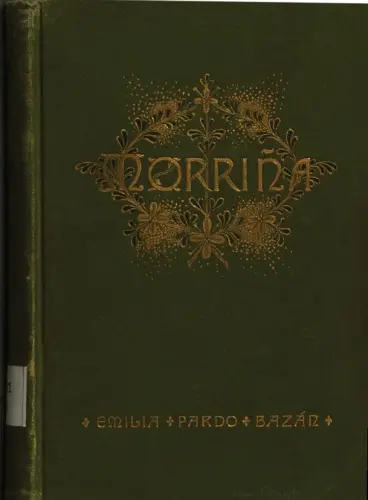
Morriña (Homesickness)
Emilia, condesa de Pardo Bazán
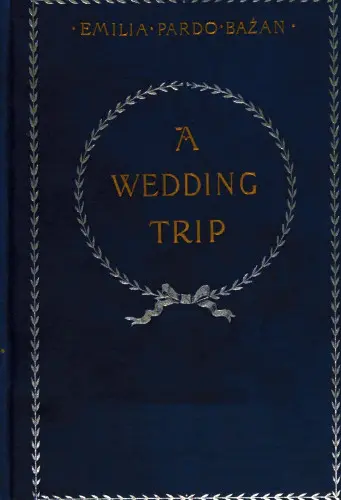
THE CLASSIC COLLECTION · 1891
"A Wedding Trip" by Emilia Pardo Bazán is a novel likely written in the late 19th century. The story revolves around Lucía, a young bride, as she embarks on her journey with her husband, Aurelio Miranda, after a marriage marked by various social dynamics and familial connections. The narrative explores themes of class, relationships, and the expectations surrounding marriage, especially for young women in that era. The opening of the story vividly sets the scene for Lucía's wedding day, illustrating the contrasting social backgrounds of the bride and groom, alongside the emotional farewells exchanged with family. We see Lucía, a figure of robust youth and grace, feeling the weight of her new position while expressing innocence and apprehension about the transition into married life. The departure at the railway station captures a poignant moment of change, with Lucía's tears juxtaposed against her excitement for the adventures ahead. As the couple sets off towards France, the narrative hints at the complexities of their relationship and the challenges that lie ahead, establishing tension about Lucía's path as she navigates her new life.
Introduction adapted from the source catalogue; source summaries may be automatically generated.
Free to read · English · 77,016 words · No account needed
MAKE TIME FOR A GOOD BOOK
On by default. Untick to stop anonymous reading totals. Each page counts after 10 seconds in view. How this works.
Anonymous counting is on unless you have switched it off.
But the weather seemed determined to favor the travelers, and shortly after their arrival in Vichy began a series of days as brilliant and serene as it was possible for days to be in autumn, that season so peculiarly serene, especially in its early part.
The sky was clear and cloudless, the air genial, vegetation in all the plenitude of its splendor of coloring and growth; the afternoons were long, the mornings were bright, and Lucía availed herself of this conjunction of favorable circumstances to persuade Pilar to take a trip into the country in accordance with the doctor’s advice. It was a part of the treatment that Pilar should take rides on a donkey in order that the uneven trot of the animal might serve her as exercise, setting her blood in motion without fatiguing her; and although the sick girl cordially detested this species of conveyance, and, until they emerged from the town, persisted in going on foot, dragging herself laboriously along rather than mount it, yet she consented to do so when they were outside the town. The exercise excited her, and imparted a faint color to her cheeks. Lucía would joke with her about her appearance.
“You see how beneficial it is to ride a spirited steed,” she would say. “You look splendid; you look like a different person; see, to make a conquest, all you have to do is to take a turn up and down as you are now, before the Casino, when the band is playing.”
“Horrors!” exclaimed the sick girl, with a little cry. “What if the Amézegas were to see me--they who never ride except in a jaunting car or a brougham!”
The two friends would go sometimes to the Montagne Verte, sometimes to the Source des Dames, sometimes to the intermittent spring of Vesse. The Montagne Verte is the highest point in the neighborhood of Vichy. The hill is covered with vegetation, but scrubby vegetation, scarcely rising above the surface of the earth, so that from a distance it looked to them like the head of a giant covered with short and very thick hair. When they reached the summit, they ascended to the mirador, and looked through the great field-glass, examining the immense panorama that lay spread before them. The gentle slopes, clad with vines, descended to the Allier, which wound in the distance like an enormous blue snake. Far away the chain of the Fonez raised its snow-capped hills, the giants of Auvergne, vaporous and gray, looked like cloud-phantoms; the castle of Borbon Busset emerged from the mists, its seignorial towers casting into the shade the peaceful palace of Randan, with all the disdain of a legitimate Bourbon for the degenerate branch of Orleans. Lucía’s favorite excursion was to the Source des Dames; a narrow footpath, shaded by leafy trees, gently followed the course of the Sichon, pausing, when the river paused to form a shallow lake, and then continuing its winding course along the border of the tranquil stream. At every step some picturesque accident broke the monotony of the rows of poplars and elms,--now a lavatory, now a little house standing on the river’s brink, now a dam, now a mill, now a duck pond. The mill, in particular, seemed as if it might have been placed there by some landscape painter for artistic effect. Ancient and moss-grown, it rested on wooden posts that were slowly decaying in the water; in the center of the structure the wheel gleamed like an enormous eye shining in the brown and wrinkled forehead of a Cyclops. The drops of liquid silver that leaped from spoke to spoke with every revolution one might fancy tears dropping from the immense eye, and the groan to which the massive wheel gave utterance as it turned completed the resemblance, imitating the breathing of the monster. Through the ill-joined planks of a bridge, boldly thrown across the very bend of the cataract which formed the dam, could be caught glimpses of the water foaming and roaring below. In the dam some half-dozen ducks were lazily paddling, and innumerable sparrows flew hither and thither under the irregular eaves of the roof, while in the dark aperture of one of the irregularly placed windows grew a pot of petunias. Lucía loved to sit and watch the mill from the bank opposite, lulled by the monotonous snore of the wheel and the gentle plash of the water. Pilar preferred the intermittent spring, which procured her the emotions of which her sickly organization was so avid. The spring was reached by a pleasant path, and from the bridge could be obtained a fine view of the surrounding country.
Your reading position is saved on this browser. Take it to another device with a library code. Reading pages adapt to text, rather than matching a printed edition.
Emilia, condesa de Pardo Bazán
Emilia, condesa de Pardo Bazán
BEHIND THE BOOK
This eBook is for the use of anyone anywhere in the United States and most other parts of the world at no cost and with almost no restrictions whatsoever. You may copy it, give it away or re-use it under the terms of the Project Gutenberg License included with this eBook or online at www.gutenberg.org. If you are not located in the United States, you will have to check the laws of the country where you are located before using this eBook. Read the source licence.
The original source file, including credits and licence, is retained by this library. Request an original-format copy at no charge. Please include the book title and Project Gutenberg identifier #54577.
KEEP YOUR CURIOSITY GOING
Coulson Kernahan

Maurice Baring
Frances Wright
Cécile Tormay

Frederic Jesup Stimson

W. H. P. (William Henry Pope) Jarvis