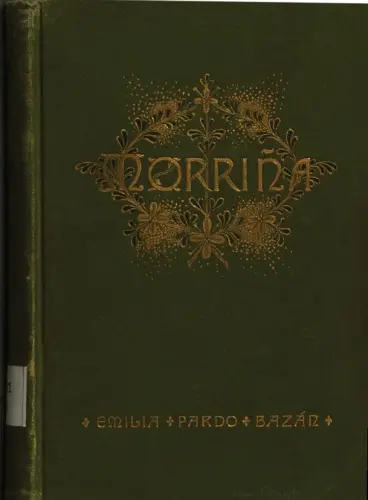
Morriña (Homesickness)
Emilia, condesa de Pardo Bazán
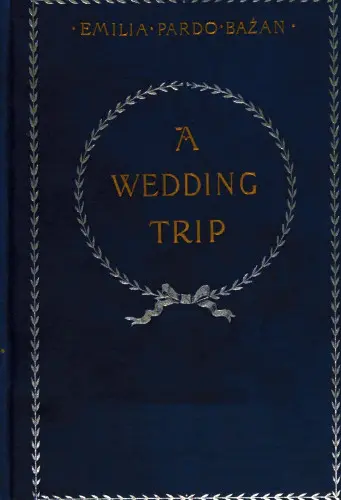
THE CLASSIC COLLECTION · 1891
"A Wedding Trip" by Emilia Pardo Bazán is a novel likely written in the late 19th century. The story revolves around Lucía, a young bride, as she embarks on her journey with her husband, Aurelio Miranda, after a marriage marked by various social dynamics and familial connections. The narrative explores themes of class, relationships, and the expectations surrounding marriage, especially for young women in that era. The opening of the story vividly sets the scene for Lucía's wedding day, illustrating the contrasting social backgrounds of the bride and groom, alongside the emotional farewells exchanged with family. We see Lucía, a figure of robust youth and grace, feeling the weight of her new position while expressing innocence and apprehension about the transition into married life. The departure at the railway station captures a poignant moment of change, with Lucía's tears juxtaposed against her excitement for the adventures ahead. As the couple sets off towards France, the narrative hints at the complexities of their relationship and the challenges that lie ahead, establishing tension about Lucía's path as she navigates her new life.
Introduction adapted from the source catalogue; source summaries may be automatically generated.
Free to read · English · 77,016 words · No account needed
MAKE TIME FOR A GOOD BOOK
On by default. Untick to stop anonymous reading totals. Each page counts after 10 seconds in view. How this works.
Anonymous counting is on unless you have switched it off.
“In company with you,” he said, “with a young and loyal creature who loves life, and feels, and believes, what business had I to speak of anything sad, or to set forth abstruse theories, turning a pleasure excursion into a lecture? Could anything be more absurd? I am a fool. Lucía,” he ended, with naturalness and without bitterness, “you will forgive me for my want of tact, will you not?”
“Yes, Don Ignacio,” she murmured, in a low voice.
Artegui drew his chair toward the fire and sat down, stretching out his hands and feet toward the blaze.
“Are you still cold?” he asked Lucía.
“No, indeed; on the contrary, I am delightfully warm.”
“Let me feel your hands.”
Lucía, without rising, held out her hands to Artegui, who found that they were soft and warm and soon released them.
“On account of the rain,” he continued, “I could not take you a little farther, as I wished to do, to Biarritz, where there are very pretty villas and parks in the English style. Indeed, we enjoyed scarcely anything of the beautiful country. How fragrant the hay and the clover were! And the earth. The smell of freshly turned earth is somewhat pungent but pleasant.”
“What was most fragrant of all was a bed of mint growing by the pond. I am sorry I did not bring a few of the plants with me.”
“Shall I go get you some? I would be back directly.”
“Heavens! What nonsense, Don Ignacio, to think of going for them now,” said Lucía; but the pleasure caused by the offer dyed her cheeks with crimson. “Do you hear how it is raining?” she added, to change the subject.
“The morning gave no indication of the coming storm,” replied Artegui. “France has, in general, a moist climate, and this basin of the Adour is no exception to the rule. It was a pity not to have been able to drive through Biarritz! There are many fine palaces and agreeable places of resort there. I would have taken you to see the Virgin, who, from her station on a rock, seems to command the troubled waters to be still. There could not be a more artistic idea.”
“How! the Virgin!” said Lucía, greatly interested.
“A statue of the Virgin, standing among the rocks; at sunset the effect is marvelous; the statue seems made of gold and is surrounded by a sea of fire. It is like an apparition.”
“Oh, Don Ignacio, will you take me there to-morrow?” cried Lucía, with, eager, wide-open eyes and clasped hands.
Your reading position is saved on this browser. Take it to another device with a library code. Reading pages adapt to text, rather than matching a printed edition.
Emilia, condesa de Pardo Bazán
Emilia, condesa de Pardo Bazán
BEHIND THE BOOK
This eBook is for the use of anyone anywhere in the United States and most other parts of the world at no cost and with almost no restrictions whatsoever. You may copy it, give it away or re-use it under the terms of the Project Gutenberg License included with this eBook or online at www.gutenberg.org. If you are not located in the United States, you will have to check the laws of the country where you are located before using this eBook. Read the source licence.
The original source file, including credits and licence, is retained by this library. Request an original-format copy at no charge. Please include the book title and Project Gutenberg identifier #54577.
KEEP YOUR CURIOSITY GOING
Coulson Kernahan

Maurice Baring
Frances Wright
Cécile Tormay

Frederic Jesup Stimson

W. H. P. (William Henry Pope) Jarvis