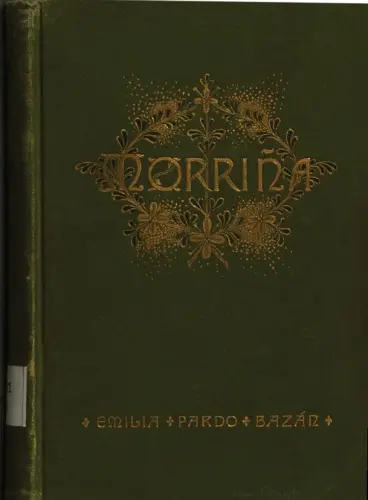
Morriña (Homesickness)
Emilia, condesa de Pardo Bazán
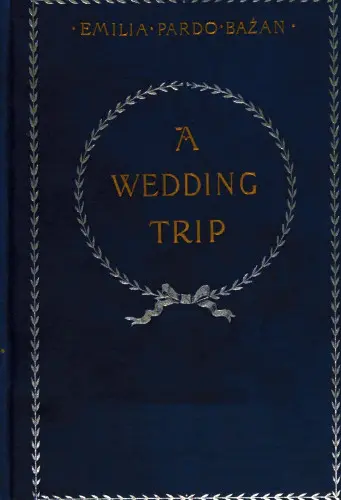
THE CLASSIC COLLECTION · 1891
"A Wedding Trip" by Emilia Pardo Bazán is a novel likely written in the late 19th century. The story revolves around Lucía, a young bride, as she embarks on her journey with her husband, Aurelio Miranda, after a marriage marked by various social dynamics and familial connections. The narrative explores themes of class, relationships, and the expectations surrounding marriage, especially for young women in that era. The opening of the story vividly sets the scene for Lucía's wedding day, illustrating the contrasting social backgrounds of the bride and groom, alongside the emotional farewells exchanged with family. We see Lucía, a figure of robust youth and grace, feeling the weight of her new position while expressing innocence and apprehension about the transition into married life. The departure at the railway station captures a poignant moment of change, with Lucía's tears juxtaposed against her excitement for the adventures ahead. As the couple sets off towards France, the narrative hints at the complexities of their relationship and the challenges that lie ahead, establishing tension about Lucía's path as she navigates her new life.
Introduction adapted from the source catalogue; source summaries may be automatically generated.
Free to read · English · 77,016 words · No account needed
MAKE TIME FOR A GOOD BOOK
On by default. Untick to stop anonymous reading totals. Each page counts after 10 seconds in view. How this works.
Anonymous counting is on unless you have switched it off.
“Is it here--is it here we are to stop for supper?” asked Lucía, whose appetite and curiosity were both alike sharpened by the event, new for her, of supping at the restaurant of a railway station.
“Here”; answered Miranda, speaking much less cheerfully than before. “Now we shall have to change trains. If I had the power, I would alter all this. There can be nothing more annoying. You have to hunt up your luggage so that it may not be carried off to Madrid--you have to move all your traps----”
As he spoke, he took down from the rack the rug, valise, and bundle of umbrellas, but Lucía, youthful and vigorous, daughter of the people as she was, snatched from his hand the bag, which was the heaviest of the articles, and leaping lightly as a bird to the ground, ran toward the restaurant.
They seated themselves at the table set for travelers; a table tasteless in its appointments, that bore the stamp of the vulgar promiscuousness of the guests who succeeded one another at it without intermission. It was long and was covered with oilcloth and surrounded, like a hen by her chickens, by smaller tables, on which were services for tea, coffee, and chocolate. The cups, resting mouth downward on the saucers, seemed waiting patiently for the friendly hand which should restore them to their natural position; the lumps of sugar heaped on metal salvers looked like building materials--blocks of white marble hewn for some Lilliputian palace. The tea-pots displayed their shining paunches and the milk-jugs protruded their lips, like badly brought-up children. The monotony that reigned in the long hall was oppressive. Price-lists, maps, and advertisements hanging from the walls, lent the apartment a certain official air. The end of the room, occupied by a tall counter covered with rows of plates, groups of freshly washed glasses, fruit-dishes in which the pyramids of apples and pears looked pale beside the bright green of the moss around them. On the principal table, in two blue porcelain vases, some drooping flowers--late roses and odorless sunflowers--were slowly withering. The travelers came in one after another and took their places, their features drawn with sleep and fatigue, the men with their traveling caps pulled down over their brows, the women with their heads covered with woolen hoods, their figures concealed by long gray water-proof cloaks, their hair disordered, their cuffs and collars crumpled. Lucía, with her smiling face, her well-fitting jacket and her fresh and natural complexion, formed a striking contrast to the women around her, and it seemed as if the crude yellow light of the gas-jets had concentrated itself above her head, leaving the faces of the other guests in a turbid half-light. They were served the invariable restaurant dinner--vegetable-soup, broiled chops, sapless wings of chickens, warmed-over fish, slices of cold ham, thin as wafers, cheese, and fruits. Miranda ate little, rejecting in turn every dish offered him, and, asking in a loud and authoritative voice for a bottle of Sherry and another of Bordeaux, he poured out some of each of the wines for Lucía, explaining to her their particular qualities. Lucía ate voraciously, giving full rein to her appetite, like a child on a holiday. With each new dish was renewed the enjoyment that a stomach unspoiled and accustomed to simple food experiences in the slightest culinary novelty. She sipped the Bordeaux, clicking her tongue against the roof of her mouth, and declaring that it smelled and tasted like the violets that Velez de Rada used sometimes to bring her. She held up the liquid topaz of the sherry to the light and closed her eyes as she drank it, declaring that it tickled her throat. But her great orgy, her forbidden fruit, was the coffee. We, the faithful and exact chroniclers of Señor Joaquin, the Leonese, have never been able to discover the secret and potent reason which had always made him prohibit the use of coffee to his daughter, as if it were some poisonous drug or pernicious philter; a prohibition all the more inexplicable since we are already aware of the inordinate passion for coffee cherished by our good Colmenarist himself. Lucía, forbidden to taste the black infusion, of which she knew her father swallowed copious draughts every day, had taken it into her head that the prohibited beverage was nectar itself, the very ambrosia of the gods, and she would sometimes say to Rosarito or Carmen, “Wait until I am married, and I will drink as much coffee as I please. You shall see if I don’t.”
Your reading position is saved on this browser. Take it to another device with a library code. Reading pages adapt to text, rather than matching a printed edition.
Emilia, condesa de Pardo Bazán
Emilia, condesa de Pardo Bazán
BEHIND THE BOOK
This eBook is for the use of anyone anywhere in the United States and most other parts of the world at no cost and with almost no restrictions whatsoever. You may copy it, give it away or re-use it under the terms of the Project Gutenberg License included with this eBook or online at www.gutenberg.org. If you are not located in the United States, you will have to check the laws of the country where you are located before using this eBook. Read the source licence.
The original source file, including credits and licence, is retained by this library. Request an original-format copy at no charge. Please include the book title and Project Gutenberg identifier #54577.
KEEP YOUR CURIOSITY GOING
Coulson Kernahan

Maurice Baring
Frances Wright
Cécile Tormay

Frederic Jesup Stimson

W. H. P. (William Henry Pope) Jarvis