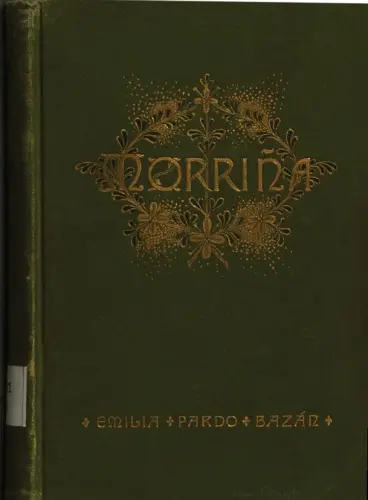
Morriña (Homesickness)
Emilia, condesa de Pardo Bazán
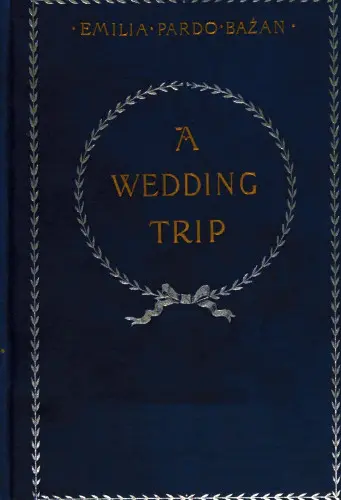
THE CLASSIC COLLECTION · 1891
"A Wedding Trip" by Emilia Pardo Bazán is a novel likely written in the late 19th century. The story revolves around Lucía, a young bride, as she embarks on her journey with her husband, Aurelio Miranda, after a marriage marked by various social dynamics and familial connections. The narrative explores themes of class, relationships, and the expectations surrounding marriage, especially for young women in that era. The opening of the story vividly sets the scene for Lucía's wedding day, illustrating the contrasting social backgrounds of the bride and groom, alongside the emotional farewells exchanged with family. We see Lucía, a figure of robust youth and grace, feeling the weight of her new position while expressing innocence and apprehension about the transition into married life. The departure at the railway station captures a poignant moment of change, with Lucía's tears juxtaposed against her excitement for the adventures ahead. As the couple sets off towards France, the narrative hints at the complexities of their relationship and the challenges that lie ahead, establishing tension about Lucía's path as she navigates her new life.
Introduction adapted from the source catalogue; source summaries may be automatically generated.
Free to read · English · 77,016 words · No account needed
MAKE TIME FOR A GOOD BOOK
On by default. Untick to stop anonymous reading totals. Each page counts after 10 seconds in view. How this works.
Anonymous counting is on unless you have switched it off.
“Silence!” the eloquent eyes suddenly commanded.
And Sardiola obeyed. Duhamel, Miranda, and Perico were entering the room. Duhamel examined the apartment minutely and declared it, in his Lusitanian-French jargon, to be sheltered, convenient, not too high, yet well ventilated, and in every way suitable for the patient. Miranda and Perico retired to the adjoining room to wash themselves after the journey, and tacitly, without debating the question, it was decided that patient and nurse should room together, and that the two men should occupy together also the room in which they were. Miranda interposed no objection to this sacrifice on Lucía’s part; for Duhamel, calling him aside, informed him that the disease was rapidly nearing its fatal termination, and that he thought the sick girl could hardly live a month longer, in view of which fact Miranda silently resolved to depart with his wife in eight or ten days’ time under some pretext or other. But fate, which had ordained that these events should have a very different dénouement, disposed matters in such a way, employing Perico as her instrument, that Miranda very soon began to find himself contented, diverted, and happy in this Parisian Babylon; this gulf among whose reefs and shoals the artful Gonzalvo piloted him with more skill and dexterity than singleness of purpose.
“What the deuce, what the deuce are you going to bury yourself in Leon for now?” exclaimed Perico. “You will have time enough, time enough to bore yourself there! Take my advice and avail yourself of the opportunity. Why, you are well enough now! Those waters have made you look ten years younger.”
The sly fellow knew very well what he was about. Neither her father nor her aunt had manifested any very great desire to come and take care of Pilar, and he foresaw that on him would devolve the disagreeable office of sick nurse. His mind, fertile in wiles, suggested a thousand artifices by which to charm Miranda in that magical city that of itself turns the heads of all who set foot in it. Lucía’s husband made acquaintance with the refinements of the French cuisine in the best restaurateurs, (close your eyes, ye purists!) and the experienced gourmet of middle age came to take a profound interest in the question as to whether the sauce Holandaise were better in this restaurant or in the one two doors below, and when the stuffed mushrooms had their richest flavor. In addition to these gastronomic enjoyments he took pleasure in frequenting the variety theaters, of which there are so many in Paris. He was amused by the comic songs, the contortions of the clown, the rollicking music, and the airy and almost Eden-like costumes of the nymphs, who went disguised as saucepans, violins, or puppets. It is even stated--but on evidence insufficient to establish it as a historical fact--that the illustrious ex-beau sought to recall his past glories and to refresh his dry and withered laurels, and selected for his victim a certain proscenium-rat, in the high-sounding language of the stage, called Zulma, although every one was well aware that in less exalted regions she might be called Antonia, Dionisia, or the like. This creature sang with inimitable grace the refrains of certain chansonnettes, and it was enough to make one split one’s sides laughing to see her when, with her hand on her hip, her right leg in the air, a wink in her eye, and parted lips she uttered some slang expression--a cry from the fish-stands or the market, repeated by her rosy mouth for the delectation and delight of the audience. Nor were these the only graces and accomplishments of the singer, for the choicest part of her repertory, the quintessence of her art, she kept rather for her hours of dalliance with those fortunate mortals who succeeded in obtaining access, well-provided with gold-dust, to this Danaë of the stage. What feline wiles did she employ with her adorers; calling grave men of sixty her little mice, her little dogs, her little cats, her bébés, and other endearing and delightful names, sweeter to them than honey. And what shall I say of the incomparable humor and grace with which she held between her pearly teeth a Russian pipe while she sent into the air wreaths of blue smoke; the contraction of her lips, accentuating the curves of her retroussé nose and the dimples of her puffed-out cheeks? What of the skill with which she balanced herself on two chairs at once without sitting, properly speaking, on either of them, since her shoulders rested against the back of the one and her heels on the seat of the other? What of the agility and dexterity with which she swallowed in ten minutes ten dozen of raw oysters, accompanied with two or three bottles of Rhine wine, so that it almost seemed as if her throat had been annointed with oil to let them slip down smoothly? What of the smiling eloquence with which she proved to some friend that such or such a diamond ring was too small for his finger while it fitted hers as if it had been made for it? In short, if the adventure that was then whispered in the corridors of a certain variety theater and at the table d’hôte of the Alavesa seems unworthy of the traditional splendor of the house of Miranda, at least it is but just to record that its heroine was the most entertaining, cajoling, and dangerous of the feline tribe that then mewed discordantly on the Parisian stage.
Your reading position is saved on this browser. Take it to another device with a library code. Reading pages adapt to text, rather than matching a printed edition.
Emilia, condesa de Pardo Bazán
Emilia, condesa de Pardo Bazán
BEHIND THE BOOK
This eBook is for the use of anyone anywhere in the United States and most other parts of the world at no cost and with almost no restrictions whatsoever. You may copy it, give it away or re-use it under the terms of the Project Gutenberg License included with this eBook or online at www.gutenberg.org. If you are not located in the United States, you will have to check the laws of the country where you are located before using this eBook. Read the source licence.
The original source file, including credits and licence, is retained by this library. Request an original-format copy at no charge. Please include the book title and Project Gutenberg identifier #54577.
KEEP YOUR CURIOSITY GOING
Coulson Kernahan

Maurice Baring
Frances Wright
Cécile Tormay

Frederic Jesup Stimson

W. H. P. (William Henry Pope) Jarvis