Morriña (Homesickness)
Emilia, condesa de Pardo Bazán
THE CLASSIC COLLECTION · 1891
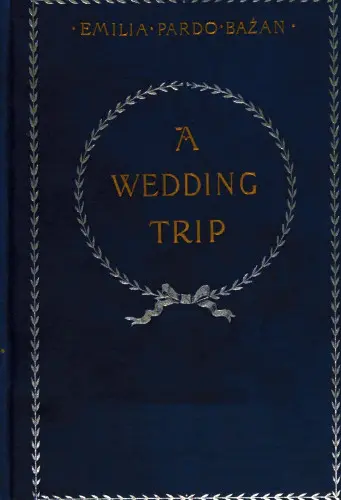
"A Wedding Trip" by Emilia Pardo Bazán is a novel likely written in the late 19th century. The story revolves around Lucía, a young bride, as she embarks on her journey with her husband, Aurelio Miranda, after a marriage marked by various social dynamics and familial connections. The narrative explores themes of class, relationships, and the expectations surrounding marriage, especially for young women in that era. The opening of the story vividly sets the scene for Lucía's wedding day, illustrating the contrasting social backgrounds of the bride and groom, alongside the emotional farewells exchanged with family. We see Lucía, a figure of robust youth and grace, feeling the weight of her new position while expressing innocence and apprehension about the transition into married life. The departure at the railway station captures a poignant moment of change, with Lucía's tears juxtaposed against her excitement for the adventures ahead. As the couple sets off towards France, the narrative hints at the complexities of their relationship and the challenges that lie ahead, establishing tension about Lucía's path as she navigates her new life.
Introduction adapted from the source catalogue; source summaries may be automatically generated.
Free to read · English · 77,016 words · No account needed
MAKE TIME FOR A GOOD BOOK
On by default. Untick to stop anonymous reading totals. Each page counts after 10 seconds in view. How this works.
Anonymous counting is on unless you have switched it off.
“I? Nothing,” answered Lucía, smiling.
“The gown of the Swede must have been lovely--cream-color and heliotrope! I like the combination. But how she is making herself talked about with Albares--a married man! Good need they both have of the waters!”
“Why, I heard your brother say that she does not take the slightest
notice of him.”
“Bah! unless you would have them pay the town-crier to publish it! Albares is a fool, inside and out, who loves to attract attention. The fact is that every one in Vichy is talking about them.”
Lucía remained thoughtful, her gaze fixed on the flower-knots of the park, that looked like enameled medallions fastened on a green satin skirt. They were formed of several varieties of the coleus; those in the center had lance-shaped and brilliant leaves of dark brown, purplish red, brick-red, red of the color of the turkey’s comb, rose-red. At the edge, a row of ruins of Italy, showed their bluish disks against the fresh vivid green of the grass. The larches and the pines formed, here and there, in some retired corner of the park, woody, Swiss-like clumps, their innumerable branches drooping languidly to the ground. Through the light foliage of the majestic catalpas streamed the last rays of the setting sun, and splashes of golden light danced here and there upon the fine sanded walk. The place had the mysterious and secluded air of a temple. A solemn, poetic silence prevailed, which it almost seemed a sacrilege to break by a word or movement.
The visitors had begun to leave the park, the light crunching of the gravel under their feet sounding fainter and fainter in the distance. But the two friends were in the habit of remaining to “lock up the place” as the saying is, for it was precisely at the sunset hour that Lucía thought the park most beautiful in this melancholy autumnal season. The dying rays of the sun, now low in the western sky, fell almost horizontally on the grassy meads, lighting them up with hues like liquid gold. The dark cones of the fir trees dotted this ocean of light in which their shadows were disproportionately prolonged. The plane trees and the Indian chestnuts were dropping their leaves, and from time to time a burr would fall to the ground with a hard, dull sound, and opening allow the shining chestnut to roll out. In the large flower-knots, which contrasted with the green of the grass, the pale eglantine dropped its fragile petals at the faintest breeze, the verbenas trailed themselves languidly, as if weary of life, their capriciously growing stalks breaking the oval outlines of the bed; the sweet milfoil raised its shower of blue stars, and the rare coleuses displayed the exotic tints and the metallic luster of their spotted leaves, resembling the scales of a serpent, white with black spots, green with flesh-colored veins, dark amaranth striped with copperish red. A profound thrill, precursor of winter, ran through all nature, who seemed to have adorned herself in her richest attire for her death. Thus, the virgin vine was arrayed in her splendid purple robe and the white poplar raised coquettishly its plumy white crest; thus the coralline decked itself with chains and rings of blood-red coral and the zinnias ran through the whole scale of vivid colors in their broidered petticoats. The striped maize shook its green and white-striped silken skirts with melodious rustle, and far away on the edge of the meadow, bathed in sunlight, a few tender saplings bent their youthful heads. The dead leaves covered the paths in such abundance that Lucía felt with delight her foot sink up to the ankle in the soft carpet. The contact of the edge of her gown with the leaves produced a quick murmuring sound, like the hurried breathing of some one following close behind; and, a prey to childish terror, she would turn back her head now and again and smile at herself when she saw that her fears were illusory. There were many varieties of leaves, some dark, decayed, almost rotted; others dry, brittle, shriveled; others yellow or still greenish, moist with the sap of the branch through which they had drawn their life. The carpet lay thicker in the shady spots by the borders of the lake, whose surface rippled like undulating glass at the light contact of the evening breeze, breaking into innumerable wavelets, that dashed unceasingly against one another.
Your reading position is saved on this browser. Take it to another device with a library code. Reading pages adapt to text, rather than matching a printed edition.
Emilia, condesa de Pardo Bazán
Emilia, condesa de Pardo Bazán
BEHIND THE BOOK
This eBook is for the use of anyone anywhere in the United States and most other parts of the world at no cost and with almost no restrictions whatsoever. You may copy it, give it away or re-use it under the terms of the Project Gutenberg License included with this eBook or online at www.gutenberg.org. If you are not located in the United States, you will have to check the laws of the country where you are located before using this eBook. Read the source licence.
The original source file, including credits and licence, is retained by this library. Request an original-format copy at no charge. Please include the book title and Project Gutenberg identifier #54577.
KEEP YOUR CURIOSITY GOING
Coulson Kernahan

Maurice Baring
Frances Wright
Cécile Tormay

Frederic Jesup Stimson

W. H. P. (William Henry Pope) Jarvis