THE CLASSIC COLLECTION✦Over Bemerton’sCLASSIC FREE BOOKS
Over Bemerton’s
E. V. (Edward Verrall) Lucas
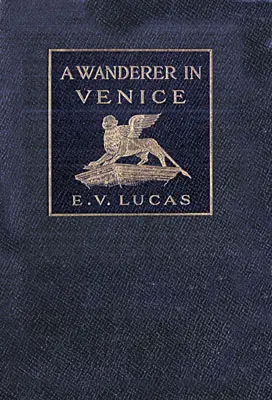
THE CLASSIC COLLECTION · 1914
"A Wanderer in Venice" by E. V. Lucas is a travel narrative written in the early 20th century. This work serves as a personal reflection and a guide to the city of Venice, expressing the author's admiration for its beauty, history, and unique atmosphere. The narrative blends history and personal experience with a descriptive exploration of notable landmarks, such as St. Mark's Basilica, the Grand Canal, and the Doges' Palace. The opening of "A Wanderer in Venice" introduces the allure of Venice, particularly through the first-time visitor's approach to the city. Lucas discusses travel routes, emphasizing the enchanting experience of entering Venice by water, specifically from Chioggia, as a method that enhances the anticipation of seeing the city's stunning architecture. He captures the overwhelming beauty and magical feel of Venice, setting the tone for a journey that focuses not just on the physical visit but also on the emotional and aesthetic responses provoked by this "bride of the Adriatic." The text promises a leisurely examination of Venetian landmarks, infused with history and personal insight, inviting readers to savor the experience alongside him.
Introduction adapted from the source catalogue; source summaries may be automatically generated.
Free to read · English · 97,159 words · No account needed
MAKE TIME FOR A GOOD BOOK
On by default. Untick to stop anonymous reading totals. Each page counts after 10 seconds in view. How this works.
Anonymous counting is on unless you have switched it off.
The twelfth has the months and their employments, divided thus: January (indoors) and February, March blowing his pipes, April with a lamb and May, June (the month of cherries), July with a sheaf of corn and August, September (the vintage), October and November, and December, pig-sticking.
The thirteenth, on a stouter column than the others, because it has a heavier duty, namely, to bear the party wall of the great Council Hall, depicts the life of man. There is no lettering. The scenes represent love (apparently at first sight), courtship, the marriage bed, and so forth, the birth of the baby, his growth and his death. Many years ago this column was shown to me by the captain of a tramp steamer, as the most interesting thing in Venice; and there are others who share his opinion. Above it on the facade is the medallion of the Queen of the Adriatic ruling her domains.
The fourteenth capital represents national types, named: Persian, Latin, Tartar, Turk, Hungarian, Greek, Goth, and Egyptian.
The fifteenth is more elaborate and ingenious. It represents the ages of man and his place in the stellar system. Thus, infancy is governed by the moon, childhood by Mercury, youth by the sun, and so forth.
The sixteenth depicts various craftsmen: the smith, the mason, the goldsmith, the carpenter, the notary, the cobbler, the man-servant, the husbandman. Over this are traces of a medallion, probably of porphyry, now removed.
The seventeenth has the heads of animals: lion, bear, wolf, and so forth, including the griffin each with its prey.
The eighteenth has eight stone-carving saints, some with a piece of coloured marble, all named, and all at work: S. Simplicius, S. Symphorian, who sculps a figure, S. Claudius, and others.
And now we are at the brave corner column which unconcernedly assumes a responsibility that can hardly be surpassed in the world. For if it were to falter all would go. Down would topple two of the loveliest facades that man ever constructed or the centuries ever caressed into greater beauty. This corner of the palace has an ever-increasing fascination for me, and at all hours of the day and night this strong column below and the slenderer one above it hold the light--whether of sun or moon or artifice--with a peculiar grace.
The design of this capital is, fittingly enough, cosmic. It represents the signs of the Zodiac with the addition, on the facet opposite the Dogana, of Christ blessing a child. Facing S. Giorgio are Aquarius and Capricornus, facing the Lido are Pisces and Sagittarius. Elsewhere are Justice on the Bull, the Moon in a boat with a Crab, and a Virgin reading to the Twins.
Your reading position is saved on this browser. Take it to another device with a library code. Reading pages adapt to text, rather than matching a printed edition.
E. V. (Edward Verrall) Lucas
E. V. (Edward Verrall) Lucas
E. V. (Edward Verrall) Lucas
E. V. (Edward Verrall) Lucas
BEHIND THE BOOK
This eBook is for the use of anyone anywhere in the United States and most other parts of the world at no cost and with almost no restrictions whatsoever. You may copy it, give it away or re-use it under the terms of the Project Gutenberg License included with this eBook or online at www.gutenberg.org. If you are not located in the United States, you will have to check the laws of the country where you are located before using this eBook. Read the source licence.
The original source file, including credits and licence, is retained by this library. Request an original-format copy at no charge. Please include the book title and Project Gutenberg identifier #16705.
KEEP YOUR CURIOSITY GOING
Wilfrid Scawen Blunt
Wilfrid Scawen Blunt

E. W. (Edgar Watson) Howe
Cécile Tormay

Moritz Busch
John L. Ransom