THE CLASSIC COLLECTION✦An outlaw’s diary: the CommuneCLASSIC FREE BOOKS
An outlaw’s diary: the Commune
Cécile Tormay
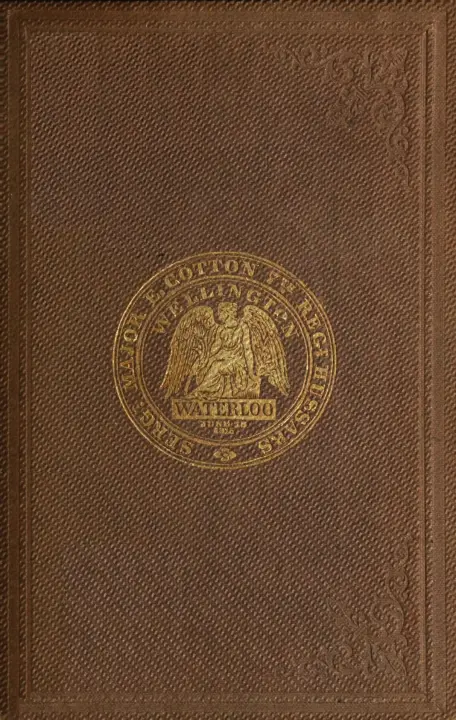
THE CLASSIC COLLECTION · 1852
“A Voice from Waterloo: A History of the Battle Fought on the 18th June, 1815” by Sergeant-Major Edward Cotton is a historical account written in the mid-19th century. This narrative seeks to provide a detailed and authentic perspective of the iconic Battle of Waterloo, focusing on Cotton's experiences as a soldier who witnessed and participated in the events. The work is thorough in correcting misconceptions and presenting factual information, combining personal observation with historical insights. The opening of the book begins with a preface where Sergeant Cotton expresses his admiration for the Duke of Wellington and reveals his unique position in narrating events, having spent over fourteen years as a guide on the battlefield. He acknowledges the difficulty of accurately portraying the battle due to the numerous conflicting accounts published over the years and outlines his aim to rectify such errors. Cotton outlines the political and military atmosphere leading up to the battle, detailing Napoleon's return from exile and his subsequent mobilization of the French army. The preparations of the allied forces, led by Wellington, are outlined, along with tactical considerations that inform the narrative that follows. Overall, the beginning sets the stage for a comprehensive exploration of the events surrounding the battle, emphasizing Cotton's direct encounters and the roles played by key figures.
Introduction adapted from the source catalogue; source summaries may be automatically generated.
Free to read · English · 99,423 words · No account needed
MAKE TIME FOR A GOOD BOOK
On by default. Untick to stop anonymous reading totals. Each page counts after 10 seconds in view. How this works.
Anonymous counting is on unless you have switched it off.
The 1st brigade, King’s German legion, under colonel Duplat, was composed of the 1st, 2d, 3d, and 4th line battalions. The 3d, Hanoverian brigade, under colonel Hugh Halkett, consisted of the militia battalions, Osnabruck, Salzgitter, Bremeverden, and Quakenbruck.
The Brunswick corps, after their duke had fallen, were under colonel Olfermann, also near Merbe-Braine. Along the Hougoumont avenue and the road leading from it to Braine-l’Alleud, were some light troops, who, in conjunction with the hussars posted on their right, had in the morning, before the battle began, a sharp skirmish with the enemy. They were part of the fourth brigade of the 4th division, under colonel Mitchell, and attached to the 2d division, composed of the 51st regiment, lieutenant-colonel Rice, the 15th regiment, lieutenant-colonel Tidy, and of the 32d fuzileers, colonel sir H. Ellis; the latter came into front line during the afternoon.
On the right of the former, was a squadron of the 15th hussars, under captain Wodehouse, who threw out vedettes and kept a look-out upon our extreme right. Upon the Nivelles road, opposite the Hougoumont avenue, was an abattis, or barricade. Near Mitchell’s brigade were posted, about two o’clock, two companies of the Coldstream guards, with their colours, in reserve.
Upon the ridge above and overlooking, Hougoumont was posted the 1st division of British guards, composed of the 2d battalion of the Coldstream guards, colonel Woodford, who was a little in advance; the 2d battalion of the 3d guards, colonel Hepburn, posted a little in rear of the crest of the ridge. The whole were in battalion columns, with deploying intervals, and in chequer.
On their left was the first brigade, composed of the 2d battalion of the 1st guards[25], colonel Askew, and posted in rear; and of the 3d battalion, colonel the Hon. W. Stuart, posted a little in advance of the crest.
On the left of Maitland, was the 3d division, under lieutenant-general count Alten; the 5th British brigade, composed of the 30th, colonel Hamilton, and the 73d, colonel G. Harris, posted in advance; and of the 33d, colonel Elphinstone, with the 69th, colonel Morice, posted upon the right rear of the 30th and 73d. The four regiments formed and acted as two.
On their left was the 1st Hanoverian brigade, under major-general count Kielmansegge. The field battalions of Bremen, Verden, York, Grubenhagen and Luneburg were posted three in front and two in second line.
Your reading position is saved on this browser. Take it to another device with a library code. Reading pages adapt to text, rather than matching a printed edition.
BEHIND THE BOOK
This eBook is for the use of anyone anywhere in the United States and most other parts of the world at no cost and with almost no restrictions whatsoever. You may copy it, give it away or re-use it under the terms of the Project Gutenberg License included with this eBook or online at www.gutenberg.org. If you are not located in the United States, you will have to check the laws of the country where you are located before using this eBook. Read the source licence.
The original source file, including credits and licence, is retained by this library. Request an original-format copy at no charge. Please include the book title and Project Gutenberg identifier #69670.
KEEP YOUR CURIOSITY GOING
Cécile Tormay

Moritz Busch
John L. Ransom
Frances Wright
Cécile Tormay

Mabel Potter Daggett