THE CLASSIC COLLECTION✦An outlaw’s diary: the CommuneCLASSIC FREE BOOKS
An outlaw’s diary: the Commune
Cécile Tormay
THE CLASSIC COLLECTION · 1852
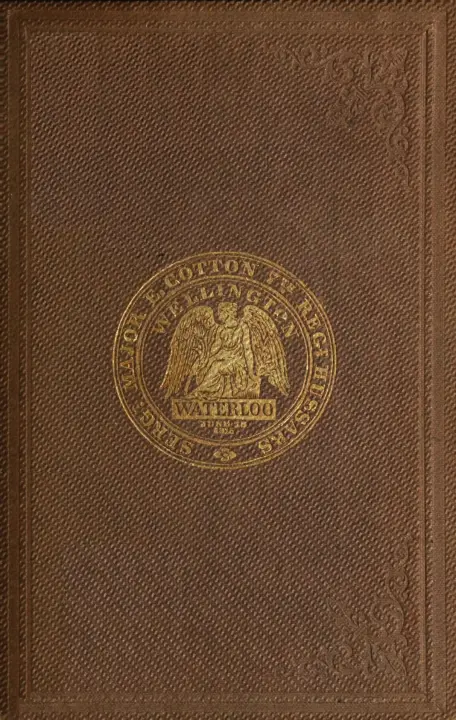
“A Voice from Waterloo: A History of the Battle Fought on the 18th June, 1815” by Sergeant-Major Edward Cotton is a historical account written in the mid-19th century. This narrative seeks to provide a detailed and authentic perspective of the iconic Battle of Waterloo, focusing on Cotton's experiences as a soldier who witnessed and participated in the events. The work is thorough in correcting misconceptions and presenting factual information, combining personal observation with historical insights. The opening of the book begins with a preface where Sergeant Cotton expresses his admiration for the Duke of Wellington and reveals his unique position in narrating events, having spent over fourteen years as a guide on the battlefield. He acknowledges the difficulty of accurately portraying the battle due to the numerous conflicting accounts published over the years and outlines his aim to rectify such errors. Cotton outlines the political and military atmosphere leading up to the battle, detailing Napoleon's return from exile and his subsequent mobilization of the French army. The preparations of the allied forces, led by Wellington, are outlined, along with tactical considerations that inform the narrative that follows. Overall, the beginning sets the stage for a comprehensive exploration of the events surrounding the battle, emphasizing Cotton's direct encounters and the roles played by key figures.
Introduction adapted from the source catalogue; source summaries may be automatically generated.
Free to read · English · 99,423 words · No account needed
MAKE TIME FOR A GOOD BOOK
On by default. Untick to stop anonymous reading totals. Each page counts after 10 seconds in view. How this works.
Anonymous counting is on unless you have switched it off.
Thanks of the Prince Regent and the parliament for Orthez 24th March, 1814. Advanced in the British peerage by the titles of Marquis of Douro and Duke of Wellington 3d May, 1814. A grant of 400,000l. voted by parliament, in addition to the former grants 24th June, 1814. Ambassador to France 5th July, 1814. Assists at Congress at Vienna January, 1815. Takes command of the British forces on the continent 11th April, 1815. Battle of Waterloo 18th June, 1815. Thanks of the Prince Regent and parliament for Waterloo 22d June, 1815. A grant of 200,000l. voted by parliament, in addition to the former grants 6th July, 1815. Created Prince of Waterloo by the king of the Netherlands 18th July, 1815. Commander in chief of the allied armies of occupation 22d October, 1815. Appointed Field-Marshal in the Austrian, Russian and Prussian armies 15th November, 1818. Visits Waterloo with George IV 1st October, 1821. Commander in Chief 22d January, 1827. First Lord of the Treasury 13th February, 1828. Appointed Lord Warden of the Cinque Ports 20th January, 1829. Elected Chancellor of the University of Oxford 29th January, 1834.
No. IV.
The reader should be aware, that in military returns, the figures which represent the strength of regiments often greatly exceed the actual number of effective men present. There are always numerous casualties, not accounted for in returns, particularly before a battle. The missing are not all eventually loss; for, if not taken prisoners most of them join after the strife. The strength of the British was of course greater on the 16th, before the action at Quatre-Bras, where the loss was particularly severe, as may be seen in the subjoined tables, in the 1st foot-guards, 1st Royal Scots, 32d, 33d, 42d, 44th, 69th, 79th, and 92d regiments.
The officers who afterwards died of their wounds, are here returned
killed.
of the strength (officers, non-commissionned officers, drummers, trumpeters, rank and file) of the British army, on the morning of the 18th of June 1815; and of the total loss, in killed, wounded and missing, on the three days: 16th, 17th, and 18th.
KILLED.—The duke of Brunswick, sir Thomas Picton, sir William Ponsonby. Colonel sir William De Lancey. Lieutenant-colonel Currie. Captains: W. Crofton (54th Reg.), T. Smith (93d Reg.).
WOUNDED.—H.R.H. the prince of Orange. Lieutenant-general sir G. Cooke. Major-generals: Sir E. Barnes, sir James Kempt, sir Colin Halkett, sir Denis Pack, sir Colquhoun Grant, sir W. Dornberg, sir F. Adam. Lieutenant-colonels: Waters, sir G. Berkeley (35th Reg.). Majors: A. Hamilton, Hunter Blair, Hon. G. Dawson. Captains: Hon. E. S. Erskine, E. Fitzgerald (25th Reg.), W. Murray, H. Seymour, T. Wright, H. M^cLeod, J. Mitchell (25th Reg.), J. Tyler, A. Langton, H. Dumaresque. Lieutenants: W. Havelock (43d Reg.), J. Hamilton (46th Reg.), J. Rooke, D. Hall.
Your reading position is saved on this browser. Take it to another device with a library code. Reading pages adapt to text, rather than matching a printed edition.
BEHIND THE BOOK
This eBook is for the use of anyone anywhere in the United States and most other parts of the world at no cost and with almost no restrictions whatsoever. You may copy it, give it away or re-use it under the terms of the Project Gutenberg License included with this eBook or online at www.gutenberg.org. If you are not located in the United States, you will have to check the laws of the country where you are located before using this eBook. Read the source licence.
The original source file, including credits and licence, is retained by this library. Request an original-format copy at no charge. Please include the book title and Project Gutenberg identifier #69670.
KEEP YOUR CURIOSITY GOING
Cécile Tormay

Moritz Busch
John L. Ransom
Frances Wright
Cécile Tormay

Mabel Potter Daggett