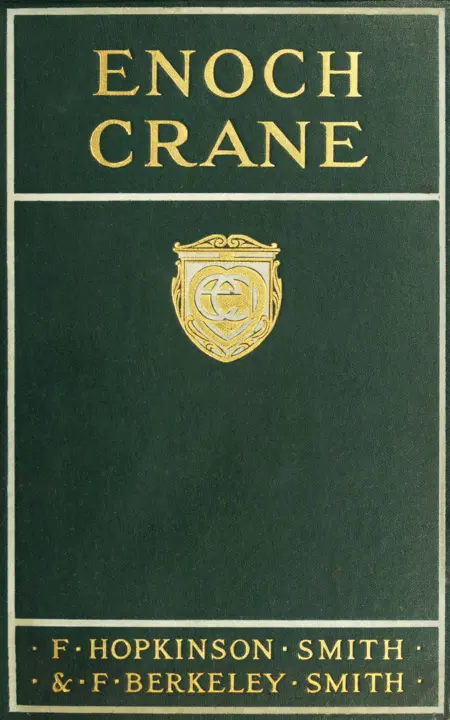
Enoch Crane
Francis Hopkinson Smith & F. Berkeley (Frank Berkeley) Smith

THE CLASSIC COLLECTION · 1910
"A Village of Vagabonds" by F. Berkeley Smith is a novel written in the early 20th century. The story revolves around a group of charming characters in a quaint fishing village called Pont du Sable, a place filled with endearing peculiarities, camaraderie, and secrets. The protagonist, a passionate artist, has abandoned his comfortable life to fully embrace the beauty and rustic allure of the village, leading to a series of encounters that explore friendship, love, and the captivating simplicity of rural life. The opening of the novel introduces us to the protagonist as he decides to move to Pont du Sable, despite the protests from his friends who dismiss the village as a "lost hole of a village of sacré vagabonds." Set against the backdrop of market day at Madame Fontaine’s café, we gain insight into the protagonist's desire for a deeper connection with nature and his love for hunting, having become enchanted by his visits to the marshlands. Through his reflections on the village life and the interesting characters he meets, including a friendly butcher, a blacksmith, and the local mayor, the reader is drawn into the vibrant world of Pont du Sable, hinting at the adventures and relationships that will unfold as the story progresses.
Introduction adapted from the source catalogue; source summaries may be automatically generated.
Free to read · English · 64,423 words · No account needed
MAKE TIME FOR A GOOD BOOK
On by default. Untick to stop anonymous reading totals. Each page counts after 10 seconds in view. How this works.
Anonymous counting is on unless you have switched it off.
"Well, the saints did not desert us. Ah, mais non! For about four o'clock in the afternoon the captain sighted Su-Tum-Tum."
"Sighted what?" I exclaimed.
"Eh ben! Su-Tum-Tum," he replied.
"Where had you drifted? To the Corean coast?"
"Mais non," he retorted, annoyed at my dullness to comprehend. "We were saved--comprenez-vous?--for there, to starboard, lay Su-Tum-Tum as plain as a sheep's nose."
"England? Impossible!" I returned.
"Mais parfaitement!" he declared, with a hopeless gesture. "Su-Tum-Tum," he reiterated slowly for my benefit.
"Never heard of it," I replied.
The next instant he was out of his chair, and fumbling in a drawer of the table extracted a warped atlas, reseated himself, and began to turn the pages.
"Eh, voila!" he cried as his forefinger stopped under a word along the English coast. "That's Su-Tum-Tum plain enough, isn't it?"
"Ah! Southampton!" I exclaimed. "Of course--plain as day."
"Ah!" ejaculated the mayor, leaning back in his chair with a broad smile of satisfaction. "You see, I was right, Su-Tum-Tum. Eh ben! Do you know," he said gently as I left him, "when you first came to Pont du Sable there were times then, my poor friend, when I could not understand a word you said in French."
Then, as if a sudden thought had struck him, he called me back as he
closed the gate.
"Are those gipsies still camped outside your wall?" he inquired, suddenly assuming the dignity of his office. "Bon Dieu! They are a bad lot, those vagabonds! If I don't tell them to be off you won't have a duck or a chicken left."
"Let them stay," I pleaded, "they do no harm. Besides, I like to see the light of their camp-fire at night scurrying over my wall."
"How many are there?" inquired his excellency.
"Seven or eight, not counting the dogs chained under the wagons," I confessed reluctantly, fearing the hand of the law, for I have a fondness for gipsies. "But you need not worry about them. They won't steal from me. Their wagons are clean inside and out."
"Ah, mais!" sighed the mayor. "It's just like you. You spoil your cat, you spoil your dog, and now you're spoiling these rascals by giving them a snug berth. Have they their papers of identity?"
"Yes," I called back, "the chief showed them to me when he asked
permission to camp."
"Of course," laughed the mayor. "You'll never catch them without them--signed by officials we never can trace."
He waved me a cheery au revoir and returned to the well of the groaning windlass while I continued on my way through the village.
Your reading position is saved on this browser. Take it to another device with a library code. Reading pages adapt to text, rather than matching a printed edition.
Francis Hopkinson Smith & F. Berkeley (Frank Berkeley) Smith

F. Berkeley (Frank Berkeley) Smith

F. Berkeley (Frank Berkeley) Smith
BEHIND THE BOOK
This eBook is for the use of anyone anywhere in the United States and most other parts of the world at no cost and with almost no restrictions whatsoever. You may copy it, give it away or re-use it under the terms of the Project Gutenberg License included with this eBook or online at www.gutenberg.org. If you are not located in the United States, you will have to check the laws of the country where you are located before using this eBook. Read the source licence.
The original source file, including credits and licence, is retained by this library. Request an original-format copy at no charge. Please include the book title and Project Gutenberg identifier #26678.
KEEP YOUR CURIOSITY GOING
Coulson Kernahan

Maurice Baring
Frances Wright
Cécile Tormay

Frederic Jesup Stimson

W. H. P. (William Henry Pope) Jarvis