
Letters to a Friend, Written to Mrs. Ezra S. Carr, 1866-1879
John Muir
THE CLASSIC COLLECTION · 1728
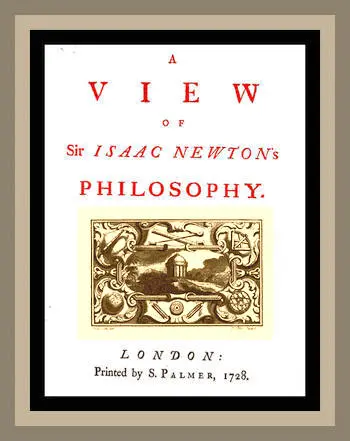
"A View of Sir Isaac Newton's Philosophy" by Henry Pemberton is a scientific publication written in the early 18th century. This work serves as a commentary and introduction to the groundbreaking ideas and methodologies developed by Sir Isaac Newton, a pivotal figure in the scientific revolution. The text aims to elucidate Newton's complex theories for readers who may not be well-versed in mathematics while celebrating his contributions to science and reason. The opening of this work presents a preface in which Pemberton describes his motivation for writing the book, following the encouragement of friends upon the publication of a new edition of Newton's "Principia." Pemberton expresses admiration for Newton's intellectual achievements, reflecting on how they have expanded humanity's understanding of the natural world. He sets a tone of reverence, acknowledging Newton's profound impact on science and his status as a national pride. Additionally, he shares personal anecdotes about his acquaintance with Newton and outlines his intentions for making Newton's philosophy accessible while also inspiring a new generation of mathematicians.
Introduction adapted from the source catalogue; source summaries may be automatically generated.
Free to read · English · 134,972 words · No account needed
MAKE TIME FOR A GOOD BOOK
On by default. Untick to stop anonymous reading totals. Each page counts after 10 seconds in view. How this works.
Anonymous counting is on unless you have switched it off.
22. AFTER the same manner, if the body were thrown upwards in the oblique straight line C A (in fig. 9.) from the point C, with such a degree of velocity as just to reach the point A; it shall by its own weight return again through the line A C by the same degrees, as it ascended.
23. AND lastly, if a body were thrown with any velocity in a line continually incurvated upwards, the like effect will be produced upon its return to the point, whence it was thrown. Suppose for instance, the body A (in fig. 12.) were hung by a string A B. Then if this body be impelled any way, it must move in the arch of a circle. Let it receive such an impulse, as shall cause it to move in the arch A C; and let this impulse be of such strength, that the body may be carried from A as far as D, before its motion is overcome by its weight: I say here, that the body forthwith returning from D, shall come again into the point A with the same velocity, as that wherewith it began to move.
24. IT will be proper in this place to observe concerning the power of gravity, that its force upon any body does not at all depend upon the shape of the body; but that it continues constantly the same without any variation in the same body, whatever change be made in the figure of the body: and if the body be divided into any number of pieces, all those pieces shall weigh just the same, as they did, when united together in one body: and if the body be of a uniform contexture, the weight of each piece will be proportional to its bulk. This has given reason to conclude, that the power of gravity acts upon bodies in proportion to the quantity of matter in them. Whence it should follow, that all bodies must fall from equal heights in the same space of time. And as we evidently see the contrary in feathers and such like substances, which fall very slowly in comparison of more solid bodies; it is reasonable to suppose, that some other cause concurs to make so manifest a difference. This cause has been found by particular experiments to be the air. The experiments for this purpose are made thus. They set up a very tall hollow glass; within which near the top they lodge a feather and some very ponderous body, usually a piece of gold, this metal being the most weighty of any body known to us. This glass they empty of the air contained within it, and by moving a wire, which passes through the top of the glass, they let the feather and the heavy body fall together; and it is always found, that as the two bodies begin to descend at the same time, so they accompany each other in the fall, and come to the bottom at the very same instant, as near as the eye can judge. Thus, as far as this experiment can be depended on, it is certain, that the effect of the power of gravity upon each body is proportional to the quantity of solid matter, or to the power of inactivity in each body. For in the limited sense, which we have given above to the word motion, it has been shown, that the same force gives to all bodies the same degree of motion, and different forces communicate different degrees of motion proportional to the respective powers[51]. In this case, if the power of gravity were to act equally upon the feather, and upon the more solid body, the solid body would descend so much slower than the feather, as to have no greater degree of motion than the feather: but as both bodies descend with equal swiftness, the degree of motion in the solid body is greater than in the feather, bearing the same proportion to it, as the quantity of matter in the solid body to the quantity of matter in the feather. Therefore the effect of gravity on the solid body is greater than on the feather, in proportion to the greater degree of motion communicated; that is, the effect of the power of gravity on the solid body bears the same proportion to its effect on the feather, as the quantity of matter in the solid body bears to the quantity of matter in the feather. Thus it is the proper deduction from this experiment, that the power of gravity acts not on the surface of bodies only, but penetrates the bodies themselves most intimately, and operates alike on every particle of matter in them. But as the great quickness, with which the bodies fall, leaves it something uncertain, whether they do descend absolutely in the same time, or only so nearly together, that the difference in their swift motion is not discernable to the eye; this property of the power of gravity, which has here been deduced from this experiment, is farther confirmed by pendulums, whose motion is such, that a very minute difference would become sufficiently sensible. This will be farther discoursed on in another place[52]; but here I shall make use of the principle now laid down to explain the nature of what is called the center of gravity in bodies.
Your reading position is saved on this browser. Take it to another device with a library code. Reading pages adapt to text, rather than matching a printed edition.
BEHIND THE BOOK
This eBook is for the use of anyone anywhere in the United States and most other parts of the world at no cost and with almost no restrictions whatsoever. You may copy it, give it away or re-use it under the terms of the Project Gutenberg License included with this eBook or online at www.gutenberg.org. If you are not located in the United States, you will have to check the laws of the country where you are located before using this eBook. Read the source licence.
The original source file, including credits and licence, is retained by this library. Request an original-format copy at no charge. Please include the book title and Project Gutenberg identifier #53161.
KEEP YOUR CURIOSITY GOING
John Muir

Asa Gray
Asa Gray

Florence Nightingale
Elizabeth Robins Pennell
Denison Olmsted