
Letters to a Friend, Written to Mrs. Ezra S. Carr, 1866-1879
John Muir
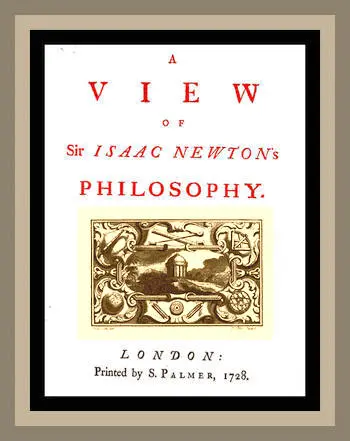
THE CLASSIC COLLECTION · 1728
"A View of Sir Isaac Newton's Philosophy" by Henry Pemberton is a scientific publication written in the early 18th century. This work serves as a commentary and introduction to the groundbreaking ideas and methodologies developed by Sir Isaac Newton, a pivotal figure in the scientific revolution. The text aims to elucidate Newton's complex theories for readers who may not be well-versed in mathematics while celebrating his contributions to science and reason. The opening of this work presents a preface in which Pemberton describes his motivation for writing the book, following the encouragement of friends upon the publication of a new edition of Newton's "Principia." Pemberton expresses admiration for Newton's intellectual achievements, reflecting on how they have expanded humanity's understanding of the natural world. He sets a tone of reverence, acknowledging Newton's profound impact on science and his status as a national pride. Additionally, he shares personal anecdotes about his acquaintance with Newton and outlines his intentions for making Newton's philosophy accessible while also inspiring a new generation of mathematicians.
Introduction adapted from the source catalogue; source summaries may be automatically generated.
Free to read · English · 134,972 words · No account needed
MAKE TIME FOR A GOOD BOOK
On by default. Untick to stop anonymous reading totals. Each page counts after 10 seconds in view. How this works.
Anonymous counting is on unless you have switched it off.
THE Deity’s omnipotence, the cause,
Th’ original of things long lay unknown.
Alone the beauties prominent to sight
(Of the celestial power the outward form)
Drew praise and wonder from the gazing world.
As when the deluge overspread the earth,
Whilst yet the mountains only rear’d their heads
Above the surface of the wild expanse,
Whelm’d deep below the great foundations lay,
Till some kind angel at heav’n’s high command
Roul’d back the rising tides, and haughty floods,
And to the ocean thunder’d out his voice:
Quick all the swelling and imperious waves,
The foaming billows and obscuring surge,
Back to their channels and their ancient seats
Recoil affrighted: from the darksome main
Earth raises smiling, as new-born, her head,
And with fresh charms her lovely face arrays.
So his extensive thought accomplish’d first
The mighty task to drive th’ obstructing mists
Of ignorance away, beneath whose gloom
Th’ inshrouded majesty of Nature lay.
He drew the veil and swell’d the spreading scene.
How had the moon around th’ ethereal void
Rang’d, and eluded lab’ring mortals care,
Till his invention trac’d her secret steps,
While she inconstant with unsteady rein
Through endless mazes and meanders guides
In its unequal course her changing carr:
Whether behind the sun’s superior light
She hides the beauties of her radiant face,
Or, when conspicuous, smiles upon mankind,
Unveiling all her night-rejoicing charms.
When thus the silver-tressed moon dispels
The frowning horrors from the brow of night,
And with her splendors chears the sullen gloom,
While sable-mantled darkness with his veil
The visage of the fair horizon shades,
And over nature spreads his raven wings;
Let me upon some unfrequented green
While sleep sits heavy on the drowsy world,
Seek out some solitary peaceful cell,
Where darksome woods around their gloomy brows
Bow low, and ev’ry hill’s protended shade
Obscures the dusky vale, there silent dwell,
Where contemplation holds its still abode,
There trace the wide and pathless void of heav’n,
And count the stars that sparkle on its robe.
Or else in fancy’s wild’ring mazes lost
Upon the verdure see the fairy elves
Dance o’er their magick circles, or behold,
In thought enraptur’d with the ancient bards,
Medea’s baleful incantations draw
Down from her orb the paly queen of night.
But chiefly ~NEWTON~ let me soar with thee,
And while surveying all yon starry vault
With admiration I attentive gaze,
Thou shalt descend from thy celestial seat,
And waft aloft my high-aspiring mind,
Shalt shew me there how nature has ordain’d
Her fundamental laws, shalt lead my thought
Through all the wand’rings of th’ uncertain moon,
And teach me all her operating powers.
She and the sun with influence conjoint
Wield the huge axle of the whirling earth,
And from their just direction turn the poles,
Slow urging on the progress of the years.
The constellations seem to leave their seats,
And o’er the skies with solemn pace to move.
You, splendid rulers of the day and night,
The seas obey, at your resistless sway
Now they contract their waters, and expose
The dreary desart of old ocean’s reign.
The craggy rocks their horrid sides disclose;
Trembling the sailor views the dreadful scene,
And cautiously the threat’ning ruin shuns.
But where the shallow waters hide the sands,
There ravenous destruction lurks conceal’d,
There the ill-guided vessel falls a prey,
And all her numbers gorge his greedy jaws.
But quick returning see th’ impetuous tides
Back to th’ abandon’d shores impell the main.
Again the foaming seas extend their waves,
Again the rouling floods embrace the shoars,
And veil the horrours of the empty deep.
Thus the obsequious seas your power confess,
While from the surface healthful vapours rise
Plenteous throughout the atmosphere diffus’d,
Or to supply the mountain’s heads with springs,
Or fill the hanging clouds with needful rains,
That friendly streams, and kind refreshing show’rs
May gently lave the sun-burnt thirsty plains,
Or to replenish all the empty air
With wholsome moisture to increase the fruits
Of earth, and bless the labours of mankind.
O ~NEWTON~, whether flies thy mighty soul,
How shall the feeble muse pursue through all
The vast extent of thy unbounded thought,
That even seeks th’ unseen recesses dark
To penetrate of providence immense.
And thou the great dispenser of the world
Propitious, who with inspiration taught’st
Our greatest bard to send thy praises forth;
Thou, who gav’st ~NEWTON~ thought; who smil’dst serene,
When to its bounds he stretch’d his swelling soul;
Who still benignant ever blest his toil,
And deign’d to his enlight’ned mind t’ appear
Confess’d around th’ interminated world:
To me O thy divine infusion grant
(O thou in all so infinitely good)
That I may sing thy everlasting works,
Thy inexhausted store of providence,
In thought effulgent and resounding verse.
O could I spread the wond’rous theme around,
Where the wind cools the oriental world,
To the calm breezes of the Zephir’s breath,
To where the frozen hyperborean blasts.
To where the boist’rous tempest-leading south
From their deep hollow caves send forth their storms.
Thou still indulgent parent of mankind,
Left humid emanations should no more
Flow from the ocean, but dissolve away
Through the long series of revolving time;
And left the vital principle decay,
By which the air supplies the springs of life;
Thou hast the fiery visag’d comets form’d
With vivifying spirits all replete,
Which they abundant breathe about the void,
Renewing the prolifick soul of things.
No longer now on thee amaz’d we call,
No longer tremble at imagin’d ills,
When comets blaze tremendous from on high,
Or when extending wide their flaming trains
With hideous grasp the skies engirdle round,
And spread the terrors of their burning locks.
For these through orbits in the length’ning space
Of many tedious rouling years compleat
Around the sun move regularly on;
And with the planets in harmonious orbs,
And mystick periods their obeysance pay
To him majestick ruler of the skies
Upon his throne of circled glory fixt.
He or some god conspicuous to the view,
Or else the substitute of nature seems,
Guiding the courses of revolving worlds.
He taught great ~NEWTON~ the all-potent laws
Of gravitation, by whose simple power
The universe exists. Nor here the sage
Big with invention still renewing staid.
But O bright angel of the lamp of day,
How shall the muse display his greatest toil?
Let her plunge deep in Aganippe’s waves,
Or in Castalia’s ever-flowing stream,
That re-inspired she may sing to thee,
How ~NEWTON~ dar’d advent’rous to unbraid
The yellow tresses of thy shining hair.
Or didst thou gracious leave thy radiant sphere,
And to his hand thy lucid splendours give,
T’ unweave the light-diffusing wreath, and part
The blended glories of thy golden plumes?
He with laborious, and unerring care,
How different and imbodied colours form
Thy piercing light, with just distinction found.
He with quick sight pursu’d thy darting rays,
When penetrating to th’ obscure recess
Of solid matter, there perspicuous saw,
How in the texture of each body lay
The power that separates the different beams.
Hence over nature’s unadorned face
Thy bright diversifying rays dilate
Their various hues: and hence when vernal rains
Descending swift have burst the low’ring clouds,
Thy splendors through the dissipating mists
In its fair vesture of unnumber’d hues
Array the show’ry bow. At thy approach
The morning risen from her pearly couch
With rosy blushes decks her virgin cheek;
The ev’ning on the frontispiece of heav’n
His mantle spreads with many colours gay;
The mid-day skies in radiant azure clad,
The shining clouds, and silver vapours rob’d
In white transparent intermixt with gold,
With bright variety of splendor cloath
All the illuminated face above.
When hoary-headed winter back retires
To the chill’d pole, there solitary sits
Encompass’d round with winds and tempests bleak
In caverns of impenetrable ice,
And from behind the dissipated gloom
Like a new Venus from the parting surge
The gay-apparell’d spring advances on;
When thou in thy meridian brightness sitt’st,
And from thy throne pure emanations flow
Of glory bursting o’er the radiant skies:
Then let the muse Olympus’ top ascend,
And o’er Thessalia’s plain extend her view,
And count, O Tempe, all thy beauties o’er.
Mountains, whose summits grasp the pendant clouds,
Between their wood-invelop’d slopes embrace
The green-attired vallies. Every flow’r
Here in the pride of bounteous nature clad
Smiles on the bosom of th’ enamell’d meads.
Over the smiling lawn the silver floods
Of fair Peneus gently roul along,
While the reflected colours from the flow’rs,
And verdant borders pierce the lympid waves,
And paint with all their variegated hue
The yellow sands beneath. Smooth gliding on
The waters hasten to the neighbouring sea.
Still the pleas’d eye the floating plain pursues;
At length, in Neptune’s wide dominion lost,
Surveys the shining billows, that arise
Apparell’d each in Phœbus’ bright attire:
Or from a far some tall majestick ship,
Or the long hostile lines of threat’ning fleets,
Which o’er the bright uneven mirror sweep,
In dazling gold and waving purple deckt;
Such as of old, when haughty Athens power
Their hideous front, and terrible array
Against Pallene’s coast extended wide,
And with tremendous war and battel stern
The trembling walls of Potidæa shook.
Crested with pendants curling with the breeze
The upright masts high bristle in the air,
Aloft exalting proud their gilded heads.
The silver waves against the painted prows
Raise their resplendent bosoms, and impearl
The fair vermillion with their glist’ring drops:
And from on board the iron-cloathed host
Around the main a gleaming horrour casts;
Each flaming buckler like the mid-day sun,
Each plumed helmet like the silver moon,
Each moving gauntlet like the light’ning’s blaze,
And like a star each brazen pointed spear.
But lo the sacred high-erected fanes,
Fair citadels, and marble-crowned towers,
And sumptuous palaces of stately towns
Magnificent arise, upon their heads
Bearing on high a wreath of silver light.
But see my muse the high Pierian hill,
Behold its shaggy locks and airy top,
Up to the skies th’ imperious mountain heaves
The shining verdure of the nodding woods.
See where the silver Hippocrene flows,
Behold each glitt’ring rivulet, and rill
Through mazes wander down the green descent,
And sparkle through the interwoven trees.
Here rest a while and humble homage pay,
Here, where the sacred genius, that inspir’d
Sublime ~MÆONIDES~ and ~PINDAR’S~ breast,
His habitation once was fam’d to hold.
Here thou, O ~HOMER~, offer’dst up thy vows,
Thee, the kind muse ~CALLIOPÆA~ heard,
And led thee to the empyrean feats,
There manifested to thy hallow’d eyes
The deeds of gods; thee wise ~MINERVA~ taught
The wondrous art of knowing human kind;
Harmonious ~PHŒBUS~ tun’d thy heav’nly mind,
And swell’d to rapture each exalted sense;
Even ~MARS~ the dreadful battle-ruling god,
~MARS~ taught thee war, and with his bloody hand
Instructed thine, when in thy sounding lines
We hear the rattling of Bellona’s carr,
The yell of discord, and the din of arms.
~PINDAR~, when mounted on his fiery steed,
Soars to the sun, opposing eagle like
His eyes undazled to the fiercest rays.
He firmly seated, not like ~GLAUCUS’~ son,
Strides his swift-winged and fire-breathing horse,
And born aloft strikes with his ringing hoofs
The brazen vault of heav’n, superior there
Looks down upon the stars, whose radiant light
Illuminates innumerable worlds,
That through eternal orbits roul beneath.
But thou all hail immortalized son
Of harmony, all hail thou Thracian bard,
To whom ~APOLLO~ gave his tuneful lyre.
O might’st thou, ~ORPHEUS~, now again revive,
And ~NEWTON~ should inform thy list’ning ear
How the soft notes, and soul-inchanting strains
Of thy own lyre were on the wind convey’d.
He taught the muse, how sound progressive floats
Upon the waving particles of air,
When harmony in ever-pleasing strains,
Melodious melting at each lulling fall,
With soft alluring penetration steals
Through the enraptur’d ear to inmost thought,
And folds the senses in its silken bands.
So the sweet musick, which from ~ORPHEUS~’ touch
And fam’d ~AMPHION’S~, on the sounding string
Arose harmonious, gliding on the air,
Pierc’d the tough-bark’d and knotty-ribbed woods,
Into their saps soft inspiration breath’d
And taught attention to the stubborn oak.
Thus when great ~HENRY~, and brave ~MARLB’ROUGH~ led
Th’ imbattled numbers of ~BRITANNIA’S~ sons,
The trump, that swells th’ expanded cheek of fame,
That adds new vigour to the gen’rous youth,
And rouzes sluggish cowardize it self,
The trumpet with its Mars-inciting voice,
The winds broad breast impetuous sweeping o’er
Fill’d the big note of war. Th’ inspired host
With new-born ardor press the trembling ~GAUL~;
Nor greater throngs had reach’d eternal night,
Not if the fields of Agencourt had yawn’d
Exposing horrible the gulf of fate;
Or roaring Danube spread his arms abroad,
And overwhelm’d their legions with his floods.
But let the wand’ring muse at length return;
Nor yet, angelick genius of the sun,
In worthy lays her high-attempting song
Has blazon’d forth thy venerated name.
Then let her sweep the loud-resounding lyre
Again, again o’er each melodious string
Teach harmony to tremble with thy praise.
And still thine ear O favourable grant,
And she shall tell thee, that whatever charms,
Whatever beauties bloom on nature’s face,
Proceed from thy all-influencing light.
That when arising with tempestuous rage,
The North impetuous rides upon the clouds
Dispersing round the heav’ns obstructive gloom,
And with his dreaded prohibition stays
The kind effusion of thy genial beams;
Pale are the rubies on ~AURORA’S~ lips,
No more the roses blush upon her cheeks,
Black are Peneus’ streams and golden sands
In Tempe’s vale dull melancholy sits,
And every flower reclines its languid head.
By what high name shall I invoke thee, say,
Thou life-infusing deity, on thee
I call, and look propitious from on high,
While now to thee I offer up my prayer.
O had great ~NEWTON~, as he found the cause,
By which sound rouls thro’ th’ undulating air,
O had he, baffling times resistless power,
Discover’d what that subtle spirit is,
Or whatsoe’er diffusive else is spread
Over the wide-extended universe,
Which causes bodies to reflect the light,
And from their straight direction to divert
The rapid beams, that through their surface pierce.
But since embrac’d by th’ icy arms of age,
And his quick thought by times cold hand congeal’d,
Ev’n ~NEWTON~ left unknown this hidden power;
Thou from the race of human kind select
Some other worthy of an angel’s care,
With inspiration animate his breast,
And him instruct in these thy secret laws.
O let not ~NEWTON~, to whose spacious view,
Now unobstructed, all th’ extensive scenes
Of the ethereal ruler’s works arise;
When he beholds this earth he late adorn’d,
Let him not see philosophy in tears,
Like a fond mother solitary sit,
Lamenting him her dear, and only child.
But as the wise ~PYTHAGORAS~, and he,
Whose birth with pride the fam’d Abdera boasts,
With expectation having long survey’d
This spot their ancient seat, with joy beheld
Divine philosophy at length appear
In all her charms majestically fair,
Conducted by immortal ~NEWTON’S~ hand.
So may he see another sage arise,
That shall maintain her empire: then no more
Imperious ignorance with haughty sway
Shall stalk rapacious o’er the ravag’d globe:
Then thou, O ~NEWTON~, shalt protect these lines.
The humble tribute of the grateful muse;
Ne’er shall the sacrilegious hand despoil
Her laurel’d temples, whom his name preserves:
And were she equal to the mighty theme,
Futurity should wonder at her song;
Time should receive her with extended arms,
Seat her conspicuous in his rouling carr,
And bear her down to his extreamest bound.
Your reading position is saved on this browser. Take it to another device with a library code. Reading pages adapt to text, rather than matching a printed edition.
BEHIND THE BOOK
This eBook is for the use of anyone anywhere in the United States and most other parts of the world at no cost and with almost no restrictions whatsoever. You may copy it, give it away or re-use it under the terms of the Project Gutenberg License included with this eBook or online at www.gutenberg.org. If you are not located in the United States, you will have to check the laws of the country where you are located before using this eBook. Read the source licence.
The original source file, including credits and licence, is retained by this library. Request an original-format copy at no charge. Please include the book title and Project Gutenberg identifier #53161.
KEEP YOUR CURIOSITY GOING
John Muir

Asa Gray
Asa Gray

Florence Nightingale
Elizabeth Robins Pennell
Denison Olmsted