
Letters to a Friend, Written to Mrs. Ezra S. Carr, 1866-1879
John Muir
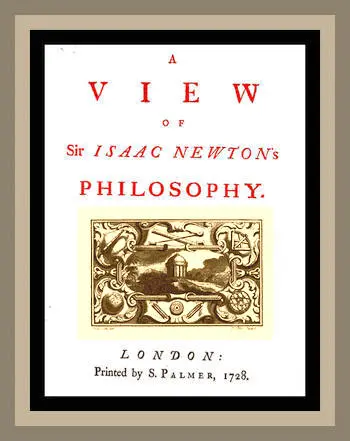
THE CLASSIC COLLECTION · 1728
"A View of Sir Isaac Newton's Philosophy" by Henry Pemberton is a scientific publication written in the early 18th century. This work serves as a commentary and introduction to the groundbreaking ideas and methodologies developed by Sir Isaac Newton, a pivotal figure in the scientific revolution. The text aims to elucidate Newton's complex theories for readers who may not be well-versed in mathematics while celebrating his contributions to science and reason. The opening of this work presents a preface in which Pemberton describes his motivation for writing the book, following the encouragement of friends upon the publication of a new edition of Newton's "Principia." Pemberton expresses admiration for Newton's intellectual achievements, reflecting on how they have expanded humanity's understanding of the natural world. He sets a tone of reverence, acknowledging Newton's profound impact on science and his status as a national pride. Additionally, he shares personal anecdotes about his acquaintance with Newton and outlines his intentions for making Newton's philosophy accessible while also inspiring a new generation of mathematicians.
Introduction adapted from the source catalogue; source summaries may be automatically generated.
Free to read · English · 134,972 words · No account needed
MAKE TIME FOR A GOOD BOOK
On by default. Untick to stop anonymous reading totals. Each page counts after 10 seconds in view. How this works.
Anonymous counting is on unless you have switched it off.
3. THE attractive power is more manifest than the other, for the parts of all bodies adhere by this principle. And the name of attraction, which our author has given to it, has been very freely made use of by many writers, and as much objected to by others. He has often complained to me of having been misunderstood in this matter. What he lays upon this head was not intended by him as a philosophical explanation of any appearances, but only to point out a power in nature not hitherto distinctly observed, the cause of which, and the manner of its acting, he thought was worthy of a diligent enquiry. To acquiesce in the explanation of any appearance by asserting it to be a general power of attraction, is not to improve our knowledge in philosophy, but rather to put a stop to our farther search.
[1] Philosoph. Nat. princ. math. L. iii. introduct.
[2] Nov. Org. Scient. L. i. Aphorism. 9.
[3] Nov. Org. L. i. Aph. 19.
[4] Ibid. Aph. 25.
[5] Aph. 30. Errores radicales & in prima digestione mentis ab excellentia functionum & remediorum sequentium non curantur.
[6] Aph. 38.
[7] Ibid.
[8] Aph. 39.
[9] Aph. 41.
[10] Aph. 10, 24.
[11] Aph. 45.
[12] De Cartes Princ. Phil. Part. 3. §. 52.
[13] Fermat, in Oper. pag. 156, &c.
[14] Nov. Org. Aph. 46.
[15] Aph. 50.
[16] Ibid.
[17] Aph 53.
[18] Aph. 54.
[19] Aph. 56.
[20] Aph. 55.
[21] Locke, On human understanding, B. iii.
[22] Nov. Org. Aph. 59.
[23] In the conclusion.
[24] Nov. Org. L. i. Aph. 59.
[25] Ibid. Aph. 60.
[26] Ibid. Aph. 62.
[27] Aph. 63.
[28] Aph. 64.
[29] Aph. 65.
[30] See above, § 4, 5.
[31] Nov. Org. L. i. Aph. 69.
[32] Ibid.
[33] Ibid. Aph. 109.
[34] Book III. Chap. iv.
[35] Book I. Chap. 2. § 14.
[36] Ibid. § 85, &c.
[37] See Book II. Ch. 3. § 3, 4. of this treatise.
[38] See Book II. Ch. 3. of this treatise.
[39] See Chap. 4.
[40] At the end of his Optics. in Qu. 21.
[41] See the same treatise, in Advertisement 2.
[42] Nov. Org. Lib. i. Ax. 105.
[43] Princip. philos. pag. 13, 14.
[44] Princ. Philos. L. II. prop. 24. corol. 7. See also B. II. Ch. 5. §
3. of this treatise.
[45] How this degree of elasticity is to be found by experiment, will
be shewn below in § 74.
[46] In oper. posthum de Motu corpor. ex percussion. prop. 9.
[47] In the above-cited place.
[48] In the place above-cited.
[49] These experiments are described in § 73.
[50] Book II. Chap. 5.
[51] Chap. 1. § 25, 26, 27, compared with § 15, &c.
[52] Book II. Chap. 5. § 3.
[53] See Euclid’s Elements, Book XII. prop. 13.
[54] Archimed. de æquipond. prop. 11.
[55] Ibid. prop. 12.
[56] Lucas Valerius De centr. gravit. solid. L. I. prop. 2.
[57] Idem L. II. prop. 2.
[60] Pag. 65, 68.
[65] Hugen. Horolog. oscillat. pag. 141, 142.
[66] See Hugen. Horolog. Oscillat. p. 142.
[67] Princip. Philos. pag. 22.
[68] Chap. 1. § 29.
[69] Princip. Philos. pag. 25.
[71] See Method. Increment. prop. 25.
[72] Lib. XI. Def.
[73] Chap. 2. § 17.
[74] See above Ch. 2. § 17.
[75] From B II. Ch. 3.
[76] Prin. Philos. pag. 7, &c.
[77] See Newton, princip. philos. pag. 9. lin. 30.
[78] Princip. Philos. pag. 10.
[79] Renat. Des Cart. Princ. Philos. Part. II. § 25.
[80] Ibid. § 30.
[81] § 85, &c.
[82] Princip. Philos. Lib. I. prop. 9.
[84] Ch. II. § 22.
[85] Viz. L. I. prop. 30, 29, & 26.
[86] Ch. II. § 21, 22.
Your reading position is saved on this browser. Take it to another device with a library code. Reading pages adapt to text, rather than matching a printed edition.
BEHIND THE BOOK
This eBook is for the use of anyone anywhere in the United States and most other parts of the world at no cost and with almost no restrictions whatsoever. You may copy it, give it away or re-use it under the terms of the Project Gutenberg License included with this eBook or online at www.gutenberg.org. If you are not located in the United States, you will have to check the laws of the country where you are located before using this eBook. Read the source licence.
The original source file, including credits and licence, is retained by this library. Request an original-format copy at no charge. Please include the book title and Project Gutenberg identifier #53161.
KEEP YOUR CURIOSITY GOING
John Muir

Asa Gray
Asa Gray

Florence Nightingale
Elizabeth Robins Pennell
Denison Olmsted