
Letters to a Friend, Written to Mrs. Ezra S. Carr, 1866-1879
John Muir
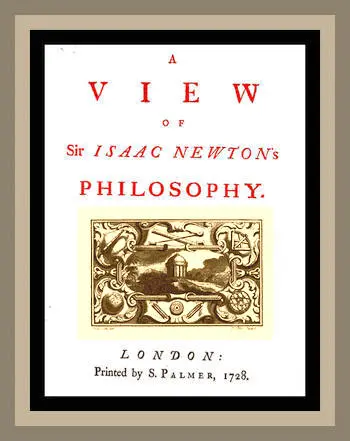
THE CLASSIC COLLECTION · 1728
"A View of Sir Isaac Newton's Philosophy" by Henry Pemberton is a scientific publication written in the early 18th century. This work serves as a commentary and introduction to the groundbreaking ideas and methodologies developed by Sir Isaac Newton, a pivotal figure in the scientific revolution. The text aims to elucidate Newton's complex theories for readers who may not be well-versed in mathematics while celebrating his contributions to science and reason. The opening of this work presents a preface in which Pemberton describes his motivation for writing the book, following the encouragement of friends upon the publication of a new edition of Newton's "Principia." Pemberton expresses admiration for Newton's intellectual achievements, reflecting on how they have expanded humanity's understanding of the natural world. He sets a tone of reverence, acknowledging Newton's profound impact on science and his status as a national pride. Additionally, he shares personal anecdotes about his acquaintance with Newton and outlines his intentions for making Newton's philosophy accessible while also inspiring a new generation of mathematicians.
Introduction adapted from the source catalogue; source summaries may be automatically generated.
Free to read · English · 134,972 words · No account needed
MAKE TIME FOR A GOOD BOOK
On by default. Untick to stop anonymous reading totals. Each page counts after 10 seconds in view. How this works.
Anonymous counting is on unless you have switched it off.
15. THE blue colour of syrup of violets our author supposes to be of the third order; for acids, as vinegar, with this syrup change it red, and salt of tartar or other alcalies mixed therewith turn it green. But if the blue colour of the syrup were of the second order, the red colour, which acids by attenuating its parts give it, must be of the first order, and the green given it by alcalies by incrassating its particles should be of the second; whereas neither of those colours is perfect enough, especially the green, to answer those produced by these changes; but the red may well enough be allowed to be of the second order, and the green of the third; in which case the blue must be likewise of the third order.
16. THE azure colour of the skies our author takes to be of the first order, which requires the smallest particles of any colour, and therefore most like to be exhibited by vapours, before they have sufficiently coalesced to produce clouds of other colours.
17. THE most intense and luminous white is of the first order, if less strong it is a mixture of the colours of all the orders. Of the latter sort he takes the colour of linnen, paper, and such like substances to be; but white metals to be of the former sort. The arguments for it are these. The opacity of all bodies has been shewn to arise from the number and strength of the reflections made within them; but all experiments shew, that the strongest reflection is made at those surfaces, which intercede transparent bodies differing most in density. Among other instances of this, the experiments before us afford one; for when air only is included between the glasses, the coloured rings are not only more dilated, as has before been said, than when water is between them; but are likewise much more luminous and bright. It follows therefore, that whatever medium pervades the pores of bodies, if so be there is any, those substances must be most opake, the density of whose parts differs most from the density of the medium, which fills their pores. But it has been sufficiently proved in the former part of this tract, that there is no very dense medium lodging in, at least pervading at liberty the pores of bodies. And it is farther proved by the present experiments. For when air is inclosed by the denser substance of glass, the rings dilate themselves, as has been said, by being viewed obliquely; this they do so very much, that at different obliquities the same thickness of air will exhibit all sorts of colours. The bubble of water, though surrounded with the thinner substance of air, does likewise change its colour by being viewed obliquely; but not any thing near so much, as in the other case; for in that the same colour might be seen, when the rings were viewed most obliquely, at more than twelve times the thickness it appeared at under a direct view; whereas in this other case the thickness was never found considerably above half as much again. Now the colours of bodies not depending only on the light, that is incident upon them perpendicularly, but likewise upon that, which falls on them in all degrees of obliquity; if the medium surrounding their particles were denser than those particles, all sorts of colours must of necessity be reflected from them so copiously, as would make the colours of all bodies white, or grey, or at best very dilute and imperfect. But on the other hand, if the medium in the pores of bodies be much rarer than their particles, the colour reflected will be so little changed by the obliquity of the rays, that the colour produced by the rays, which fall near the perpendicular, may so much abound in the reflected light, as to give the body their colour with little allay. To this may be added, that when the difference of the contiguous transparent substances is the same, a colour reflected from the denser substance reduced into a thin plate and surrounded by the rarer will be more brisk, than the same colour will be, when reflected from a thin plate formed of the rarer substance, and surrounded by the denser; as our author experienced by blowing glass very thin at a lamp furnace, which exhibited in the open air more vivid colours, than the air does between two glasses. From these considerations it is manifest, that if all other circumstances are alike, the densest bodies will be most opake. But it was observed before, that these white metals can hardly be made so thin, except by being dissolved in corroding liquors, as to be rendred transparent; though none of them are so dense as gold, which proves their great opacity to have some other cause besides their density; and none is more fit to produce this, than such a size of their particles, as qualifies them to reflect the white of the first order.
Your reading position is saved on this browser. Take it to another device with a library code. Reading pages adapt to text, rather than matching a printed edition.
BEHIND THE BOOK
This eBook is for the use of anyone anywhere in the United States and most other parts of the world at no cost and with almost no restrictions whatsoever. You may copy it, give it away or re-use it under the terms of the Project Gutenberg License included with this eBook or online at www.gutenberg.org. If you are not located in the United States, you will have to check the laws of the country where you are located before using this eBook. Read the source licence.
The original source file, including credits and licence, is retained by this library. Request an original-format copy at no charge. Please include the book title and Project Gutenberg identifier #53161.
KEEP YOUR CURIOSITY GOING
John Muir

Asa Gray
Asa Gray

Florence Nightingale
Elizabeth Robins Pennell
Denison Olmsted