
Letters to a Friend, Written to Mrs. Ezra S. Carr, 1866-1879
John Muir
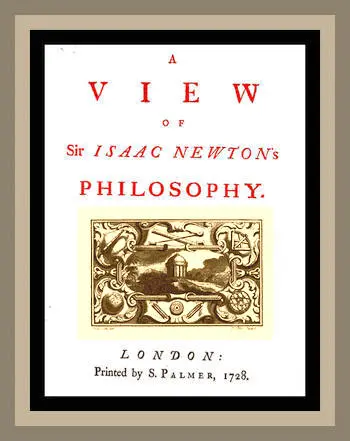
THE CLASSIC COLLECTION · 1728
"A View of Sir Isaac Newton's Philosophy" by Henry Pemberton is a scientific publication written in the early 18th century. This work serves as a commentary and introduction to the groundbreaking ideas and methodologies developed by Sir Isaac Newton, a pivotal figure in the scientific revolution. The text aims to elucidate Newton's complex theories for readers who may not be well-versed in mathematics while celebrating his contributions to science and reason. The opening of this work presents a preface in which Pemberton describes his motivation for writing the book, following the encouragement of friends upon the publication of a new edition of Newton's "Principia." Pemberton expresses admiration for Newton's intellectual achievements, reflecting on how they have expanded humanity's understanding of the natural world. He sets a tone of reverence, acknowledging Newton's profound impact on science and his status as a national pride. Additionally, he shares personal anecdotes about his acquaintance with Newton and outlines his intentions for making Newton's philosophy accessible while also inspiring a new generation of mathematicians.
Introduction adapted from the source catalogue; source summaries may be automatically generated.
Free to read · English · 134,972 words · No account needed
MAKE TIME FOR A GOOD BOOK
On by default. Untick to stop anonymous reading totals. Each page counts after 10 seconds in view. How this works.
Anonymous counting is on unless you have switched it off.
9. BUT now the chord having recovered its rectilinear situation I k L, the following motion will be changed, for the point K, which before advanced with a motion more and more accelerated, though by the force it has acquired it will go on to move the same way as before, till it has advanced near as far forwards, as it was at first drawn backwards; yet the motion of it will henceforth be gradually lessened. The effect of which upon the particles a, b, c, d, e, f, g will be, that by the time the chord has made its utmost advance, and is upon the return, these particles will be put into a contrary rangement; so that f shall be nearer to g, than e to f, and e nearer to f than d to e; and the like of the rest, till you come to the first particles a, b, whose distance will then be nearly or quite what it was at first. All which will appear as follows. The present distance between a and b is such, that the elastic power, by which a repels b, is strong enough to maintain that distance, though a advance with the velocity, with which the string resumes its rectilinear figure; and the motion of the particle a being afterwards slower, the present elasticity between a and b will be more than sufficient to preserve the distance between them. Therefore while it accelerates b it will retard a. The distance b c will still diminish, till b come about as near to c, as it is from a at present; for after the distances a b and b c are become equal, the particle b will continue its velocity superior to that of c by its own power of inactivity, till such time as the increase of elasticity between b and c more than shall be between a and b shall suppress its motion: for as the power of inactivity in b made a greater elasticity necessary on the side of a than on the side of c to push b forward, so what motion b has acquired it will retain by the same power of inactivity, till it be suppressed by a greater elasticity on the side of c, than on the side of a. But as soon as b begins to slacken its pace the distance of b from c will widen as the distance a b has already done. Now as a acts on b, so will b on c, c on d, &c. so that the distances between all the particles b, c, d, e, f, g will be successively contracted into the distance of a from b, and then dilated again. Now because the time, in which the chord describes this present half of its vibration, is about equal to that it took up in describing the former; the particles a, b will be as long in dilating their distance, as before in contracting it, and will return nearly to their original distance. And farther, the particles b, c, which did not begin to approach so soon as a, b, are now about as much longer, before they begin to recede; and likewise the particles c, d, which began to approach after b, c, begin to separate later. Whence it appears that the particles, whose distance began to be lessened, when that of a, b was first enlarged, viz. the particles f, g, should be about their nearest distance, when a and b have recovered their prime interval. Thus will the particles a, b, c, d, e, f, g have changed their situation in the manner asserted. But farther, as the particles f, g or F, G gradually approach each other, they will move by degrees the succeeding particles to as great a length, as the particles A, B did by a like approach. So that, when the chord has made its greatest advance, being arrived into the situation I ϰ L, the particles moved by it will have the rangement noted by the points α, β, γ, δ, ε, ζ, η, θ, λ, μ, ν, χ. Where α, β are at the original distance of the particles in the line A H; ζ, η are the nearest of all, and the distance ν χ is equal to that between α and β.
Your reading position is saved on this browser. Take it to another device with a library code. Reading pages adapt to text, rather than matching a printed edition.
BEHIND THE BOOK
This eBook is for the use of anyone anywhere in the United States and most other parts of the world at no cost and with almost no restrictions whatsoever. You may copy it, give it away or re-use it under the terms of the Project Gutenberg License included with this eBook or online at www.gutenberg.org. If you are not located in the United States, you will have to check the laws of the country where you are located before using this eBook. Read the source licence.
The original source file, including credits and licence, is retained by this library. Request an original-format copy at no charge. Please include the book title and Project Gutenberg identifier #53161.
KEEP YOUR CURIOSITY GOING
John Muir

Asa Gray
Asa Gray

Florence Nightingale
Elizabeth Robins Pennell
Denison Olmsted