
Letters to a Friend, Written to Mrs. Ezra S. Carr, 1866-1879
John Muir
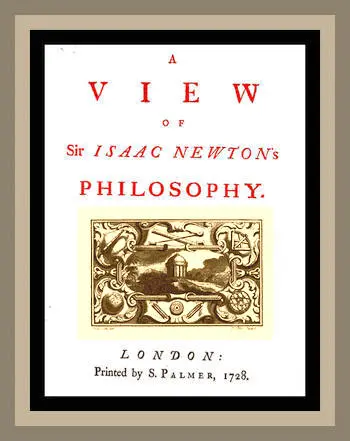
THE CLASSIC COLLECTION · 1728
"A View of Sir Isaac Newton's Philosophy" by Henry Pemberton is a scientific publication written in the early 18th century. This work serves as a commentary and introduction to the groundbreaking ideas and methodologies developed by Sir Isaac Newton, a pivotal figure in the scientific revolution. The text aims to elucidate Newton's complex theories for readers who may not be well-versed in mathematics while celebrating his contributions to science and reason. The opening of this work presents a preface in which Pemberton describes his motivation for writing the book, following the encouragement of friends upon the publication of a new edition of Newton's "Principia." Pemberton expresses admiration for Newton's intellectual achievements, reflecting on how they have expanded humanity's understanding of the natural world. He sets a tone of reverence, acknowledging Newton's profound impact on science and his status as a national pride. Additionally, he shares personal anecdotes about his acquaintance with Newton and outlines his intentions for making Newton's philosophy accessible while also inspiring a new generation of mathematicians.
Introduction adapted from the source catalogue; source summaries may be automatically generated.
Free to read · English · 134,972 words · No account needed
MAKE TIME FOR A GOOD BOOK
On by default. Untick to stop anonymous reading totals. Each page counts after 10 seconds in view. How this works.
Anonymous counting is on unless you have switched it off.
10. THE first of these assertions is a very evident consequence from the latter. And before we proceed to the proof, it must first be shewn, that the third law of motion, which makes action and reaction equal, holds in these attractive powers. The most remarkable attractive force, next to the power of gravity, is that, by which the loadstone attracts iron. Now if a loadstone were laid upon water, and supported by some proper substance, as wood or cork, so that it might swim; and if a piece of iron were caused to swim upon the water in like manner: as soon as the loadstone begins to attract the iron, the iron shall move toward the stone, and the stone shall also move toward the iron; when they meet, they shall stop each other, and remain fixed together without any motion. This shews, that the velocities, wherewith they meet, are reciprocally proportional to the quantities of solid matter in each; and that by the stone’s attracting the iron, the stone itself receives as much motion, in the strict philosophic sense of that word[244], as it communicates to the iron: for it has been declared above to be an effect of the percussion of two bodies, that if they meet with velocities reciprocally proportional to the respective bodies, they shall be stopped by the concourse, unless their elasticity put them into fresh motion; but if they meet with any other velocities, they shall retain some motion after meeting[245]. Amber, glass, sealing-wax, and many other substances acquire by rubbing a power, which from its having been remarkable, particularly in amber, is called electrical. By this power they will for some time after rubbing attract light bodies, that shall be brought within the sphere of their activity. On the other hand Mr. BOYLE found, that if a piece of amber be hung in a perpendicular position by a string, it shall be drawn itself toward the body whereon it was rubbed, if that body be brought near it. Both in the loadstone and in electrical bodies we usually ascribe the power to the particular body, whose presence we find necessary for producing the effect. The loadstone and any piece of iron will draw each other, but in two pieces of iron no such effect is ordinarily observed; therefore we call this attractive power the power of the loadstone: though near a loadstone two pieces of iron will also draw each other. In like manner the rubbing of amber, glass, or any such body, till it is grown warm, being necessary to cause any action between those bodies and other substances, we ascribe the electrical power to those bodies. But in all these cases if we would speak more correctly, and not extend the sense of our expressions beyond what we see; we can only say that the neighbourhood of a loadstone and a piece of iron is attended with a power, whereby the loadstone and the iron are drawn toward each other; and the rubbing of electrical bodies gives rise to a power, whereby those bodies and other substances are mutually attracted. Thus we must also understand in the power of gravity, that the two bodies are mutually made to approach by the action of that power. When the sun draws any planet, that planet also draws the sun; and the motion, which the planet receives from the sun, bears the same proportion to the motion, which the sun it self receives, as the quantity of solid matter in the sun bears to the quantity of solid matter in the planet. Hitherto, for brevity sake in speaking of these forces, we have generally ascribed them to the body, which is least moved; as when we called the power, which exerts itself between the sun and any planet, the attractive power of the sun; but to speak more correctly, we should rather call this power in any case the force, which acts between the sun and earth, between the sun and Jupiter, between the earth and moon, &c. for both the bodies are moved by the power acting between them, in the same manner, as when two bodies are tied together by a rope, if that rope shrink by being wet, or otherwise, and thereby cause the bodies to approach, by drawing both, it will communicate to both the same degree of motion, and cause them to approach with velocities reciprocally proportional to the respective bodies. From this mutual action between the sun and planet it follows, as has been observed above[246], that the sun and planet do each move about their common center of gravity. Let A (in fig. 108.) represent the sun, B a planet, C their common center of gravity. If these bodies were once at rest, by their mutual attraction they would directly approach each other with such velocities, that their common center of gravity would remain at rest, and the two bodies would at length meet in that point. If the planet B were to receive an impulse, as in the direction of the line D E, this would prevent the two bodies from falling together; but their common center of gravity would be put into motion in the direction of the line C F equidistant from B E. In this case Sir ~ISAAC NEWTON~ proves[247], that the sun and planet would describe round their common center of gravity similar orbits, while that center would proceed with an uniform motion in the line C F; and so the system of the two bodies would move on with the center of gravity without end. In order to keep the system in the same place, it is necessary, that when the planet received its impulse in the direction B E, the sun should also receive such an impulse the contrary way, as might keep the center of gravity C without motion; for if these began once to move without giving any motion to their common center of gravity, that center would always remain fixed.
Your reading position is saved on this browser. Take it to another device with a library code. Reading pages adapt to text, rather than matching a printed edition.
BEHIND THE BOOK
This eBook is for the use of anyone anywhere in the United States and most other parts of the world at no cost and with almost no restrictions whatsoever. You may copy it, give it away or re-use it under the terms of the Project Gutenberg License included with this eBook or online at www.gutenberg.org. If you are not located in the United States, you will have to check the laws of the country where you are located before using this eBook. Read the source licence.
The original source file, including credits and licence, is retained by this library. Request an original-format copy at no charge. Please include the book title and Project Gutenberg identifier #53161.
KEEP YOUR CURIOSITY GOING
John Muir

Asa Gray
Asa Gray

Florence Nightingale
Elizabeth Robins Pennell
Denison Olmsted