
Letters to a Friend, Written to Mrs. Ezra S. Carr, 1866-1879
John Muir
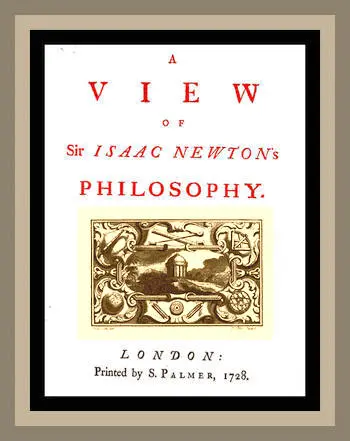
THE CLASSIC COLLECTION · 1728
"A View of Sir Isaac Newton's Philosophy" by Henry Pemberton is a scientific publication written in the early 18th century. This work serves as a commentary and introduction to the groundbreaking ideas and methodologies developed by Sir Isaac Newton, a pivotal figure in the scientific revolution. The text aims to elucidate Newton's complex theories for readers who may not be well-versed in mathematics while celebrating his contributions to science and reason. The opening of this work presents a preface in which Pemberton describes his motivation for writing the book, following the encouragement of friends upon the publication of a new edition of Newton's "Principia." Pemberton expresses admiration for Newton's intellectual achievements, reflecting on how they have expanded humanity's understanding of the natural world. He sets a tone of reverence, acknowledging Newton's profound impact on science and his status as a national pride. Additionally, he shares personal anecdotes about his acquaintance with Newton and outlines his intentions for making Newton's philosophy accessible while also inspiring a new generation of mathematicians.
Introduction adapted from the source catalogue; source summaries may be automatically generated.
Free to read · English · 134,972 words · No account needed
MAKE TIME FOR A GOOD BOOK
On by default. Untick to stop anonymous reading totals. Each page counts after 10 seconds in view. How this works.
Anonymous counting is on unless you have switched it off.
2. THE first thing demonstrated of these secondary planets is, that they are drawn towards their respective primary in the same manner as the primary planets are attracted by the sun. That each secondary planet is kept in its orbit by a power pointed towards the center of the primary planet, about which the secondary revolves; and that the power, by which the secondaries of the same primary are influenced, bears the same relation to the distance from the primary, as the power, by which the primary planets are guided, does in regard to the distance from the sun[172]. This is proved in the satellites of Jupiter and Saturn, because they move in circles, as far as we can observe, about their respective primary with an equable course, the respective primary being the center of each orbit: and by comparing the times, in which the different satellites of the same primary perform their periods, they are found to observe the same relation to the distances from their primary, as the primary planets observe in respect of their mean distances from the sun[173]. Here these bodies moving in circles with an equable motion, each satellite passes over equal parts of its orbit in equal portions of time; consequently the line drawn from the center of the orbit, that is, from the primary planet, to the satellite, will pass over equal spaces along with the satellite in equal portions of time; which proves the power, by which each satellite is held in its orbit, to be pointed towards the primary as a center[174]. It is also manifest that the centripetal power, which carries a body in a circle concentrical with the power, acts upon the body at all times with the same strength. But Sir ~ISAAC NEWTON~ demonstrates that, when bodies are carried in different circles by centripetal powers directed to the centers of those circles, then, the degrees of strength of those powers are to be compared by considering the relation between the times, in which the bodies perform their periods through those circles[175]; and in particular he shews, that if the periodical times bear that relation, which I have just now asserted the satellites of the same primary to observe; then the centripetal powers are reciprocally in the duplicate proportion of the semidiameters of the circles, or in that proportion to the distances of the bodies from the centers[176]. Hence it follows that in the planets Jupiter and Saturn, the centripetal power in each decreases with the increase of distance, in the same proportion as the centripetal power appertaining to the sun decreases with the increase of distance. I do not here mean that this proportion of the centripetal powers holds between the power of Jupiter at any distance compared with the power of Saturn at any other distance; but only in the change of strength of the power belonging to the same planet at different distances from him. Moreover what is here discovered of the planets Jupiter and Saturn by means of the different satellites, which revolve round each of them, appears in the earth by the moon alone; because she is found to move round the earth in an ellipsis after the same manner as the primary planets do about the sun; excepting only some small irregularities in her motion, the cause of which will be particularly explained in what follows, whereby it will appear, that they are no objection against the earth’s acting on the moon in the same manner as the sun acts on the primary planets; that is, as the other primary planets Jupiter and Saturn act upon their satellites. Certainly since these irregularities can be otherwise accounted for, we ought not to depart from that rule of induction so necessary in philosophy, that to like bodies like properties are to be attributed, where no reason to the contrary appears. We cannot therefore but ascribe to the earth the same kind of action upon the moon, as the other primary planets Jupiter and Saturn have upon their satellites; which is known to be very exactly in the proportion assigned by the method of comparing the periodical times and distances of all the satellites which move about the same planet; this abundantly compensating our not being near enough to observe the exact figure of their orbits. For if the little deviation of the moon’s orbit orbit from a true permanent ellipsis arose from the action of the earth upon the moon not being in the exact reciprocal duplicate proportion of the distance, were another moon to revolve about the earth, the proportion between the periodical times of this new moon, and the present, would discover the deviation from the mentioned proportion much more manifestly.
Your reading position is saved on this browser. Take it to another device with a library code. Reading pages adapt to text, rather than matching a printed edition.
BEHIND THE BOOK
This eBook is for the use of anyone anywhere in the United States and most other parts of the world at no cost and with almost no restrictions whatsoever. You may copy it, give it away or re-use it under the terms of the Project Gutenberg License included with this eBook or online at www.gutenberg.org. If you are not located in the United States, you will have to check the laws of the country where you are located before using this eBook. Read the source licence.
The original source file, including credits and licence, is retained by this library. Request an original-format copy at no charge. Please include the book title and Project Gutenberg identifier #53161.
KEEP YOUR CURIOSITY GOING
John Muir

Asa Gray
Asa Gray

Florence Nightingale
Elizabeth Robins Pennell
Denison Olmsted