
Letters to a Friend, Written to Mrs. Ezra S. Carr, 1866-1879
John Muir
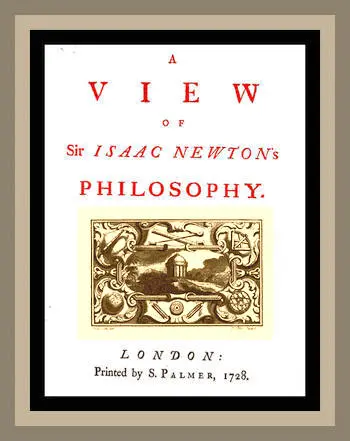
THE CLASSIC COLLECTION · 1728
"A View of Sir Isaac Newton's Philosophy" by Henry Pemberton is a scientific publication written in the early 18th century. This work serves as a commentary and introduction to the groundbreaking ideas and methodologies developed by Sir Isaac Newton, a pivotal figure in the scientific revolution. The text aims to elucidate Newton's complex theories for readers who may not be well-versed in mathematics while celebrating his contributions to science and reason. The opening of this work presents a preface in which Pemberton describes his motivation for writing the book, following the encouragement of friends upon the publication of a new edition of Newton's "Principia." Pemberton expresses admiration for Newton's intellectual achievements, reflecting on how they have expanded humanity's understanding of the natural world. He sets a tone of reverence, acknowledging Newton's profound impact on science and his status as a national pride. Additionally, he shares personal anecdotes about his acquaintance with Newton and outlines his intentions for making Newton's philosophy accessible while also inspiring a new generation of mathematicians.
Introduction adapted from the source catalogue; source summaries may be automatically generated.
Free to read · English · 134,972 words · No account needed
MAKE TIME FOR A GOOD BOOK
On by default. Untick to stop anonymous reading totals. Each page counts after 10 seconds in view. How this works.
Anonymous counting is on unless you have switched it off.
6. BUT now, in these demonstrations some very minute inequalities in the motion of the planets are neglected; which is done with a great deal of judgment; for whatever be their cause, the effects are very inconsiderable, they being so exceeding small, that some astronomers have thought fit wholly to pass them by[163]. However the excellency of this philosophy, when in the hands of so great a geometer as our author, is such, that it is able to trace the least variations of things up to their causes. The only inequalities, which have been observed common to all the planets, are the motion of the aphelion and the nodes. The transverse axis of each orbit does not always remain fixed, but moves about the sun with a very slow progressive motion: nor do the planets keep constantly the same plane, but change them, and the lines in which those planes intersect each other by insensible degrees. The first of these inequalities, which is the motion of the aphelion, may be accounted for, by supposing the gravitation of the planets towards the sun to differ a little from the forementioned reciprocal duplicate proportion of the distances; but the second, which is the motion of the nodes, cannot be accounted for by any power directed towards the sun; for no such can give the planet any lateral impulse to divert it from the plane of its motion into any new plane, but of necessity must be derived from some other center. Where that power is lodged, remains to be discovered. Now it is proved, as shall be explained in the following chapter, that the three primary planets Saturn, Jupiter, and the earth, which have satellites revolving about them, are endued with a power of causing bodies, in particular those satellites, to gravitate towards them with a force, which is reciprocally in the duplicate proportion of their distances; and the planets are in all respects, in which they come under our examination, so similar and alike, that there is no reason to question, but they have all the same property. Though it be sufficient for the present purpose to have it proved of Jupiter and Saturn only; for these planets contain much greater quantities of matter than the rest, and proportionally exceed the others in power[164]. But the influence of these two planets being allowed, it is evident how the planets come to shift continually their planes: for each of the planets moving in a different plane, the action of Jupiter and Saturn upon the rest will be oblique to the planes of their motion; and therefore will gradually draw them into new ones. The same action of these two planets upon the rest will cause likewise a progressive motion of the aphelion; so that there will be no necessity of having recourse to the other cause for this motion, which was before hinted at[165]; viz, the gravitation of the planets towards the sun differing from the exact reciprocal duplicate proportion of the distances. And in the last place, the action of Jupiter and Saturn upon each other will produce in their motions the same inequalities, as their joint action produces in the rest. All this is effected in the same manner, as the sun produces the same kind of inequalities and many others in the motion of the moon and the other secondary planets; and therefore will be best apprehended by what shall be said in the next chapter. Those other irregularities in the motion of the secondary planets have place likewise here; but are too minute to be observable: because they are produced and rectified alternately, for the most part in the time of a single revolution; whereas the motion of the aphelion and nodes, which continually increase, become sensible in a long series of years. Yet some of these other inequalities are discernible in Jupiter and Saturn, in Saturn chiefly; for when Jupiter, who moves faster than Saturn, approaches near to a conjunction with him, his action upon Saturn will a little retard the motion of that planet, and by the reciprocal action of Saturn he will himself be accelerated. After conjunction, Jupiter will again accelerate Saturn, and be likewise retarded in the same degree, as before the first was retarded and the latter accelerated. Whatever inequalities besides are produced in the motion of Saturn by the action of Jupiter upon that planet, will be sufficiently rectified, by placing the focus of Saturn’s ellipsis, which should otherwise be in the sun, in the common center of gravity of the sun and Jupiter. And all the inequalities in the motion of Jupiter, caused by Saturn’s action upon him, are much less considerable than the irregularities of Saturn’s motion[166].
Your reading position is saved on this browser. Take it to another device with a library code. Reading pages adapt to text, rather than matching a printed edition.
BEHIND THE BOOK
This eBook is for the use of anyone anywhere in the United States and most other parts of the world at no cost and with almost no restrictions whatsoever. You may copy it, give it away or re-use it under the terms of the Project Gutenberg License included with this eBook or online at www.gutenberg.org. If you are not located in the United States, you will have to check the laws of the country where you are located before using this eBook. Read the source licence.
The original source file, including credits and licence, is retained by this library. Request an original-format copy at no charge. Please include the book title and Project Gutenberg identifier #53161.
KEEP YOUR CURIOSITY GOING
John Muir

Asa Gray
Asa Gray

Florence Nightingale
Elizabeth Robins Pennell
Denison Olmsted