
Letters to a Friend, Written to Mrs. Ezra S. Carr, 1866-1879
John Muir
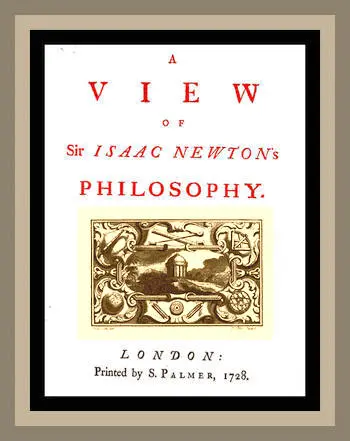
THE CLASSIC COLLECTION · 1728
"A View of Sir Isaac Newton's Philosophy" by Henry Pemberton is a scientific publication written in the early 18th century. This work serves as a commentary and introduction to the groundbreaking ideas and methodologies developed by Sir Isaac Newton, a pivotal figure in the scientific revolution. The text aims to elucidate Newton's complex theories for readers who may not be well-versed in mathematics while celebrating his contributions to science and reason. The opening of this work presents a preface in which Pemberton describes his motivation for writing the book, following the encouragement of friends upon the publication of a new edition of Newton's "Principia." Pemberton expresses admiration for Newton's intellectual achievements, reflecting on how they have expanded humanity's understanding of the natural world. He sets a tone of reverence, acknowledging Newton's profound impact on science and his status as a national pride. Additionally, he shares personal anecdotes about his acquaintance with Newton and outlines his intentions for making Newton's philosophy accessible while also inspiring a new generation of mathematicians.
Introduction adapted from the source catalogue; source summaries may be automatically generated.
Free to read · English · 134,972 words · No account needed
MAKE TIME FOR A GOOD BOOK
On by default. Untick to stop anonymous reading totals. Each page counts after 10 seconds in view. How this works.
Anonymous counting is on unless you have switched it off.
10. THIS I prove as follows. Let D E and F E be continued beyond E. In D E thus continued take at pleasure the length E H, and let H I be so drawn, as to be equidistant from the line G E. Then, by what has been written upon the second law of motion[84], it follows, that after the impulse on the body in E it will move through E I in the same time, as it would have imployed in moving from E to H, with the velocity which it had in the line D E. In F E prolonged take E K equal to E I, and draw K L equidistant from G E. Then, because the body is thrown back in the line F E with the same velocity as that wherewith it went forward in that line; if, when the body was returned to E, it were permitted to go straight on, it would pass through E K in the same time, as it took up in passing through E I, when it went forward in the line E F. But, if at the body’s return to the point E, such an impulse directed toward the point D were to be given it, whereby it should be turned into the line D E; I say, that the impulse necessary to produce this effect must be equal to that, which turned the body out of the line D E into E F; and that the velocity, with which the body will return into the line E D, is the same, as that wherewith it before moved through this line from D to E. Because E K is equal to E I, and K L and H I, being each equidistant from G E, are by consequence equidistant from each other; it follows, that the two triangular figures I E H and K E L are altogether like and equal to each other. If I were writing to mathematicians, I might refer them to some proportions in the elements of EUCLID for the proof of this[85] but as I do not here address my self to such, so I think this assertion will be evident enough without a proof in form; at least I must desire my readers to receive it as a proposition true in geometry. But these two triangular figures being altogether like each other and equal; as E K is equal to E I, so E L is equal to E H, and K L equal to H I. Now the body after its return to E being turned out of the line F E into E D by an impulse acting upon it in E, after the manner above expressed; the body will receive such a velocity by this impulse, as will carry it through E L in the same time, as it would have imployed in passing through E K, if it had gone on in that line undisturbed. And it has already been observed, that the time, in which the body would pass over E K with the velocity wherewith it returns, is equal to the time it took up in going forward from E to I; that is, equal to the time, in which it would have gone through E H with the velocity, wherewith it moved from D to E. Therefore the time, in which the body will pass through E L after its return into the line E D, is the same, as would have been taken up by the body in passing through E H with the velocity, wherewith the body first moved in the line D E. Since therefore E L and E H are equal, the body returns into the line D E with the velocity, which it had before in that line. Again I say, the second impulse in E is equal to the first. By what has been said on the second law of motion concerning the effect of oblique impulses[86], it will be understood, that the impulse in E, whereby the body was turned out of the line D E into the line E F, is of such strength, that if the body had been at rest, when this impulse had acted upon it, this impulse would have communicated so much motion to the body, as would have carried it through a length equal to H I, in the time wherein the body would have passed from E to H, or in the time wherein it passed from E to I. In the same manner, on the return of the body, the impulse in E, whereby the body is turned out of the line F E into E D, is of such strength, that if it had acted on the body at rest, it would have caused the body to move through a length equal to K L, in the same time, as the body would imploy in passing through E K with the velocity, wherewith it returns in the line F E. Therefore the second impulse, had it acted on the body at rest, would have caused it to move through a length equal to K L in the same space of time, as would be taken up by the body in passing through a length equal to H I, were the first impulse to act on the body when at rest. That is, the effects of the first and second impulse on the body when at rest would be the same; for K L and H I are equal: consequently the second impulse is equal to the first.
Your reading position is saved on this browser. Take it to another device with a library code. Reading pages adapt to text, rather than matching a printed edition.
BEHIND THE BOOK
This eBook is for the use of anyone anywhere in the United States and most other parts of the world at no cost and with almost no restrictions whatsoever. You may copy it, give it away or re-use it under the terms of the Project Gutenberg License included with this eBook or online at www.gutenberg.org. If you are not located in the United States, you will have to check the laws of the country where you are located before using this eBook. Read the source licence.
The original source file, including credits and licence, is retained by this library. Request an original-format copy at no charge. Please include the book title and Project Gutenberg identifier #53161.
KEEP YOUR CURIOSITY GOING
John Muir

Asa Gray
Asa Gray

Florence Nightingale
Elizabeth Robins Pennell
Denison Olmsted