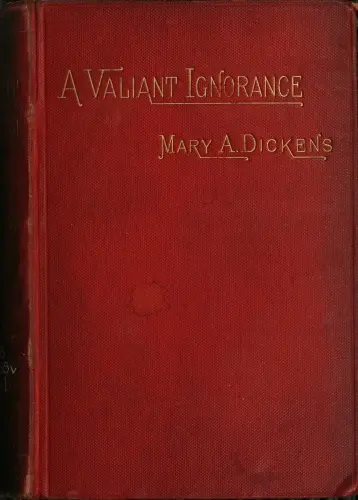
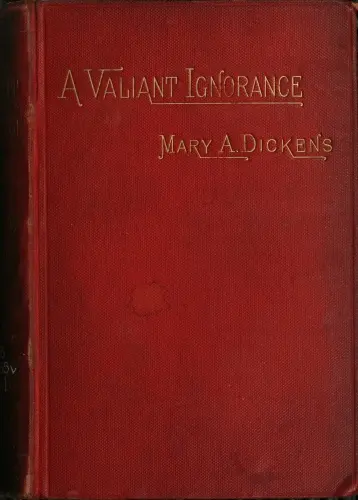
A Valiant Ignorance; vol. 3 of 3 A Novel in Three Volumes
Mary Angela Dickens
THE CLASSIC COLLECTION · 1894
"A Valiant Ignorance; vol. 2 of 3" by Mary Angela Dickens is a novel written during the late 19th century. The narrative seems to revolve around the complexities of social relationships, particularly focusing on Julian Romayne and the emotional dynamics between him, his mother Mrs. Romayne, and Marston Loring. The story delves into themes of independence, societal expectations, and personal identity as the characters navigate their connections and the expectations imposed upon them. The opening of the novel sets an atmospheric tone, illustrating the transition of Julian's character as he grapples with his mood and independence following a period of unrest. The narrative intricately captures the subtleties of his interactions with his mother, Mrs. Romayne, who appears to be strained yet eager to maintain a cheerful demeanor despite her anxieties about Julian's well-being and social engagements. We are introduced to Julians' growing connection with a workgirl named Clemence, which introduces elements of class disparity and the potential for emotional conflict as Julian attempts to carve out a separate identity. The relationship dynamics are further complicated by the presence of Loring, whose sardonic air and often cynical observations cast a critical eye on Julian's life choices. This opening sets the stage for deeper explorations of morality, familial bonds, and personal aspirations.
Introduction adapted from the source catalogue; source summaries may be automatically generated.
Free to read · English · 48,372 words · No account needed
MAKE TIME FOR A GOOD BOOK
On by default. Untick to stop anonymous reading totals. Each page counts after 10 seconds in view. How this works.
Anonymous counting is on unless you have switched it off.
Mrs. Romayne did not answer directly, except with a laugh.
“I am almost inclined to envy mothers with daughters,” she said, smiling at Miss Pomeroy again. “I wonder, now”--a sudden idea had apparently struck Mrs. Romayne--“I wonder whether you would lend me your daughter now and then, and I wonder whether she would consent to be lent.”
“I should be delighted,” said Mrs. Pomeroy, with vague amiability, and an equally vague glance at her daughter. “And I’m sure Maud will be delighted, too, won’t you, Maud?”
“Delighted!” assented Maud, with pretty promptitude.
“Well, then, we must arrange it some time or other,” declared Mrs. Romayne gaily. “Perhaps you would come and spend a week with me, Maud--that would be charming!”
But she did not press the point, letting the subject drop with apparent carelessness, and talking about other things, always keeping the girl in the conversation; turning to her now and then with a pleasant, familiar word, or a gesture which was lightly affectionate. The mother and daughter had risen to take leave when she said carelessly:
“Oh, by-the-bye, Maud, dear, have you anything to do to-morrow afternoon? I’ve been bothered into taking two tickets for a matinée, a charity affair, you know, but they say it will be rather good. It would be so nice of you to come with me!”
“It will be very nice of you to take me!” was the response. “Thank you
very much!”
A minute or two more passed in the arrangement of the place and hour for meeting, and then Mrs. Pomeroy drifted blandly out of the room, followed by her daughter, and Mrs. Romayne was again alone.
She walked to the fireplace this time, and putting one foot on the fender, stood looking down, her face intent and satisfied.
“Just the right sort of girl!” she said to herself. “Just the right sort
of girl!”
She was wearing the little gold bangle which Julian had given her on her birthday--the one which Miss Pomeroy had helped him to choose--and she was turning it on her wrist with tender, contemplative touches. She was so absorbed in her reflection that she did not hear the servant come into the room, or notice for the moment that the girl was standing beside her with a letter. She started at last, and looked up; took the letter, and opened it carelessly, without looking at it, as the woman took away the tea-table.
“Unless I hear from you to the contrary, I propose to call on you to-morrow (Saturday), at three o’clock, on a matter of grave importance.
“Faithfully yours,
Your reading position is saved on this browser. Take it to another device with a library code. Reading pages adapt to text, rather than matching a printed edition.
Mary Angela Dickens
Mary Angela Dickens
BEHIND THE BOOK
This eBook is for the use of anyone anywhere in the United States and most other parts of the world at no cost and with almost no restrictions whatsoever. You may copy it, give it away or re-use it under the terms of the Project Gutenberg License included with this eBook or online at www.gutenberg.org. If you are not located in the United States, you will have to check the laws of the country where you are located before using this eBook. Read the source licence.
The original source file, including credits and licence, is retained by this library. Request an original-format copy at no charge. Please include the book title and Project Gutenberg identifier #54094.
KEEP YOUR CURIOSITY GOING
Coulson Kernahan

Maurice Baring
Frances Wright
Cécile Tormay

Frederic Jesup Stimson

W. H. P. (William Henry Pope) Jarvis